


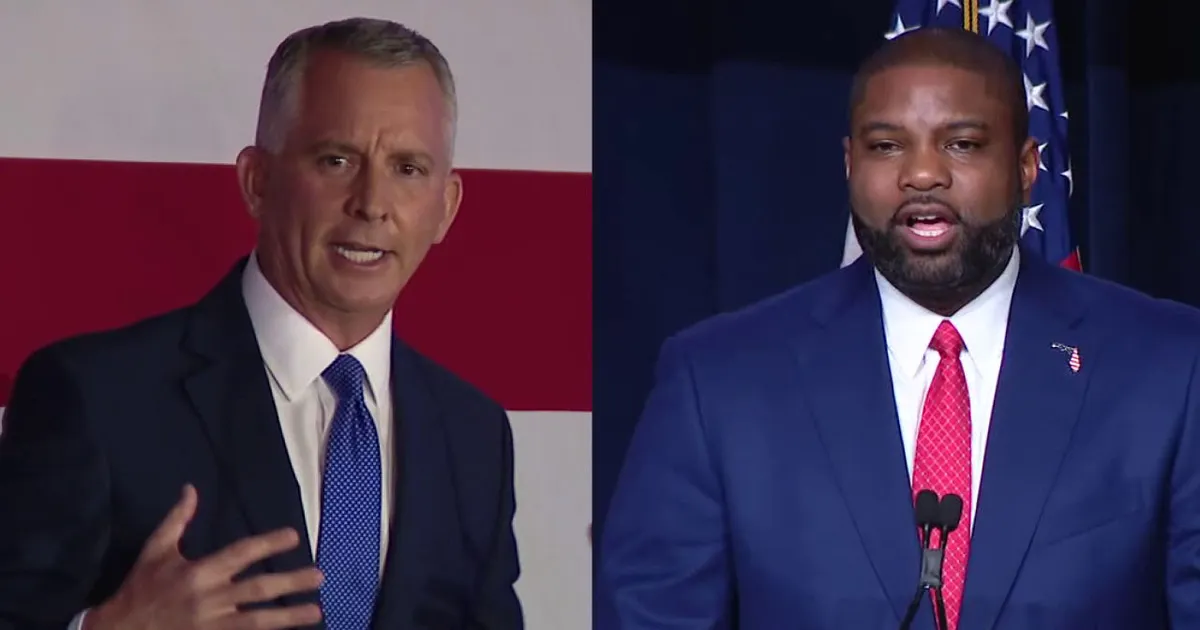
Florida’s governor’s race has tightened into a dead heat, with Democrat David Jolly running effectively level with Republican Byron Donalds despite the state’s strong conservative lean and Donalds’ overwhelming financial advantage.
The contest to succeed term-limited Governor Ron DeSantis is being treated as a toss-up by Decision Desk HQ, which gives Mr Donalds about a 60 per cent chance of victory. That forecast reflects Florida’s Republican voting history, the party’s sizeable registration advantage and the Republican candidate’s far greater campaign resources.
Florida governor’s race enters final stretch
Polling conducted during August and September has nevertheless shown a closely fought contest. The numbers suggest Mr Donalds has yet to establish a consistent message with the wider electorate, while Mr Jolly is attempting to attract independent voters and moderate Republicans.
Mr Jolly, a former Republican congressman who is now the Democratic nominee, has focused heavily on the cost of living, property insurance and government accountability. Those issues have become central in a state where voters remain concerned about housing costs, utility bills and the price of insuring their homes.
Campaign finance figures underline the scale of the challenge facing the Democrat. Filings through 11 September show Mr Donalds and affiliated committees had raised about $120.9 million, compared with roughly $14.6 million for Mr Jolly.
Mr Donalds also had about $43.5 million available to spend, nearly seven times Mr Jolly’s remaining $6.4 million. Around $60 million is expected to be spent on political advertising in the governor’s contest overall.
Florida’s voter registration figures provide another significant advantage for the Republican. State data recorded 5.649 million active registered Republicans and 4.098 million Democrats as of 31 August, a gap of approximately 1.55 million voters. ([dos.fl.gov](https://dos.fl.gov/elections/data-statistics/voter-registration-statistics/voter-registration-reports/voter-registration-by-county-and-party?utm_source=openai))
That built-in advantage is one reason analysts remain cautious about Mr Jolly’s prospects. Florida has not elected a Democratic governor since 1994, and the Democrat must continue winning over independents and persuadable voters to overcome the state’s partisan balance.
AI data centres emerge as an election issue
A newer dividing line has emerged over the expansion of artificial intelligence data centres. A University of North Florida poll found that 68 per cent of Floridians opposed a data centre being built in their community, with concerns centred on pressure on electricity supplies and water use.
Mr Jolly is backing a one-year statewide pause on new projects while their environmental effects are assessed. Mr Donalds opposes a blanket moratorium and instead favours local decision-making, alongside measures designed to protect consumers from higher utility costs.
Matt Towery, a pollster with Insider Advantage, said Mr Donalds’ campaign had used a series of differing approaches and had not initially appeared sufficiently focused on Florida-specific concerns.
“Byron’s been all over the place. He’s had different types of ads,” Mr Towery said. “I think he’s not been seen as Florida-centric enough. And he certainly has made every effort now to talk about the issues that face Florida.”
Mr Towery described Mr Jolly as an established candidate who is widely regarded as a moderate, and said the Republican needed to accelerate his efforts as the election approached.
“Will it be close? It can be very close,” he said, comparing the contest with the narrow 2018 Florida governor’s race between Republican Ron DeSantis and Democrat Andrew Gillum.
The election campaign is now entering its decisive phase. Florida’s deadline to register to vote is 5 October, while mandatory early voting is due to run from 24 to 31 October. Election Day is 3 November. ([dos.fl.gov](https://dos.fl.gov/elections/for-voters/election-dates?utm_source=openai))
