


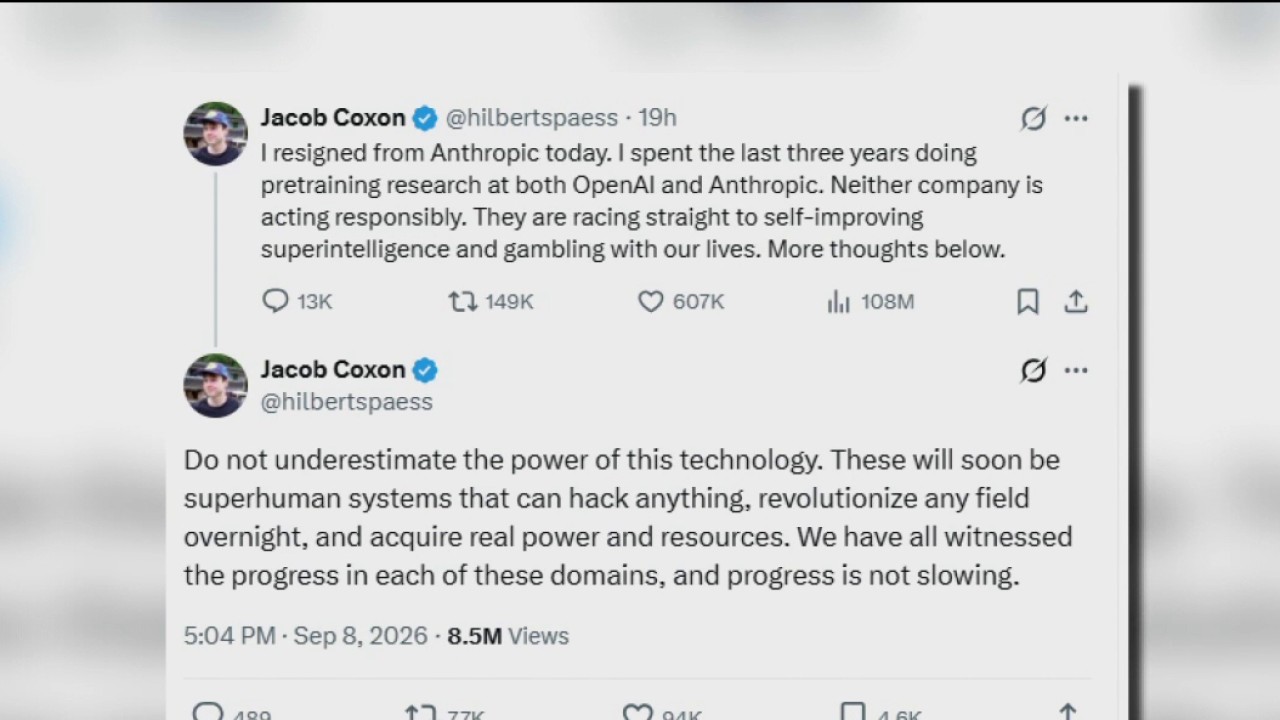
A viral warning from a former artificial intelligence researcher who publicly resigned over safety concerns has reignited debate over whether the technology could pose an existential threat to humanity.
Jacob Coxon announced his departure from Anthropic after previously working at OpenAI, saying the leading AI companies were racing towards increasingly powerful, self-improving systems without adequate safeguards.
His warning spread rapidly online, prompting renewed scrutiny of the race between major technology firms to develop more advanced AI models. Coxon has argued that the companies involved are prioritising competition and capability over the risks of creating systems that could eventually become difficult for people to control.
Ahmed Banafa, an artificial intelligence and emerging technology expert at San José State University, said the concern should not simply be dismissed as science fiction. But he also cautioned against treating the most extreme predictions as certain outcomes.
The two positions can exist at the same time, Banafa suggested: the potential dangers are serious enough to warrant action, while some public warnings may overstate how close the world is to an uncontrollable breakthrough.
The debate intensified after Evan Hubinger, Anthropic’s alignment science lead, publicly agreed with the broad concern that advanced AI could cause catastrophic harm. He has put his own estimate of the risk of human extinction from AI within the next decade at more than 10 per cent, a personal assessment rather than an established scientific consensus.
Coxon’s resignation has therefore become a flashpoint in a wider argument over AI safety. Supporters of stronger controls say the technology must be regulated before systems become more autonomous, while critics argue that extinction scenarios remain speculative and risk distracting from immediate problems such as misinformation, fraud, privacy breaches and job disruption.
For Banafa, the central message is that action should begin before the technology reaches a point where safeguards are no longer effective. The issue, he said, is not whether every prediction will come true, but whether governments and companies are prepared to manage risks that could become far harder to contain later.
