


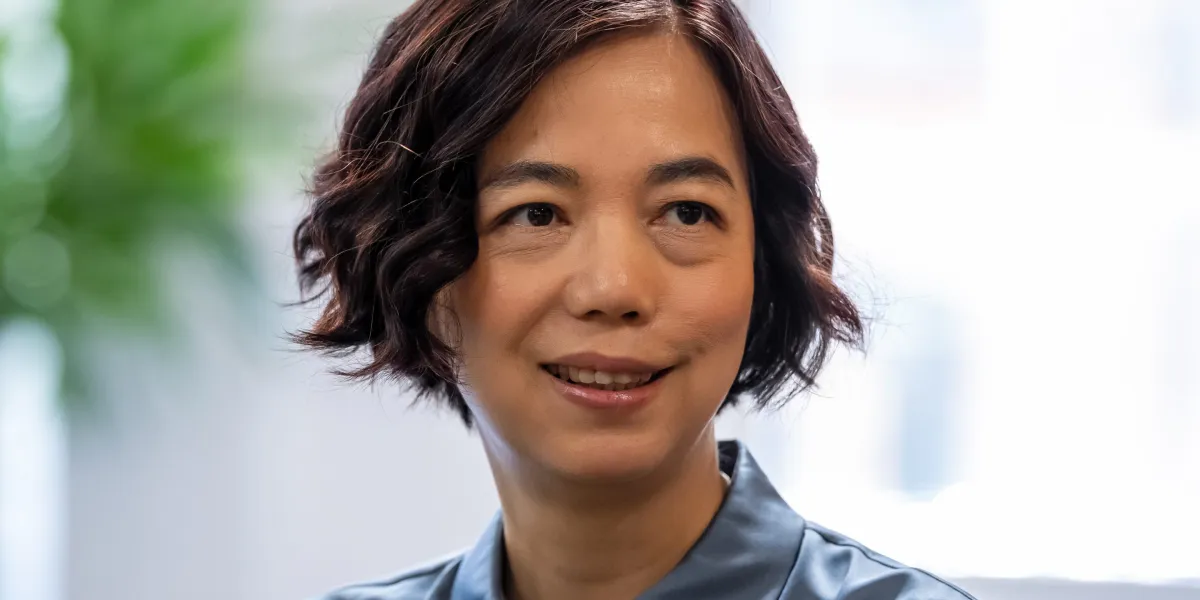
Fei-Fei Li, the computer scientist known as the “godmother of AI”, has said artificial intelligence is certain to become part of warfare, arguing that it would be unrealistic to expect technology to remain outside military use.
“To imagine any tools we build will not enter the practice of defence and military is… hardly pragmatic and realistic,” Li told Walter Isaacson on his podcast, The Builders with Walter Isaacson.
She said the history of conflict had repeatedly involved new technology, from “stones, rocks” and knives to fire, gunpowder and aircraft. “I believe it will be using AI,” she said.
Li stopped short of endorsing either side of the debate in Silicon Valley over whether technology companies should work with the military. Asked about the use of drones and autonomous weapons in conflicts including Ukraine and Iran, she described the issue as “very, very nuanced”.
“I don’t think there is a singular answer,” she said, adding that AI was a double-edged sword that could be used to defend peace but also needed to be controlled to prevent unnecessary harm.
Fei-Fei Li’s changing position on military AI
Her comments represent a change in emphasis from 2018, when Li was chief scientist of AI at Google Cloud and said it was against her principles to work on anything she believed would weaponise AI.
She became embroiled in the controversy over Project Maven, a Pentagon contract involving the analysis of drone footage. In internal emails reported at the time, she supported the deal while warning colleagues against publicly presenting it as an AI project.
“Avoid at ALL COSTS any mention or implication of AI,” she wrote. “Weaponized AI is probably one of the most sensitized topics of AI—if not THE most.”
In a statement at the time, Li said: “It is deeply against my principles to work on any project that I think is to weaponize AI.” Google later declined to renew the contract, and Li returned to Stanford.
Speaking to Isaacson, she said her work at Stanford’s Institute for Human-Centered Artificial Intelligence had involved political scientists, national security scholars and the Hoover Institution in considering how AI should be governed.
“If we have to put a North Star… I believe most people would say peace is a North Star,” she said. “But how do we get to that North Star is actually a really, really tough question.”
Li is now executive vice-president and chief scientist at AMD after the chipmaker completed its acquisition of World Labs, the start-up she co-founded. World Labs is developing “world models” designed to help machines understand and move through three-dimensional space.
She also co-founded Stanford’s institute in 2019 and built ImageNet, a database of millions of labelled images that helped drive the deep-learning boom in 2012.
AI’s impact on jobs will be decided by people, Li says
Li told Isaacson that the effect of AI on employment would depend on human choices rather than code alone. “TBD. I think the answer is in us,” she said when asked whether human-centred AI would create more dignified work or eliminate large numbers of jobs.
Teachers, doctors, artists and communities all had a role in shaping the technology, she said, through their work and through politics. “I don’t want a technology that… accentuates our differences and create a worse world for us,” she said.
Li also called for researchers to communicate more openly with the public and policymakers, arguing that many people encountered AI mainly through fear and anxiety rather than reliable information.
“At this moment, as a AI scholar, I actually don’t think ivory tower is the right symbol,” she said.
