


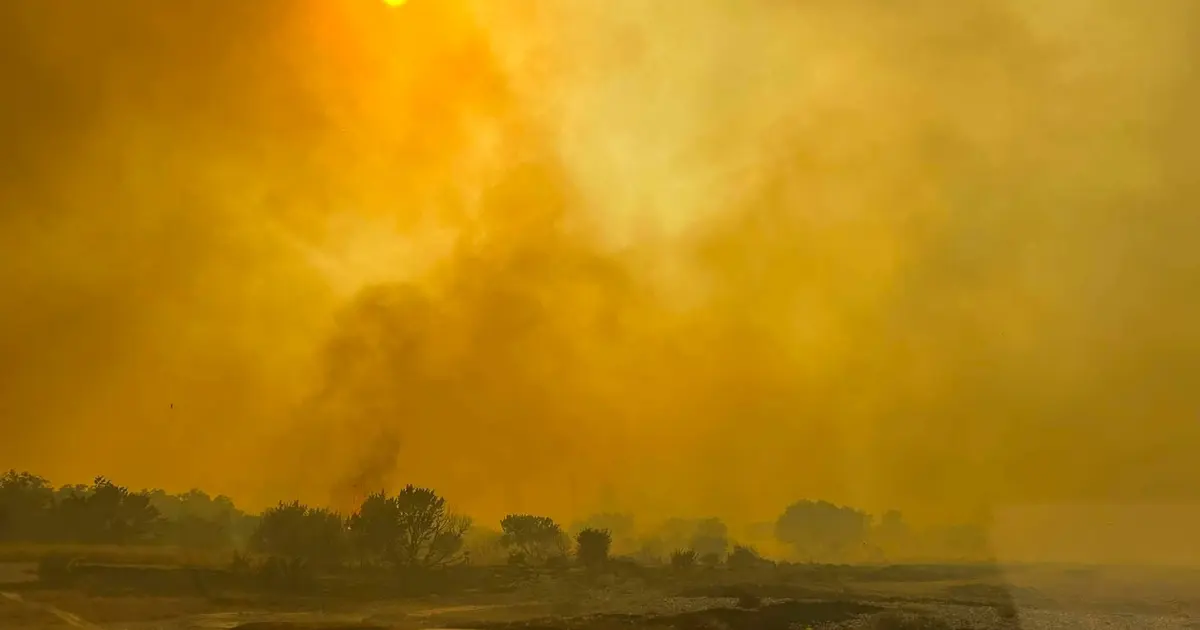
Firefighters in Texas are battling the 8,761-acre Dry River Fire near Sonora as a spell of extreme heat and dry weather continues to put pressure on emergency services across the state.
The blaze, in Sutton County, began west of Sonora on Tuesday, September 15, and was 30 per cent contained by Thursday. Temporary closures on Sutton County Road 104 and Ranch Road 1989 have since been lifted.
Dry River Fire continues to produce smoke near Sonora
Crews have been building dozer lines and indirect containment lines around the fire, while aircraft have been used to drop retardant on parts of the blaze. Smoke has been reported across western Sutton and neighbouring Schleicher counties, with authorities monitoring conditions near Interstate 10.
The National Weather Service in San Angelo said the region would remain hot and dry through the end of the week, with temperatures reaching about 99F to 101F (37C to 38C). Relative humidity was expected to fall to around 20 per cent, while gusty winds were forecast to make new fires harder to control. ([forecast.weather.gov](https://forecast.weather.gov/product.php?format=txt&glossary=0&highlight=on&issuedby=SJT&product=AFD&site=NWS&version=3&utm_source=openai))
No injuries or structural losses have been reported in connection with the Dry River Fire, and no evacuation orders are currently in place.
Texas A&M Forest Service officials said eight new requests for wildfire assistance had been received during a 24-hour period, with those incidents adding more than 600 acres to the total area burning across the state.
Other active fires included the 1,523-acre Clark Fire in Edwards County, the 1,100-acre Hydra Fire in Bosque County, the 658-acre Lobo Fire in Eastland County, the 500-acre Breezy Fire in Starr County and the 50-acre Medusa Draw Fire, also in Sutton County.
In north Texas, firefighters reached full containment on the Ross Fire after it burned 89,989 acres across Palo Pinto and Jack counties over three weeks. The blaze destroyed 167 structures and was described by the National Weather Service as the second-largest wildfire in the region’s recent history. ([texastribune.org](https://www.texastribune.org/2026/09/16/north-texas-ross-fire-containment/?utm_source=openai))
Fire authorities continue to urge caution with outdoor activities as high temperatures, low humidity and dry vegetation maintain an elevated risk of further ignitions.
