


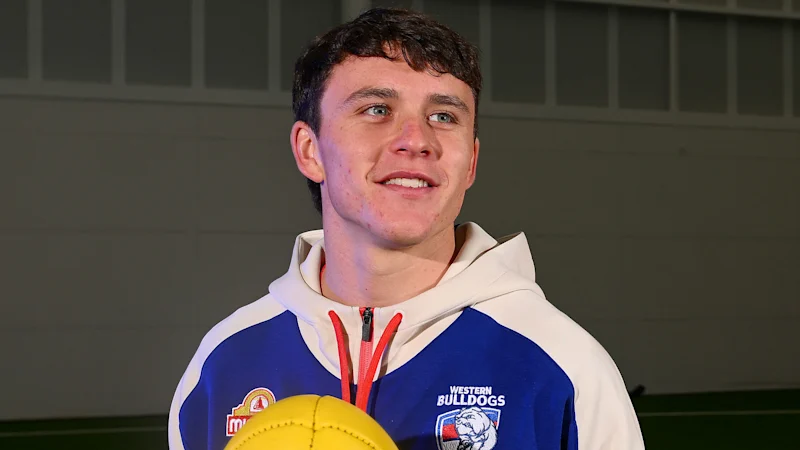
Former Western Bulldogs draftee Aiden O’Driscoll has been left traumatised after an AFL-ordered assessment classified his condition as a “mild” traumatic brain injury, despite eight brain bleeds and a fractured skull forcing him into medical retirement.
The reclassification, issued more than two years after the 21-year-old was forced to leave the game without playing a senior match, has derailed his claim for a $600,000 severe injury benefit and triggered a dispute between his management and the AFL.
O’Driscoll retired in May 2024, aged 18, after suffering a head-on-head collision during a Western Bulldogs pre-season match simulation. He was taken to The Alfred hospital after experiencing a seizure, with an MRI later revealing eight brain bleeds and a fracture behind his ear.
He received a career-ending injury payment of more than $150,000, but his application for the additional severe injury benefit was rejected this year by the AFL and the AFL Players’ Association.
The decision relied on a neuropsychological assessment completed in Perth in March by clinicians who concluded that O’Driscoll had sustained a “mild TBI”. The finding shocked O’Driscoll and his agent, Peter Jess, and meant he was judged not to meet the criteria for the larger payment.
An AFL medical panel report from April 2024 recorded the extent of his injuries and stated: “Aiden has more micro-haemorrhages than the panel has seen in other athletes.” He was subsequently medically retired by the AFL’s independent concussion panel.
O’Driscoll said he continues to experience daily memory loss, nausea, anxiety, dizziness and sleep difficulties. He described the assessment as inconsistent with what he has experienced since the collision.
“It [mild assessment] does not add up. My memory for basic things is shocking, really bad. It has progressively got worse over time,” O’Driscoll said.
He gave the example of forgetting why he had gone to the shops, despite remembering two of the three items he needed. “I obviously can’t live a normal life,” he said.
Dispute over brain injury assessment
Jess said the medical classification should have been moderate or severe traumatic brain injury rather than mild, arguing that the assessment could not be relied upon. He has begun examining possible legal action against several parties.
“It’s frightening what has gone on here. It has destroyed the kid’s life,” Jess said, adding that O’Driscoll had not worked for months and was earning no money.
The AFL Players’ Association said in a rejection letter in March that O’Driscoll had not shown a permanent impairment of cognitive function that would reduce his future earning capacity by at least 40 per cent. The association declined to comment further, citing confidentiality. The AFL was contacted for comment.
In a discharge summary dated May 18 2026, AFL chief medical officer Michael Makdissi did not comment on the “mild TBI” classification. He said O’Driscoll had not attended his final case review after his request to be accompanied by Jess, a non-related third party, was deemed inappropriate by the league.
Makdissi recorded that O’Driscoll’s current work capacity was limited by ongoing symptoms. The former draftee had undertaken one-to-one football training and disability support work, but could not tolerate AFL-level exertion because of nausea and feeling unwell and remained barred from contact sport.
The March assessment report said O’Driscoll had pre-existing diagnoses of ADHD and dyslexia, with some cognitive weaknesses already evident in baseline testing. It also recorded vulnerabilities in working memory, attention and mental flexibility after his injury.
Makdissi said a follow-up review had found mildly increased cognitive and physical fatigue, slower processing, reduced time management and intermittent forgetfulness. His recommendations included psychological support, exercise, specialist physiotherapy for exercise-related nausea and referral to memory rehabilitation services.
“It has been [traumatic], it has been very difficult,” O’Driscoll said. “The severity of my injury … it has had severe impacts on me.”
