


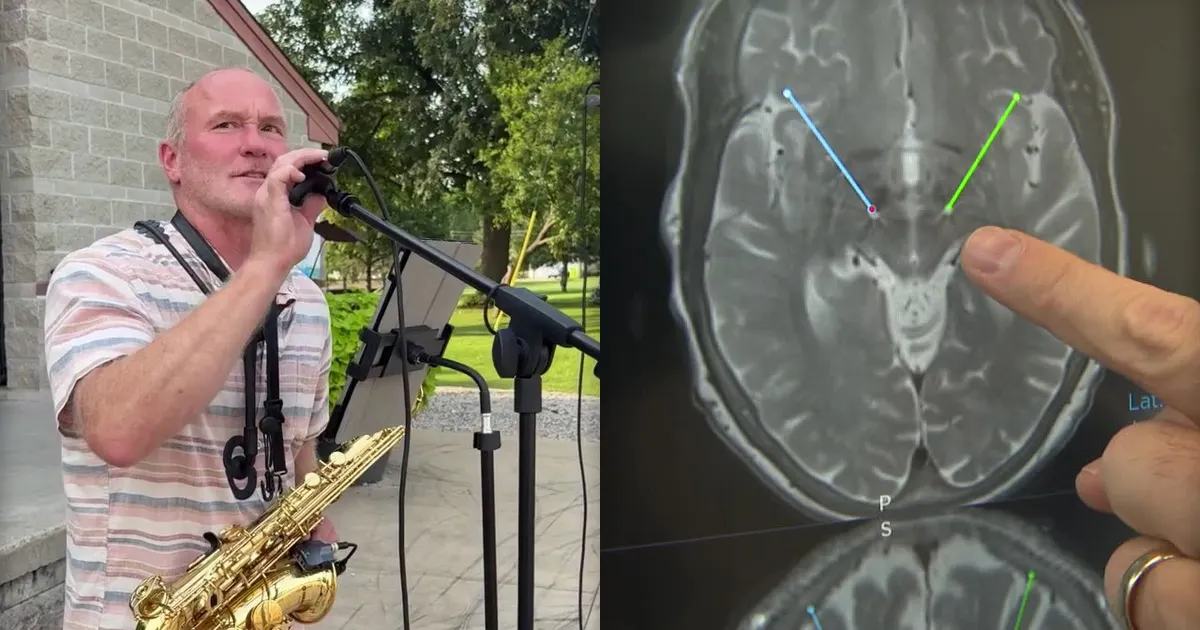
A Hartland saxophonist who feared Parkinson’s disease had ended his music career has regained control of his tremors after undergoing deep brain stimulation surgery.
Tim Nett was 48 when doctors at Aurora St Luke’s Medical Center diagnosed him with the condition. He had first noticed problems in 2018, when the fingers on his right hand began to feel as though they were dragging while he worked at his computer.
The symptoms later progressed to tremors, shaking legs and changes to his handwriting. Although medication initially helped, Nett said the uncertainty over how far the disease might advance was difficult to manage.
“I had tremors, then my legs started shaking and my handwriting – it was like there’s this unknown feeling of where is it going to stop and how bad is it going to get,” he said.
Nett, who has played the saxophone since elementary school, eventually decided in 2023 to undergo deep brain stimulation, or DBS. The treatment involves placing electrodes in areas of the brain involved in movement and connecting them to a battery-powered device in the chest.
Dr Kyle Swanson, a neurosurgeon at Aurora St Luke’s, said DBS had been used for years but had continued to develop, making the procedure easier for many patients to undergo. Aurora says the electrical stimulation can be adjusted or switched off using a wireless programmer, while some patients are able to reduce their medication after surgery. ([aurorahealthcare.org](https://www.aurorahealthcare.org/services/neuroscience/neurology/neurological-conditions/parkinsons-disease/deep-brain-stimulation))
Deep brain stimulation helps musician return to the stage
Nett can now control the device with a remote. When the stimulation is switched off, his tremors return; when it is activated, the difference is immediate.
The treatment has also significantly reduced the number of pills he needs to take. Swanson said medication remained the usual first treatment for Parkinson’s, but symptoms could become harder to control as the progressive disease advanced.
Aurora offers both awake and asleep DBS operations. The health provider says electrodes can be positioned under general anaesthetic, with CT scanning used during surgery to confirm their placement. ([aurorahealthcare.org](https://www.aurorahealthcare.org/services/neuroscience/neurology/neurological-conditions/parkinsons-disease/deep-brain-stimulation))
Swanson said he had carried out several hundred such procedures, with many patients returning home the following day. DBS does not cure Parkinson’s, and Aurora says it is generally considered for suitable patients who have had the disease for at least four years and whose symptoms are no longer adequately controlled by medication. ([aurorahealthcare.org](https://www.aurorahealthcare.org/services/neuroscience/neurology/neurological-conditions/parkinsons-disease/deep-brain-stimulation))
For Nett, the operation has allowed him to return to performing, including a gig at Nixon Park in August. He now also meets prospective DBS patients at Aurora to share his experience and reassure those who are uncertain about brain surgery.
“For me, it was like, ‘I don’t want to get brain surgery. Maybe as a last resort.’ It’s not a last resort like it used to be,” Nett said.
