


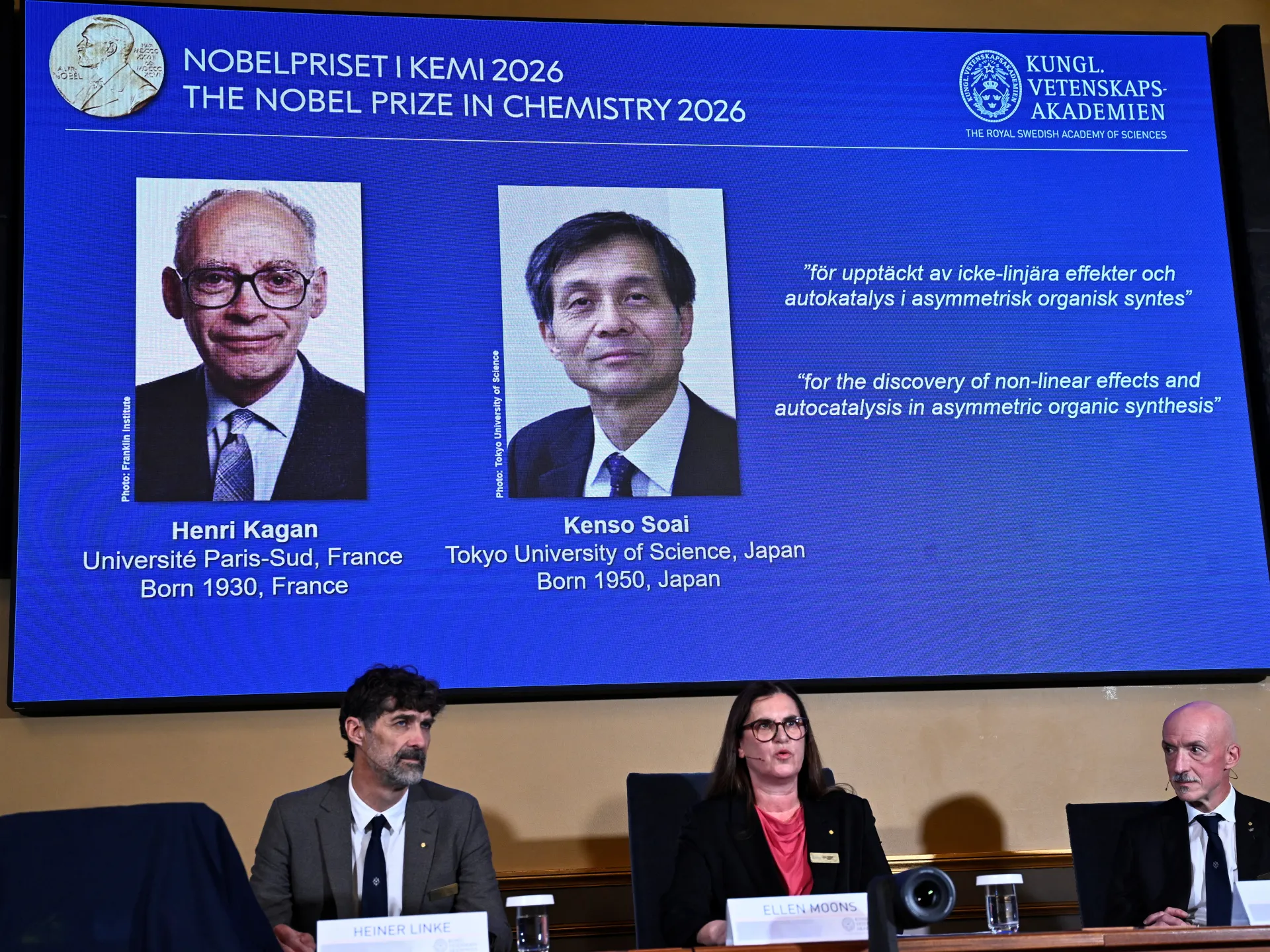
Henri Kagan and Kenso Soai have been awarded the 2026 Nobel Prize in Chemistry for explaining how chemical reactions can favour one molecular “mirror image” over another, a breakthrough that has been important in the manufacture of pharmaceuticals.
The Royal Swedish Academy of Sciences said Kagan, 95, from France, and Soai, 76, from Japan, were being recognised “for the discovery of nonlinear effects and autocatalysis in asymmetric organic synthesis”.
Their work gave chemists methods for directing reactions towards a single form of a molecule, helping in the design and production of medicines.
Many molecules vital to life occur in two forms that are mirror images of one another, comparable to a left and right hand. Living organisms, however, almost exclusively use just one of those forms – a phenomenon known as homochirality.
The difference can be medically significant. “The left-handed version of the drug can have one effect, and the right-handed version can have another effect, and then we need methods for selectively preparing them,” said Peter Somfai, a member of the Nobel Committee for Chemistry.
“In developing such methods, the findings of this year’s laureates are important. They provided powerful tools for that,” he said.
Solving a century-old chemical mystery
Heiner Linke, chair of the committee, said the laureates had addressed a mystery more than a century old: how homochirality can arise spontaneously. He described the chemical reactions developed by the scientists as “spectacular”.
Soai said he had been out shopping when he received news of the award during a telephone appearance at the Nobel Prize news conference.
“This is the most exciting day in my life, I am very glad to share this prize with Professor Henri Kagan,” he said.
The chemistry award is the third Nobel to be announced during Nobel week, following the prizes for medicine and physics. The literature laureate is due to be announced on Thursday, with the peace prize scheduled for Friday.
Last year’s chemistry prize went to Susumu Kitagawa, Richard Robson and Omar Yaghi for developing metal-organic frameworks, molecular structures that can help address challenges including climate change and freshwater shortages.
