


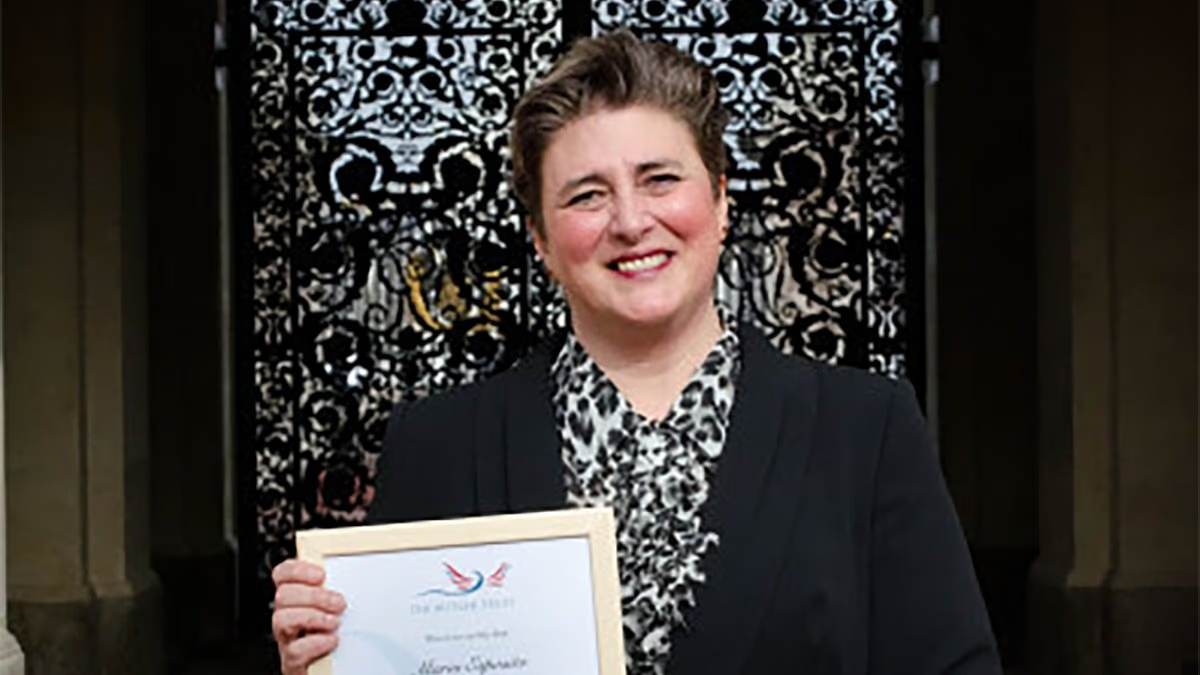
When Maria Espocito placed her mother Kathleen in a care home in 2008, she knew she would need help covering fees of thousands of pounds every month.
She feared she would have to sell the family home to cover the cost.
So when she asked the care home about funding available through the NHS to those with a so-called ‘primary healthcare need’, Maria was hopeful that Kathleen, who was 77 at the time and had Alzheimer’s, would qualify.
The NHS fully funds people requiring ‘continuing healthcare’ with complex care needs. This pays for the entire cost of a care home or home carer visits and is not means tested.
It is designed for people like Kathleen, with significant ongoing physical or mental health needs and it can be worth thousands a week. But to Maria’s shock, when the now 66-year-old tried to apply, she was told her mother had already been assessed and wasn’t eligible.
It’s a line all too familiar to families trying to secure Continuing Healthcare (CHC) funding.
As nursing home fees hit an average of £1,535 a week, the funding can be invaluable in preserving wealth built up over a lifetime. But the threshold is high. Individuals must have a primary health need to qualify, which means the main reason they need care is for a medical or health reason, as opposed to social, such as help with dressing or washing.
When Maria Espocito placed her mother Kathleen in a care home in 2008, she knew she would need help covering fees of thousands of pounds every month
And the process is guarded by an army of assessors that put up endless hoops for you to jump through – 83 per cent of those who pass an initial screening test and progress to a full assessment are turned down for the funding.
And a cruel postcode lottery means that some areas have even lower acceptance rates.
Maria was adamant her mother’s dementia meant she should be eligible for funding, so she appealed. For the next ten months she fought back and forth with officials to overturn their judgment – and won.
But her victory was short lived. Those who qualify are reviewed again every 12 months – so just months after her success, Kathleen was told her mother no longer qualified for the following year.
It was a battle she had to fight over and over again every 12 months for almost a decade, usually having to go through an appeal process.
Then, in 2016, Maria and her siblings, Stefan and Giulietta, were so persistent they ended up winning funding for life for Kathleen.
In total, the family saved £510,000 in the 13 years before Kathleen died aged 89 in 2020, as fees had by then risen to £4,000 a month (£5,200 in today’s terms).
Kathleen would have had to sell her house to pay them.
Maria, who lives in Surrey with her wife Sue, says it’s ‘tragic’ so many people are not getting the funding they deserve after paying into the NHS all their working lives.
Since fighting for Kathleen, she’s helped her mother-in-law get the funding. Today, Maria reveals the exact tricks she used to beat the stubborn NHS funding system.
There is no need to reveal any savings
Unlike council-funded social care, CHC is not means tested.
Someone’s assets, such as savings or the value of their home, should have no bearing on whether they are eligible.
But in the application process, Maria, a retired television producer, says she initially received questions about Kathleen’s financial position.
‘I questioned why that was,’ she says. ‘If you disclose the finances, no one can make an objective decision because they are solely focused on what you have.’

When she asked the care home about funding available, Maria was hopeful that Kathleen, pictured, who was 77 at the time and had Alzheimer’s, would qualify
CHC advice service Beacon confirms that if someone asks you about your loved one’s finances then you can simply refuse to answer.
Attend both of the assessments in person
After you put in an application, there are two stages to a CHC assessment – and Maria says family should absolutely attend both.
In an initial screening, a health or social care expert runs through a list of questions to decide if your relative merits a full assessment.
If they pass, a team then scores their care needs across 12 domains in a 36-page form called a ‘decision support tool’ to decide if your relative has a primary health need.
Maria says: ‘Never let them do an assessment without a member of the family there.
‘One of our earliest assessments was carried out by a social worker who interviewed my mother alone, despite her having significant cognitive impairment.
‘Afterwards I was told, “Your mother said she knows where she is and knows all her family.”
‘My mum would have said yes to any questions they asked. But she was confused about the time and place.’
Social work practice Nellie Supports says if you are in those meetings, you can share information that healthcare workers may not know. For example, you can talk about how often difficult episodes occur and what your loved one was like six months ago.
If you are told you can’t attend the assessment, ask why this is, and for this to be put in writing. At this point, they will usually relent.
Insist on having a multi-agency meeting
The second assessment, the decision support tool stage, is done by a multi-disciplinary team – usually at least two assessors, one from health and one from social care.
They should ideally be involved in the treatment or care of your loved one, and should be trained in the assessment process.
It’s their job to gather as much information as possible to score your loved one across the 12 key domains, including breathing, mobility and nutrition.
The assessors take evidence from social, medical and care records.
Maria says you can ask the assessors to consider a report from carers at the home or their GP, too. This will allow them to get first-hand evidence of your loved one’s condition and their daily needs. She adds that you can push for more representatives to be there if you think it will benefit the application.
Maria says: ‘You need somebody from the care home, nurses and relatives, as well as assessors from the medical and social worker side, to get a full sense of their care needs.’
While you have every right to ask for this larger meeting during the second stage of the assessment, the initial checklist can be completed by a nurse, doctor, social worker or other healthcare professional.
Do not downplay a loved one’s care needs
When you meet the assessors, you may end up downplaying a relative’s health condition, for example, being drawn into saying ‘we manage’ or ‘they do have good days’.
But Maria says it is vital to be brutally honest about their condition.
She says: ‘That instinct is understandable. Who wants to think of their relative as violent and aggressive? But it can cost them the care they deserve.
‘However painful it is to describe a loved one in the extreme terms you might not want to acknowledge, you have to – that’s the reality of the illness.’
For Kathleen, Alzheimer’s meant she became angry when being showered, occasionally running away from the care home and dealing with paranoia and confusion.
If care workers or community nurses are attending the meeting, you should ask they accurately reflect your relative’s needs, too, instead of simply describing what they are like on good days.
Learn the language of the assessors
To be successful you have to become familiar with the language the assessors use, Maria says.

If care workers or community nurses are attending the meeting, you should ask they accurately reflect your relative’s needs, too
Learn each of the 12 care domains in the tool and what they describe. Go to gov.uk and search for ‘NHS continuing healthcare decision support tool guidance’.
You should look at how needs are ranked, from none, low, moderate, high, severe and, in some domains, priority. Use these specific terms when answering any questions from assessors.
They will look at the nature, intensity, complexity and unpredictability of needs. If you understand the language and how the scoring works, you can challenge inconsistency in the assessments and rankings you don’t agree with. For instance, one year Kathleen’s cognition was ‘severe’, but the next it was ‘moderate’. Maria says: ‘I remember asking, “Have they found a cure for Alzheimer’s?” ’
If you disagree, raise this during the meeting. If a resolution can’t be reached, ask them to make a note of your concerns in the decision support tool and refuse to leave until that has been done.
If turned down, appeal immediately
Maria says: ‘Do not assume the first decision is correct simply because it comes from the NHS.’
Put together a list of all failures in the assessment process, says CHC information website Care To Be Different. You may have felt intimidated by officials, or found there was no multi-disciplinary team put together by the NHS. Note all inaccuracies in the decision support tool and any evidence ignored. Then write to the integrated care board, responsible for making eligibility decisions, and outline the reasons for a review.
You may first be offered a ‘local dispute resolution meeting’, but families typically find these are with assessors trying to persuade you that they are right. In this case, you have six months to ask for an independent review.
You may find your relative has been deemed ineligible for CHC at the initial checklist stage. If so, write to the CHC and ask for the test to be repeated, outlining why you disagree with the decision.
If funding is awarded, there is a yearly review. But, as Maria found, officials can still suggest the funding is reassessed and can be withdrawn. You can appeal this too.
Never take no for an answer
Above all, Maria’s top tip is to never take no for an answer.
In 2016 Kathleen’s funding was refused. But Maria requested a meeting with the director of the clinical commissioning group, the bodies that previously led CHC funding, sending dozens of documents. She even made a graph of scores in the decision support tools to show her mother hadn’t been improving.
And this perseverance worked – not only did Kathleen have her funding paid for that year, it was put in place for life.
Do not throw away any documents
That challenge was only possible because Maria never threw away any decision support tools. And while appealing a decision, keep receipts of everything you pay – if you win, you can claim it back.
Kathleen died in the first wave of the pandemic. Maria says: ‘She was absolutely lovely. However, what I remember most from those years is not just the heartbreak of Alzheimer’s, but the constant battle to persuade the system to recognise needs that were obvious to everyone who knew her.’
What has been your experience of trying to get funding care? Email money@mailonsunday.co.uk
