


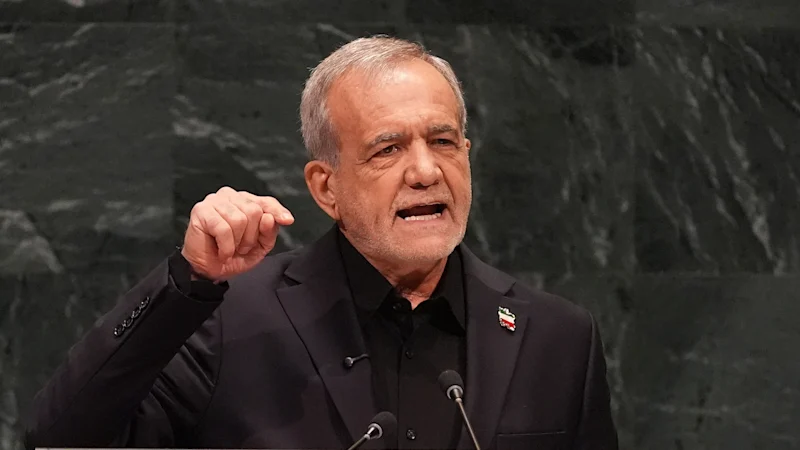
Iranian President Masoud Pezeshkian has told the United Nations that his country will not surrender, in a defiant speech delivered a day after Donald Trump threatened to “annihilate” Iran.
Addressing the UN General Assembly in New York, Mr Pezeshkian said Iran remained open to negotiations and a diplomatic solution, but rejected any suggestion that military pressure could force Tehran into submission.
“They have learned that Iran cannot be made to surrender,” he said. “He [Trump] must know that the resistance of the Iranian people will only increase in the face of sanctions, increased pressure, increased bullying. We will never bow our head or bend at the knee.”
The address was described as the first time in the UN’s 81-year history that a foreign leader whose country was at war with the United States had travelled to its New York headquarters to speak.
Mr Pezeshkian held up photographs of Iran’s assassinated supreme leader, Ali Khamenei, and children killed by missiles during the conflict, which began almost seven months ago.
“I come from an Iran where, in truth, they bombed a school,” he said. “You see these children? These children perished under bombs, with weapons used by the United States and Israel. They were innocent.”
The United States has not publicly accepted responsibility for a missile strike on an Iranian girls’ school on the first day of the war that reportedly killed about 120 children and dozens of adults. Reports by US news organisations have said internal investigations found the United States was responsible.
Iranian officials have previously been unable to secure a lasting diplomatic agreement with Washington, despite a short-lived memorandum of understanding signed in June. Mr Pezeshkian nevertheless said Tehran was ready to resume talks.
He also defended Iran’s right to maintain a civilian nuclear programme, repeating Tehran’s position that it does not seek nuclear weapons. Iran has a history of constructing secret nuclear sites and uranium enrichment facilities, as well as restricting access for weapons inspectors.
Mr Pezeshkian argued that Israel, rather than Iran, should face scrutiny over its nuclear capabilities and military actions. “The nuclear weapon is in Israel, but the inspector is in Iran. Israel kills, but Iran is subject to sanctions. This is a true tragedy,” he said.
A lone American delegate walked out shortly after the Iranian president began speaking. Foreign Minister Abbas Araghchi and other members of the Iranian delegation were authorised by the United States to attend, although some proposed delegates were refused visas.
The Iranian president also warned that Tehran would continue to assert its claim over the Strait of Hormuz, the key shipping route between Iran and the Arabian Peninsula.
“We cannot let some have free access and gain their interest from a waterway while at the same time using that waterway to impose their aggression upon us,” he said. “They close access for us to our own waterway … we will not succumb to that.”
Mr Trump has said a deal with Iran could follow the US midterm elections, while arguing that Tehran was prolonging the dispute to inflict political pressure through higher oil and petrol prices.
Brent crude was trading at just above 100 US dollars a barrel on Wednesday. Iran-backed Houthi rebels in Yemen have recently targeted Saudi Arabian energy infrastructure and the Bab al-Mandab strait, another important oil shipping route.
Israeli Prime Minister Benjamin Netanyahu is due to address the UN after arriving in New York, before returning immediately to Israel.
