


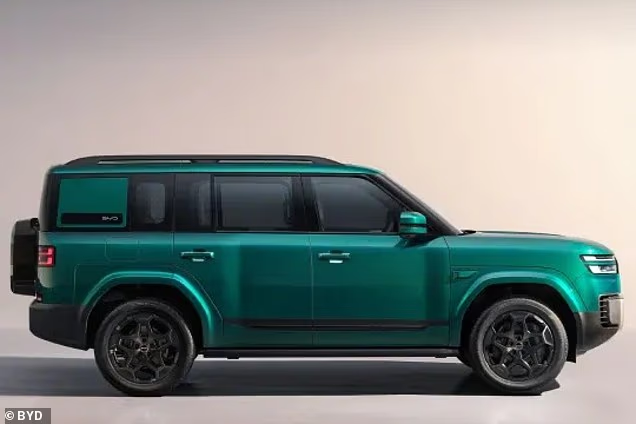
Jaguar Land Rover has launched a legal case against BYD after alleging that the Chinese carmaker’s new Ti7 SUV copies the design of its best-selling Defender.
Bailiffs seized digital documents from BYD’s offices in Schiedam and Hoofddorp in the Netherlands in August, as JLR seeks evidence to support its claim that the vehicle’s boxy styling infringes its intellectual property.
A court is due to decide this week which, if any, of the confiscated records can be used in the dispute. JLR is seeking to establish that BYD deliberately copied the latest-generation Defender rather than independently developing a similar-looking SUV.
The two companies have already appeared before a court in The Hague. BYD is understood to have described the seizure as a “fishing expedition” while contesting how the documents could be used.
A JLR spokesman said the company “does not comment on ongoing legal proceedings”. A BYD representative has also declined to comment.
BYD Ti7 due in UK next year
JLR is expected to seek a ban on the Ti7 being sold in European showrooms, although the case is unlikely to be resolved before the model is due to arrive in Britain in January.
The seven-seat plug-in hybrid combines a 1.5-litre turbocharged petrol engine with two electric motors and a 35.6kWh lithium iron phosphate battery. BYD says it can travel up to 102 miles in electric-only mode and accelerate from 0 to 62mph in 4.8 seconds.
Measuring 5,146mm long, 1,995mm wide and 1,865mm tall, the Ti7 sits between the five-seat Defender 110 and the seven-seat Defender 130 in overall size.
BYD describes the vehicle as having an “unapologetically boxy profile” and says its “imposing, chunky design” is aimed at the preferences of SUV buyers.
Prices are due to start at £47,995, making the Ti7 about £21,000 cheaper than the least expensive Defender 110 with seven seats and around £35,000 less than a comparable Defender 130.
The Defender is JLR’s best-selling model. More than 115,000 were ordered last year, accounting for about three in 10 of the company’s global deliveries.
This is not the first time JLR has taken legal action over alleged design copying. In 2020, it failed to trademark the shape of the original Defender in an attempt to prevent the launch of the Ineos Grenadier, which it claimed was too similar to the iconic off-roader.
The company did, however, win a case in China the previous year against Jiangling Motor Corporation. A Beijing court ruled that the Landwind X7 had copied five distinctive features of the Range Rover Evoque.
Chinese carmakers expand in Britain
The dispute with BYD comes as Chinese brands gain ground in the UK with lower-priced vehicles, generous equipment levels and designs aimed at established European and Japanese rivals.
Chinese models accounted for 21.6 per cent of new cars registered in October, while almost 338,000 vehicles from Chinese brands had been ordered in Britain since the start of the year. BYD alone had sold almost 75,000 cars to British buyers.
JLR has not brought a similar case against Jaecoo, whose 7 SUV has been likened to a cheaper Range Rover Velar. The Chinese brand’s parent company, Chery Group, has had a strategic partnership with JLR for more than a decade.
Under a deal announced in June 2024, JLR agreed to license the Freelander name to Chery for a range of electric vehicles using the Chinese company’s platform. The new Freelander 8 is due to be sold through Chery dealerships in the UK next year.
JLR’s legal action against BYD is also being pursued as BYD’s luxury subsidiary, Yangwang, prepares a flagship limousine which has been described as resembling the Rolls-Royce Phantom and is expected to cost about half as much.
