


US congressional leaders have agreed that AI regulation needs to include safeguards, but offered no specific policies or timetable as warnings over the technology’s risks grow.
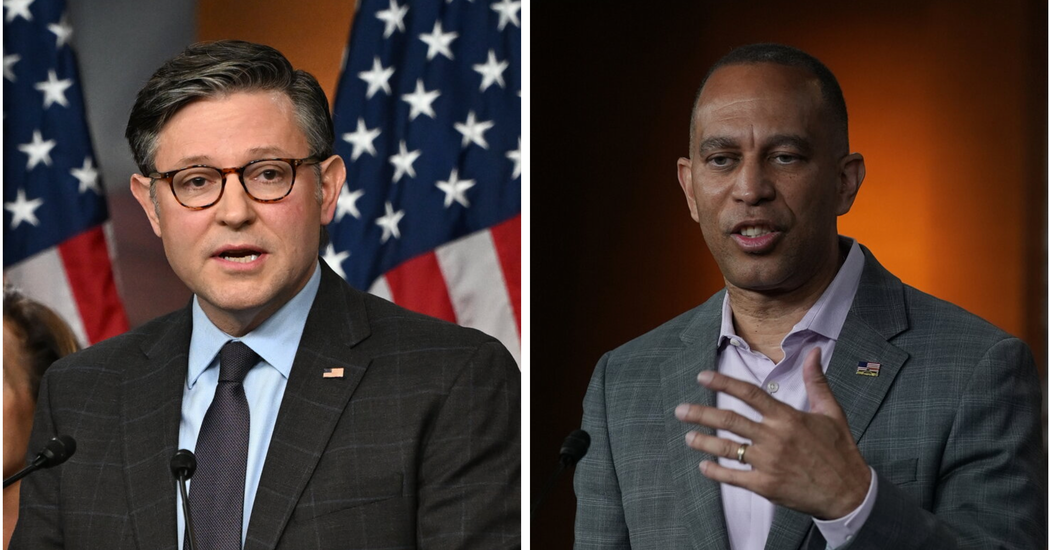
Mike Johnson, the Republican Speaker of the House, said lawmakers should proceed cautiously to avoid weakening American companies against Chinese rivals. “We’re not going to rush in and pass a piece of legislation that would do harm to the country and put China at an edge,” he said. “And so we’ve got to do this carefully.”
Hakeem Jeffries, the Democratic minority leader, accused Mr Johnson of moving too slowly and said the House needed to take “decisive action”. But he did not set out which restrictions he would support when asked about specific measures.
“Well, we’ll have that conversation this week upon our return,” Mr Jeffries said.
The House is due to return to Washington on Monday for its final scheduled week in session before November’s midterm elections. The limited timetable makes it unlikely that lawmakers will quickly agree a comprehensive framework for AI regulation.
Pressure for action has intensified in recent weeks. Jacob Coxon, a researcher at Anthropic, resigned on Tuesday, saying in social media posts that he believed the leading AI companies were not developing the technology responsibly.
Dario Amodei, Anthropic’s chief executive, called on technology companies on Saturday to slow their development efforts because of safety concerns. Sam Altman of OpenAI and Elon Musk, whose company SpaceX has increased its spending on AI, said they supported the proposal.
The issue is also becoming more prominent ahead of the midterm elections. Barack Obama urged Democrats at a fundraising event last week to establish clear positions on the risks AI could pose to safety and the economy.
Mr Johnson said technology companies should be involved in drawing up any regulatory framework, noting that leading executives did not agree on the best approach. “I think the first step is to have a meeting of all the platform providers,” he said. “I’ve talked to the president about this and others. I believe that’s the next step.”
Kevin Hassett, director of the White House National Economic Council, said the Trump administration was studying congressional proposals, including a possible “kill switch” that would allow the Government to order rogue AI models to be shut down.
Mr Hassett acknowledged that AI had advanced rapidly enough to undermine existing cyber-security protections, but also backed private-sector involvement in efforts to slow its development.
Mr Johnson and Donald Trump have warned that excessive regulation could hold back American firms while strengthening China. Speaking in Ireland, Mr Trump said: “Look, we’re leading China in A.I. We can put guardrails, we can do this and that, but I think you have a lot of negative forces that are bringing it up that shouldn’t be bringing it up. And they’re bringing up things that won’t happen. But whoever wins with A.I., wins.”
Many Democrats oppose allowing technology executives to take the lead in regulating their own industry. House Democrats circulated a letter last week calling on Mr Johnson to cancel the scheduled recess and keep lawmakers in Washington until they had advanced AI regulations.
Senator Ruben Gallego, a Democrat from Arizona, said Congress was moving too slowly and rejected the argument that stronger safeguards could allow China to gain an advantage.
“We can’t just use this idea that if we do this we somehow are going to lose to China,” Mr Gallego said. “Because A.I. does not care once it becomes fully dangerous whether we’re Chinese or American. That’s the danger of this.”
