


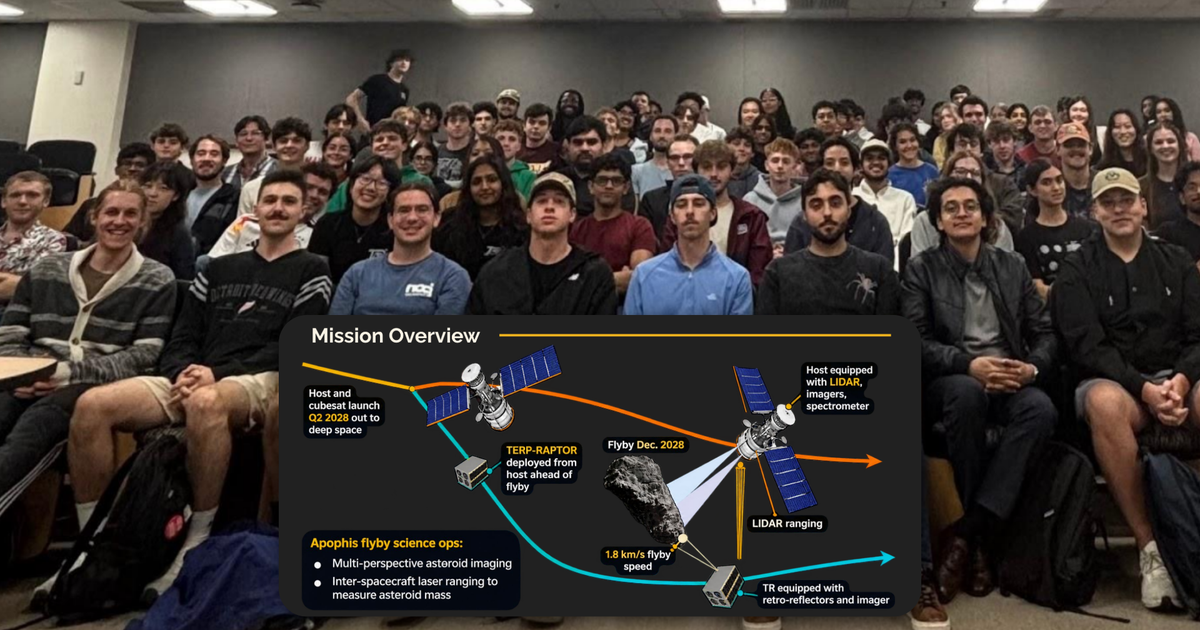
More than 90 University of Maryland students are building a small spacecraft designed to reach asteroid Apophis months before its exceptionally close pass by Earth in April 2029.
The student-led TERP RAPTOR mission is being developed in Prince George’s County, where teams ranging from undergraduates to PhD candidates are working on a CubeSat intended to travel into deep space and observe the potentially hazardous asteroid.
Apophis is expected to pass within about 30,600 kilometres of Earth’s surface on April 13, 2029 — closer than many geostationary satellites. It will be the nearest known flyby of an object of its size and is expected to become visible to the naked eye from parts of the world.
Rather than waiting for the main encounter, TERP RAPTOR is scheduled to launch on a commercial rideshare mission in the second quarter of 2028. The spacecraft is expected to reach Apophis in December that year, around three and a half months before its closest approach to Earth.
University of Maryland students prepare Apophis spacecraft
The mission aims to obtain close-range images from several perspectives, create a three-dimensional model of the asteroid and help scientists determine its mass using a laser-ranging technique involving the CubeSat and its host spacecraft.
If successful, the laser-based experiment would provide a new way to measure the mass of a potentially hazardous asteroid during a high-speed flyby. The information could help researchers better understand Apophis’s structure, movement and gravitational field.
TERP RAPTOR began in 2024 as a graduate capstone project at the University of Maryland’s A. James Clark School of Engineering. It has since grown into a 16-subteam programme involving students working on propulsion, electrical systems, flight software, guidance, navigation, instrumentation and mission operations.
The project has also secured access to dedicated laboratory space at NASA’s Goddard Space Flight Center in Greenbelt under a Space Act Agreement. The team says it is the first group of students to receive badges under the agreement to work from the site’s specialist facilities.
NASA has provided $380,000 in funding, while a further $46,000 has been raised through university crowdfunding. George Mason University is supporting propulsion testing and engineering work, and The Aerospace Corporation is providing environmental testing and technical assistance.
Design work and hardware procurement are due to continue through 2026 and 2027, followed by assembly and testing before the planned launch. The spacecraft is intended to be the first university-built CubeSat to reach Apophis.
Project leaders hope the mission will establish a permanent CubeSat programme and a Space Mission Development Center at the University of Maryland, giving future students the opportunity to work on flight-ready space hardware.
