


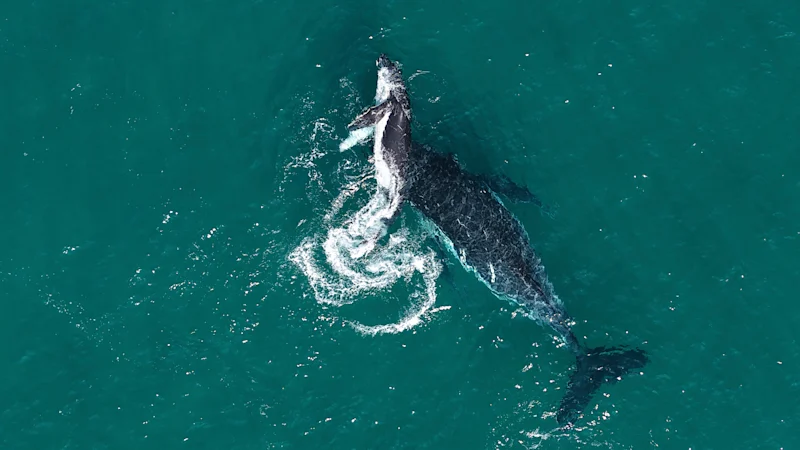
Rare footage of a humpback whale repeatedly tending to the body of her stillborn calf has provided researchers with what they believe is the first detailed record of possible grief behaviour in the species.
The young female was filmed at Palm Beach Reef, off the Gold Coast, after members of the public reported concerns that two whales in shallow water might be injured or entangled. Andrew Mulville, a whale rescue boat captain with Sea World, was nearby and investigated.
He found the whales were not hurt, but an amniotic sack, part of a placenta, was floating on the surface. Using an underwater camera, he recorded the female diving repeatedly to the seabed, where she lay beside the calf and gently nudged its body with her head and fin.
Dr Olaf Meynecke, a whale scientist at Griffith University, said the footage showed what appeared to be attempts by the mother to make eye contact with the calf and check for signs of life. The female and another whale, described as an escort, were also heard vocalising to each other.
“She was going and literally lying on the bottom … she was definitely spending time with the deceased calf,” Dr Meynecke said.
A paper by Dr Meynecke and Mr Mulville, examining the incident, says the whale probably understood that the calf had died because she did not try to raise it to the surface to breathe. Public sightings suggest the whales may have stayed near the body for almost three days.
The researchers describe the behaviour as a rare “post-mortem attentive response”. Such responses can include carrying, nudging, circling or guarding a dead offspring, and have been recorded more often among toothed whales than baleen whales such as humpbacks.
Similar behaviour has been documented in the orca known as Tahlequah, which carried the body of a dead calf for 17 days in 2018 and was seen doing so again after another calf died last year.
Whether animals experience grief in a way comparable to humans remains unresolved. Dr Meynecke said the behaviour could reflect confusion or a caregiving instinct that continued after the calf’s death.
“Of course, from a science perspective, we can’t prove it’s grief,” he said. “It’d be so much easier if you could just ask them.”
Dr Meynecke said observations of humpbacks responding to entangled whales and protecting other species from predators suggested they experienced a powerful emotional state, even if it was not directly comparable with human feelings.
Rebecca Dunlop, an associate professor and whale behaviour expert at the University of Queensland who was not involved in the study, cautioned that interpreting animal behaviour through human concepts risked anthropomorphism.
She said the paper presented a balanced account of the possible explanations, but terms including “grief”, “emotion” and “distress” needed to be used carefully because researchers could not know what the whale was consciously experiencing.
