


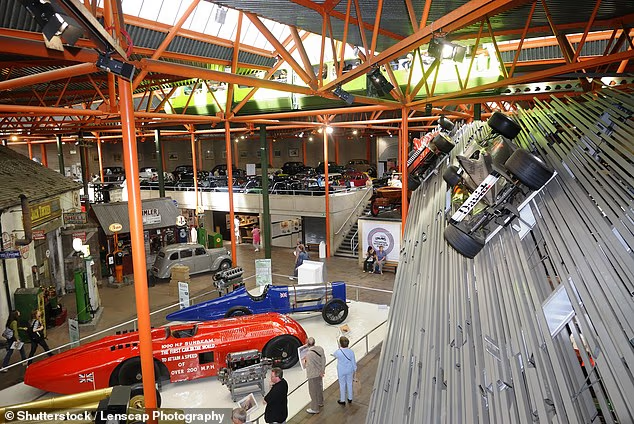
The National Motor Museum is set to leave its long-time home at Beaulieu after trustees announced plans to relocate the attraction and its collection of nearly 300 vehicles.
The National Motor Museum Trust (NMMT) said the museum, which is based within the grounds of the Beaulieu Estate in Hampshire, will not renew its lease when the current 60-year agreement expires in the coming years.
The museum attracts over 350,000 visitors every year.
Trustees have now launched the search for a new site capable of housing the museum’s growing collection.
The charity, which was founded in 1970 to manage the collection previously overseen by Beaulieu owner Lord Montagu, said the move forms part of a long-term strategy to secure its future.
In a statement, the Trust said: ‘This strategy is focused on reimagining and reinvigorating the Museum, engaging with new generations of motoring enthusiasts and diverse communities, while developing and preserving the Designated collection for generations to come.’
The National Motor Museum is set to leave its long-time home at Beaulieu after trustees announced plans to relocate the attraction and its collection of nearly 300 vehicles
The Trust and the Montagu family, who continue to own the Beaulieu estate, believe the current site can no longer meet the museum’s long-term needs, with the expanding collection requiring additional space.
The NMMT said it wants to broaden its learning and community engagement programmes, including creating a dedicated training centre for heritage engineering apprenticeships.
It added that a new home would help the museum ‘fulfil its national remit’ and ‘share the stories of motoring heritage more widely than ever before’.
The collection currently contains around 285 vehicles, ranging from big-screen favourites and TV stars to land speed record cars, Formula One machinery and some of the oldest surviving motorised carriages.
The museum also houses a number of vehicles made famous on BBC’s Top Gear during the programme’s peak years in the 2000s and 2010s.
Alongside the cars, it retains a vast archive of photographs, books and automobilia charting the history of Britain’s motor industry.
In total, the museum’s holdings comprise more than 1.9 million individual artefacts.
However, some of those items are owned by the Beaulieu estate and are expected to remain in Lord Montagu’s possession.

The National Motor Museum has been based within the grounds of the Beaulieu Estate in Hampshire for over half a century and welcomes some 350,000 visitors per year

The collection currently contains around 285 vehicles, ranging from big-screen favourites and TV stars to land speed record cars
Robert MacGregor, chair of the NMMT board of trustees, said: ‘We are sad that the National Motor Museum will be leaving Beaulieu but are, at the same time, very excited about this once-in-a-generation opportunity to transform the Museum for the future.
‘We want to thank the Montagu family for founding the Trust in 1970 and for their continued support as the Museum finds a new home and embarks on the next stage of its journey.
‘A new home can refresh our whole approach, enable us to make the collection more accessible, expand our educational and community impact, and ensure Britain’s motoring story remains relevant.’
Lord Montagu added: ‘My father’s underlying ambition was to record and celebrate the story of motoring for the benefit of the nation.
‘He founded the National Motor Museum Trust to do that, but its collections and activities have expanded beyond what anyone at the time envisaged.
‘The charity’s long-term aims will now stand the best chance of being achieved if it can be based in a new home.
‘I remain committed to honouring my father’s legacy by continuing to do all I can to support the trust.
‘Wherever the National Motor Museum and its collections may be located in the future, Beaulieu will continue to develop as a leading south coast attraction, offering a comparable range of experiences to those people enjoy today, with cars remaining very much a part of our identity.’
The Trust said it will now ‘begin exploring potential locations capable of supporting its long-term ambitions while safeguarding its internationally important collection and continuing public access’.
Visitors to Beaulieu are expected to see no changes while the search for a new home is carried out.
