


The AFL is under pressure to intervene after a transgender footballer was cleared to continue playing in a women’s competition despite rival clubs raising concerns about player safety.
Women’s Forum Australia has appealed directly to AFL chief executive Andrew Dillon, demanding a review of the decision allowing Freya Golding to play for Westminster Old Scholars in the Adelaide Footy League women’s competition.
Golding, who reportedly stands about 6ft 2in and weighs more than 90kg, previously played in the league’s men’s competition.
The AFL Gender Diversity Policy Committee recently ruled it was not satisfied Golding’s participation posed an unacceptable safety risk to other players.
But Women’s Forum Australia head of advocacy Stephanie Bastiaan has challenged the finding and called for an overhaul of the AFL’s community football policy.
‘What will it take for AFL to take a common-sense approach grounded in biological reality?’ Bastiaan wrote in an August 11 letter to Dillon.
‘More serious injuries? A player’s death?’
Bastiaan pointed to footage from a game earlier this year in which Golding laid a heavy bump on an opponent, leaving the player writhing in pain on the ground.
She said the incident prompted three clubs to raise duty-of-care concerns with the league and the AFL.
Bastiaan also claimed she had spoken to female community and state-level footballers who suffered serious injuries while competing against transgender players.
She said the cases included ‘one life-changing concussion that forced a Victorian university student to withdraw from her studies’ and another collision that resulted in a player requiring stomach surgery.
Bastiaan argued the AFL could exclude players from sporting competitions under Section 42 of the Sex Discrimination Act 1984 where strength, stamina or physique were relevant.
‘The AFL is not being asked to do something the law prohibits; it is being asked to use a protection provided under Australian law for the safety and fairness of women and girls in sport,’ she wrote.
She also questioned why different eligibility requirements apply at community and elite levels.
Transgender women seeking to compete in the AFLW and state leagues must meet testosterone requirements, while those in lower-level community competitions are generally permitted to compete in women’s leagues based on gender identity.
‘Girls playing school, community or state football deserve the same duty of care as those at elite level; their safety should not depend on which tier of the game they play in,’ Bastiaan wrote.
‘A policy that excludes females from having a category of their own is not inclusive of women, it excludes them.’
Women’s rights activist and Giggle for Girls founder Sall Grover also criticised the policy, arguing expectations around inclusion were being imposed on women’s football but not the men’s game.
‘The AFLW wants to appear inclusive, but the onus is only on women. The AFL men’s league is under no such pressure to be inclusive,’ Grover said.
Grover argued sporting categories should be based on biological sex rather than gender identity.
‘Sport is played by bodies not identities,’ she said.
‘We don’t separate sport based on Star Sign, veganism or any other identity. We separate sport by sex and age [and when appropriate, weight, as in boxing]). How a person identifies is irrelevant.’
She also claimed the concerns of female footballers opposed to transgender participation were being disregarded.
‘Women AFL players are saying no to men in their league. Why are they ignored but the man claiming to be a woman is listened to? That’s not inclusive or equality,’ she said.
‘This isn’t about inclusion, it’s about virtue signaling, at the expense of women’s safety, fairness, opportunities and rights.’
Golding has previously rejected claims she holds a significant physical advantage or dominates opponents.
‘I’m not the biggest and tallest player getting around,’ Golding said earlier this year.
‘And by no means am I a dominant player.
‘I’ve had some good moments, but it’s rare I get in the best players.
‘I just want to play the sport I love with a great group of people and I’ve been so lucky to do that this year.’
The AFL committee ultimately found there was insufficient evidence to prevent Golding from continuing to compete.
It said it was ‘not satisfied that the player’s participation in the Competition gives rise to unacceptable safety risks’.
‘Accordingly, the player is permitted to continue to participate in the competition,’ it said.
Adelaide Footy League chief executive John Kernahan has also strongly criticised the AFL’s handling of the case.
In an email to the committee, Kernahan called the result ‘entirely predictable’ and accused the AFL of ‘marking its own homework’ because it wrote the policy, appointed the committee and assessed the evidence.
‘Our concern was neither political nor ideological,’ Kernahan wrote.
‘It arose from administering this competition at the coalface, observing this player and forming the considered view that participant safety required us to act.
‘Your committee reached a different conclusion. That is your prerogative and it is now also your responsibility.’
The league must abide by the ruling despite maintaining concerns about Golding’s participation.
The committee left open the possibility of another assessment if new information emerged that could alter its findings.
The dispute comes amid a broader debate over transgender participation in community sport.
The Australian Sports Commission and Australian Human Rights Commission have produced guidelines aimed at encouraging inclusion and protecting participants from discrimination.
Several prominent athletes have also backed transgender participation in community sport.
Olympic silver medallist Madeleine Groves has previously argued transgender people should have the same opportunity to participate as other Australians.
‘Australia prides itself on being a country that gives people a fair go, we should never deny people opportunities because of their gender… Trans people deserve to play sport like anyone else,’ she said.
WNBL star Anneli Maley has also argued transgender athletes are not the biggest challenge facing women’s sport.
‘The primary challenge for women’s sport is not transgender women but rather a lack of general support from men and the wider community,’ she said.
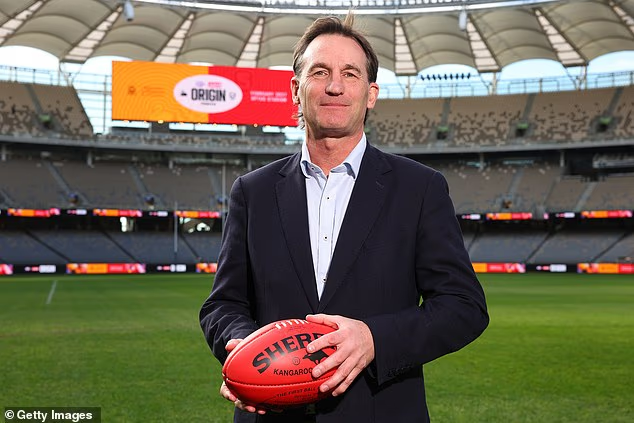
Women’s Forum Australia has now asked AFL chief Andrew Dillon (pictured) to urgently review the committee’s ruling on Golding

Adelaide Footy League boss John Kernahan (pictured) maintained Golding presented safety concerns and criticised the AFL committee’s review process

The transgender footballer, pictured in jersey 39, said she only wanted to continue playing the sport she loved alongside her Westminster teammates

The AFL reviewed Freya Golding’s (pictured) eligibility after three clubs raised concerns about safety in the women’s community competition

Sall Grover claimed inclusion pressures were being imposed on women’s football but not equally on the men’s competition

Golding was cleared to continue playing after the committee found she did not present an unacceptable safety risk
Daily Mail Australia has contacted the AFL for comment.
