


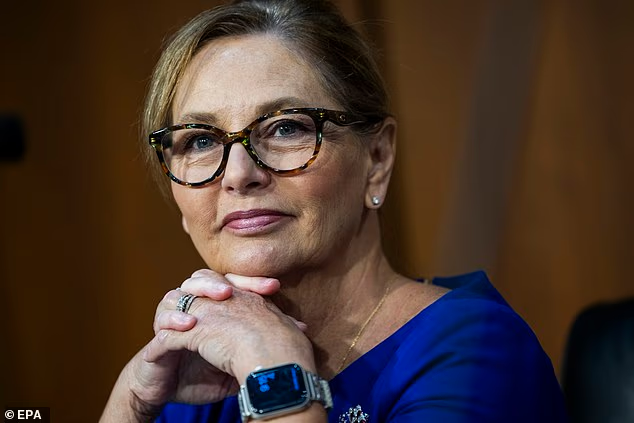
Lindsey Graham’s sister, Darline, has advanced in the runoff election to replace her late brother – one month after his sudden death.
Darline, 62, had been appointed to serve out the remainder of her late brother’s term by South Carolina Governor Henry McMaster following his unexpected passing on July 11.
She has since expressed her desire to run for a full term in November, and earned the backing of President Donald Trump.
But first she had to face a 10-person field in Tuesday’s primary, as the rare open Senate seat attracted a broad field, including some of the state’s top Republicans.
South Carolina voters had reliably returned Lindsey Graham to Washington for decades despite periodic primary challengers who accused the dealmaker and foreign policy hawk of being insufficiently conservative.
Tuesday’s contest featured one of Lindsey Graham´s earlier foes, as well as two US House members and Mark Sanford, the former governor and congressman eager for a political comeback in a field crowded with familiar faces.
One other Republican will advance to the August 25 runoff, and the winner will face Democrat Annie Andrews in the general election.
Lindsey Graham’s sister, Darline, has advanced in the runoff election to replace her late brother – one month after his sudden death

Darline, 62, was appointed to her brother’s seat following his shock death but confirmed Monday that she’s running for a full term in November, with Donald Trump’s blessing
The unexpected primary began even before funeral observances in Washington and South Carolina for Graham, who died at his Washington home after suffering a tear in his aorta, concluded.
State law prescribed a compressed timeline that forced candidates to navigate the decorum of mourning the senator’s death while jockeying to replace him.
Some voters have since said Lindsey’s reputation helped tilt them to support Darline Graham.
‘She’s not a politician, but she was kin to probably one of the greatest senators ever,’ Frank Bohn of Horry County said.
While Darline Graham couldn’t directly access the millions in Lindsey Graham’s campaign account, there was no limit to how much could be transferred to the National Republican Senatorial Committee, which funded advertising to support her.
A super PAC that once supported Lindsey Graham has also spent hundreds of thousands of dollars backing Darline Graham. Mailers tout her as ‘President Trump’s choice’ and ‘Prepared to Carry on Lindsey’s Legacy.’
More familiar to South Carolina voters in their own right were two U.S. House members in the race, one of whom already has a statewide profile.
Fresh off an unsuccessful primary run for governor, U.S. Rep. Ralph Norman entered the Senate contest and snapped up endorsements from the likes of Sens. Rick Scott of Florida and Mike Lee of Utah.
One of the most conservative House members, Norman is well-known across South Carolina as a fiscal conservative. At times, however, he has been at odds with Trump, backing former South Carolina Gov. Nikki Haley in the 2024 presidential primary.
Also running were Rep. Russell Fry, who appeared poised to gain Trump’s backing after Lindsey Graham’s death. Despite lacking the president’s endorsement, he announced his own candidacy and has been trying to boost his name recognition beyond his pro-Trump, Myrtle Beach-area district.
Voter George Mitford said Fry’s service stood out to him over Darline Graham, who hasn’t been in elected office.
‘I just thought he´d probably had more experience in this than she would have had,’ Mitford said, adding that he had supported Lindsey Graham´s Senate tenure.
The former South Carolina congressman and governor whose political ascendency was stalled by a 2009 extramarital affair made yet another attempt to return to public office.
Sanford´s Senate bid came just three months after he ended an effort to retake his former U.S. House seat, saying then he was quitting the race to establish a nonprofit to address the national debt, his signature issue.
Sanford had entered that contest on the last day of filing in a race already full of other Republicans. He’s been crisscrossing South Carolina, reintroducing himself to voters after more than a decade out of statewide office.
Mark Lynch, a Greenville businessman who tried to oust Graham in last month’s regular Republican primary, swiftly relaunched his campaign after Graham´s death. Lynch has campaigned as a Trump supporter, but in June, the president on social media called him a ‘lunatic’ and a ‘disaster for the Republican Party.’
Andrews, a Charleston physician, won her party´s June primary outright. Having set up her campaign based around challenging Graham, Andrews has been forced to pivot to a broader critique of the Republican contenders.
No Democrat has won a US Senate seat here in decades. And when Graham last ran in 2020, he defeated his Democratic opponent, Jaime Harrison, by a 10 percentage point margin.
