


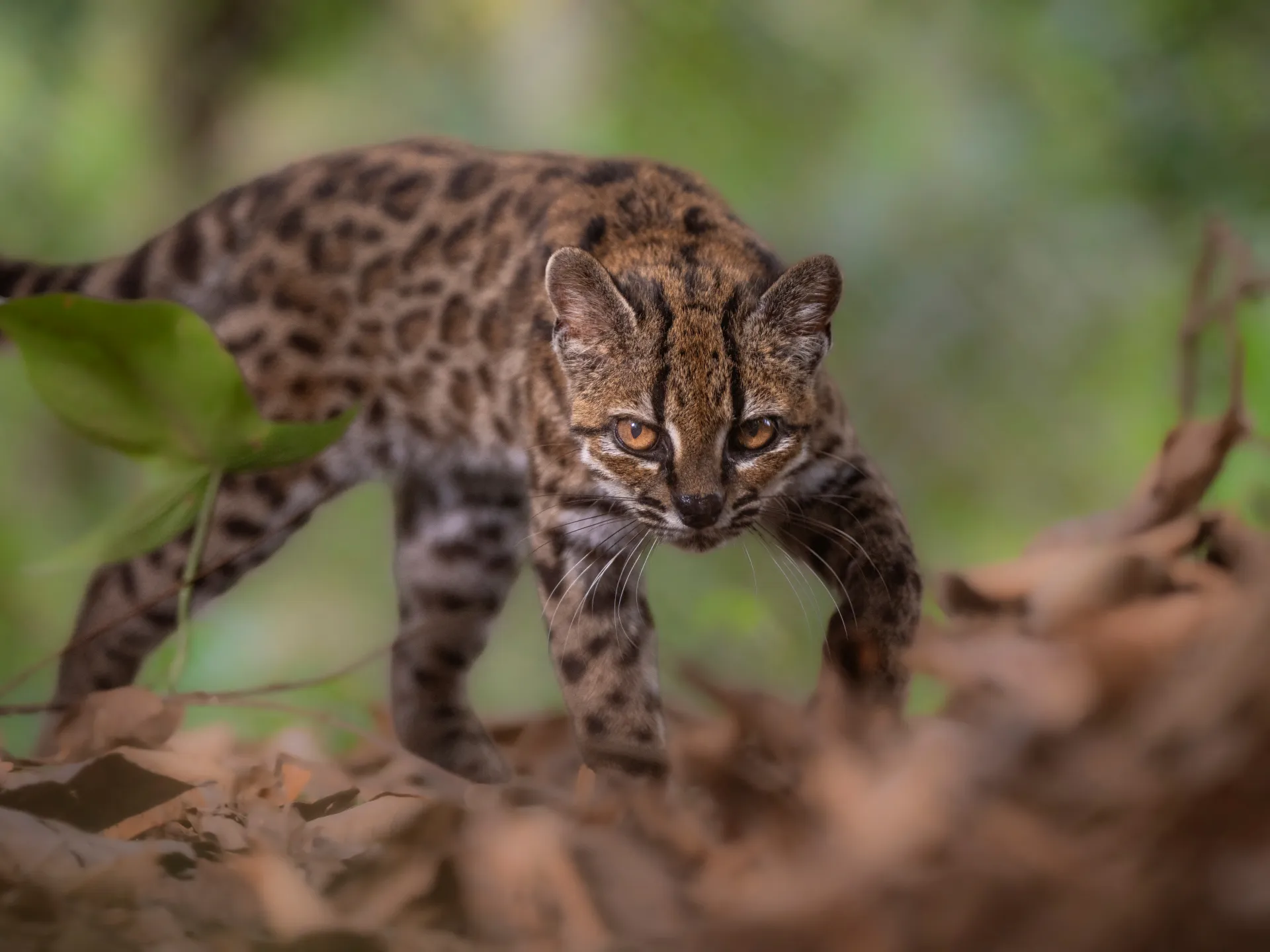
A new tiger cat species has been formally identified in Bolivia’s cloud forests, the first living feline species to be named and described in more than a century.
Named Leopardus tilcayo, the small cat was found in the Yungas, a mountainous region where forests are frequently cloaked in cloud and marked by high humidity. Local communities call it “tilcayo”.
The animal is part of the tiger cat group, which is found across much of South America. It measures about 46cm long and weighs roughly 1.4kg, making it smaller than an average domestic cat.
Its light-brown coat is marked with irregularly shaped rosettes, according to Paola Nogales-Ascarrunz, a National Geographic Explorer and an author of the study published in the journal Current Biology.
Scientists know little about the species’ behaviour or biology. Remains of small rodents found in scat suggest they may be among its prey, while camera-trap images indicate the cat could be more active at night.
DNA study reveals five tiger cat species
The Bolivian cat attracted researchers’ attention because its characteristics did not correspond with existing descriptions, most of which were based on cats from Brazil.
“This made us wonder, what tiger cat do we actually have in Bolivia?” Nogales-Ascarrunz said.
The research team analysed DNA from 38 cats sampled in several South American countries, including eight museum specimens. The results showed that tiger cats comprise five genetically distinct species.
Tiger cats are known as cryptic species because they can be difficult to distinguish from one another by appearance alone, said Jonas Lescroart, an evolutionary biologist at the University of Antwerp and co-lead author of the study.
“We never expected this Bolivian tiger cat to be a separate species, and no one had ever proposed it as a different animal, subspecies or otherwise,” Lescroart said.
Genetic analysis indicated that the lineage leading to Leopardus tilcayo separated from other tiger cats about 1.4 million years ago.
The researchers also identified a new tiger cat subspecies in Peru’s Yungas. They named it Leopardus tigrinus antisuyo, after Antisuyu, the region of the former Inca Empire that included the area where it lives.
