


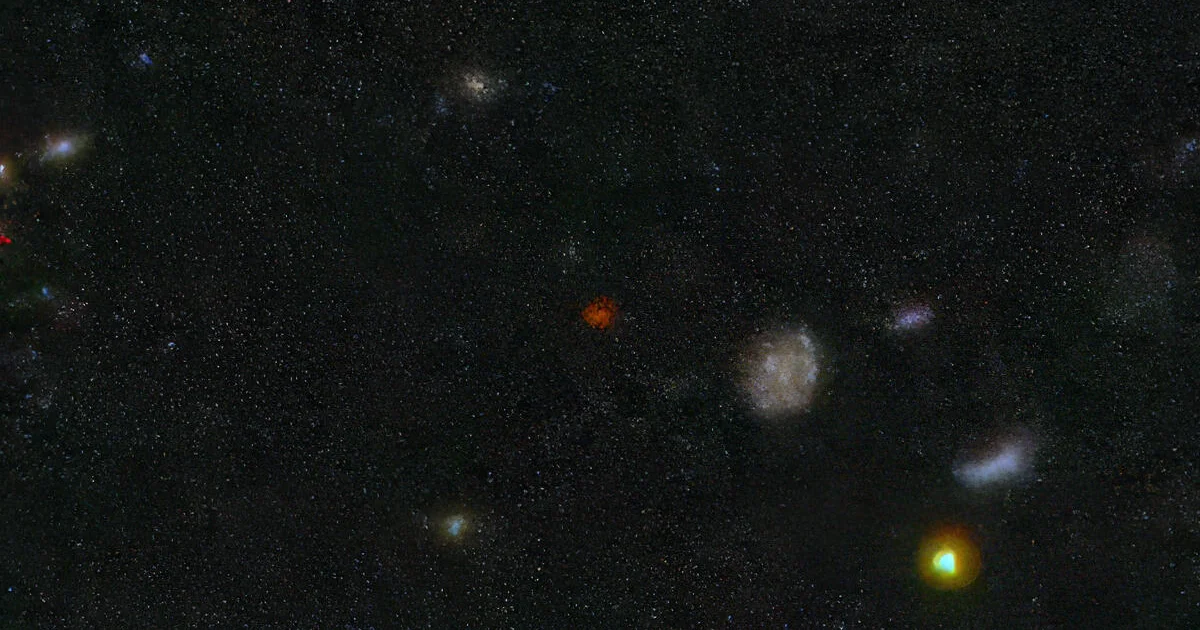
Scientists have identified the most distant quasar ever observed, dating from just 630 million years after the Big Bang, when the universe was less than 5% of its current age.
The object, found in observations from the European Space Agency’s Euclid telescope, is powered by a black hole with a mass equivalent to 360 million suns. It was discovered by a German-led team headed by Julien Wolf of the European Southern Observatory.
The quasar is being seen as it appeared 13.1 billion years ago. Its discovery extends the record by nearly 40 million years, a far greater leap than the previous two advances, which each reached back by about 15 million years or less.
“This time the leap in cosmic time is huge!” Wolf said. “The previous two records each took us back by about 15 million years or less. This one takes us back by nearly 40 million years, the biggest advance in nearly a decade!”
Euclid, launched in 2023, is surveying galaxies to help scientists study dark matter and dark energy. Wolf’s team found the quasar while examining millions of observations gathered by the telescope.
Finding a quasar from so early in the universe is unusual. The scale of its black hole makes the discovery more puzzling, particularly because it appears to have been consuming surrounding material relatively slowly despite its enormous size.
The researchers have named the quasar Dun Aonghasa, after the prehistoric stone fort on Ireland’s Aran Islands. Wolf said his Irish wife and daughter had visited the site with him, leaving him struck by its sense of “the promise of a vast horizon still to explore”.
Observations from the Hubble and Webb space telescopes, along with other observatories on and off Earth, supported the team’s findings. Webb enabled scientists to estimate the mass of the quasar’s central black hole at about 360 million times that of the Sun.
The results have been published in the journal Astronomy & Astrophysics. Wolf said Dun Aonghasa had created a new challenge for understanding the early universe: “About 630 million years after the Big Bang, its black hole had already grown to about 360 million times the mass of the sun. But how?”
The search for objects from the universe’s earliest period is continuing. Wolf said the record could be broken again within months or remain unbeaten for years.
