


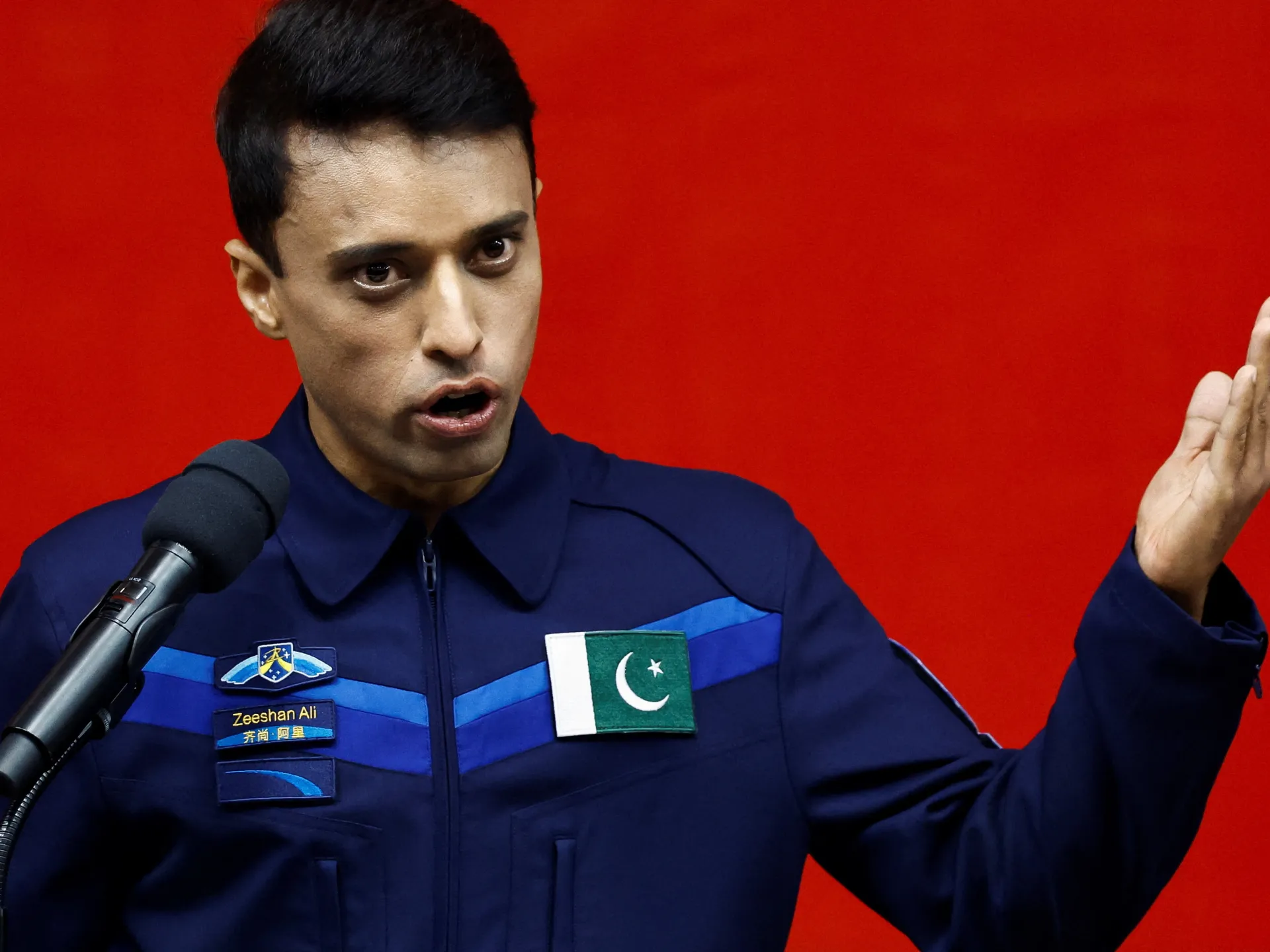
Pakistan is set to send its first astronaut into space on Wednesday, when air force pilot Muhammad Zeeshan Ali joins China’s Shenzhou-24 mission to the Tiangong space station.
Ali, 40, will serve as a payload specialist alongside mission commander Tang Hongbo and flight engineer Wu Yi. The spacecraft is due to lift off from the Jiuquan Satellite Launch Centre in north-west China at 8.18am Beijing time, or 5.18am in Pakistan.
The launch will mark the first joint flight involving Chinese and foreign astronauts in China’s crewed space programme, according to Zhang Jingbo, a spokesman for the China Manned Space Agency (CMSA).
After reaching orbit, Shenzhou-24 is expected to complete an autonomous rendezvous lasting about three and a half hours before docking with the forward port of the Tianhe core module.
Ali’s mission will be short. He is due to return to Earth aboard the Shenzhou-23 spacecraft after a brief period of joint operations, while Zhu Yangzhu, a member of that crew, remains aboard the station for a year. Pakistan’s Space and Upper Atmosphere Research Commission (SUPARCO) has said Ali will spend about a week in orbit.
Speaking to reporters before the launch, Ali said he regarded the mission as a national responsibility.
“I want to assure you that I am not flying for myself. I carry the name of Pakistan on my shoulder, the hopes of 250 million Pakistanis,” he said.
Pakistan’s first astronaut prepares for mission
Ali and fellow Pakistan Air Force pilot Khurram Daud were chosen through a three-stage selection process involving medical, psychological and technical assessments. The pair were named reserve astronauts by the CMSA in April and began training at the Astronaut Centre of China in Beijing days later.
Daud was not selected for the Shenzhou-24 crew, and it has not been confirmed whether he will take part in a later mission. SUPARCO said reserve astronauts would act as experts and help to develop Pakistan’s space programme.
Pakistan’s Planning Minister Ahsan Iqbal, who is in China for the launch, said both men had performed strongly during their preparation.
“They trained in centrifuges and simulators, in emergency drills and in a new language. Both performed exceptionally well in training. Though Zeeshan Ali will fly tomorrow both have already made Pakistan proud,” he wrote.
Ali said the training had included centrifuge exercises, rescue and survival procedures and emergency drills. Learning the technical language required for the mission had been particularly demanding, he added.
“The real challenge, honestly speaking, was mastering the Chinese language, because all the switches, all the software, all the programmes, all the voice announcements, everything is in Chinese,” he said in a promotional video released by the Chinese space agency.
He thanked his instructors, SUPARCO and the CMSA, saying: “No matter who flies, we have already made history together.”
Experiments on Tiangong space station
Ali will take part in the station crew’s routine work but will focus mainly on China-Pakistan scientific projects, including installing samples and equipment and conducting tests in orbit.
The mission will include four joint projects covering biotechnology and materials. Ali will also conduct an experiment involving cyanobacteria, photosynthetic microorganisms.
Pakistan’s Information Ministry has said the research will also involve materials science, fluid physics and life sciences, with possible applications in climate resilience, food security and industrial innovation.
SUPARCO said the experiments had been proposed by research institutes and universities in Pakistan. The station would provide a fully equipped laboratory, allowing Ali to begin installing the projects and collect data showing whether the equipment had survived the stresses of launch and been safely installed in microgravity.
The commission said completing the four experiments would take between six and 12 months, meaning much of the work would continue after Ali’s return.
A new stage in China-Pakistan space co-operation
The mission follows an astronaut agreement signed by SUPARCO and the CMSA in Islamabad in February last year. It also comes as Pakistan and China mark 75 years of diplomatic ties.
Zhang described Pakistan as China’s “all-weather strategic cooperative partner” and said the flight represented another milestone in their relationship.
China developed its own space station after being excluded from the International Space Station. Pakistan has not sent an astronaut to the ISS, and the Tiangong mission gives it an opportunity to take part in human spaceflight through its partnership with Beijing.
Ali said the mission should be viewed as the beginning of a broader programme rather than an isolated flight.
“This mission is not a finish line; it is a launchpad. And I hope the next chapter of China-Pakistan space cooperation to grow from one astronaut, one flight, to multiple joint flights, to Moon, Mars, and beyond,” he said.
Pakistan is already working with China on a lunar mission tentatively planned for 2028. Its previous lunar involvement has focused on robotic exploration, including the iCube-Qamar satellite, which entered lunar orbit aboard China’s Chang’e-6 mission in 2024.
SUPARCO has also developed a rover expected to fly on the Chang’e-8 mission, planned for about 2028. China has said it aims to send astronauts to the Moon by 2030.
