


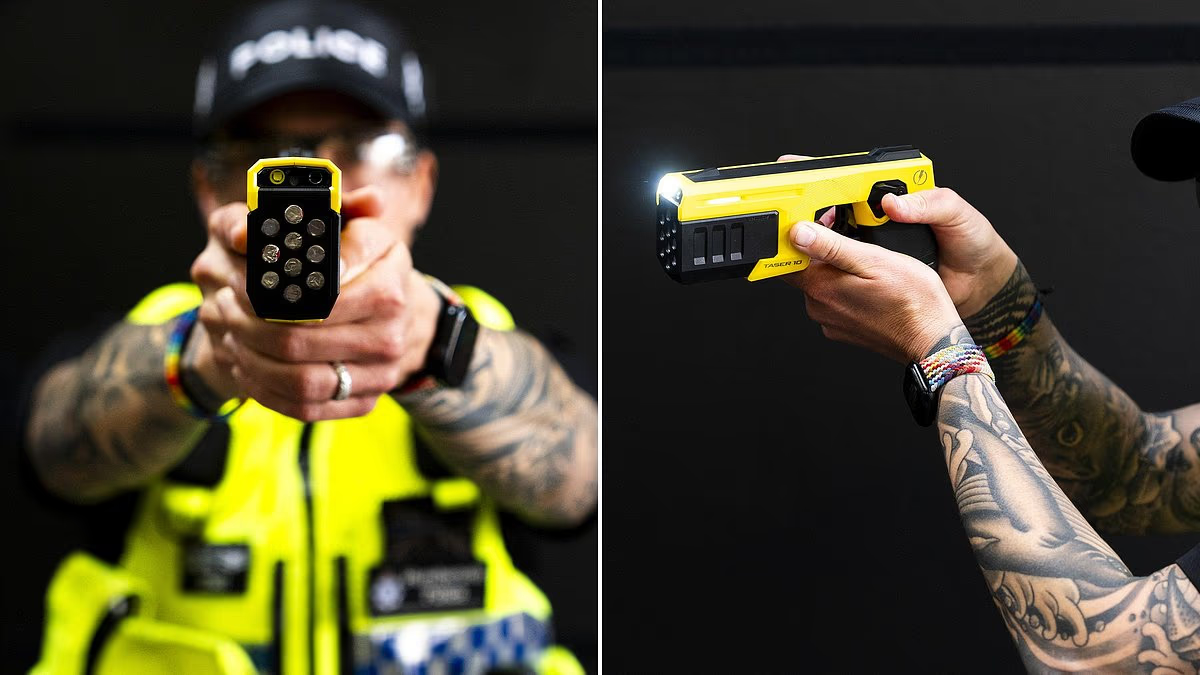
Police officers in Scotland are set to be armed with a new type of ‘super Taser’ –despite official warnings they pose an increased risk of serious injury.
Although Tasers have been in use for more than 20 years, The Scottish Mail on Sunday can disclose that Police Scotland is planning to switch to an upgraded and more powerful version of the weapon.
The newly developed Taser 10 can fire up to ten electrical ‘darts’ without needing to be reloaded. It also has double the range of previous models – allowing officers to shoot a suspect from a distance of 45 feet.
With violent crime on the rise and growing numbers of attacks on officers, police believe the weapon will help protect staff and improve public safety.
Documents state: ‘Police Scotland will commence the use of the new Home Office-approved Taser device, the Taser 10, in 2028.’
A Taser is a hand-held electroshock weapon that delivers a high-voltage electrical pulse to temporarily immobilise a suspect.
The Taser 10, costing around £1,000, is manufactured by US firm Axon Enterprise and features a green daylight laser that helps aim the weapon.
The pistol-like device fires a sharp-pointed barb into the suspect at 140mph. Connected to the weapon by a wire, the first shot doesn’t have any electrical charge.
A police officer demonstrates the ‘Taser 10’ which is due to be used in Scotland

The ‘Taser 10’ can fire at longer distances and fire up to ten single probes at a time
However, pulling the trigger a second time fires another barb which completes the electrical circuit and sends a 1,000-volt shock through the target’s neuromuscular system to incapacitate them. The current model used by Police Scotland is the Taser X2 which can only fire two darts, at a far slower speed, and has a range of 25ft.
The Taser 10 has recently been approved by the Home Office, and is being introduced by several English forces – despite concerns by a government agency that the weapon raises the risk of injury.
Earlier this year, the Scientific Advisory Committee on the Medical Implications of Less-Lethal Weapons concluded: ‘The kinetic energy and momentum of the Taser 10 probes are higher than with previous devices.
‘This is likely to raise the severity of skin wounds produced by probes and the dart of the probe has the potential to produce deeper penetrating injuries.’
The committee explained that the skull, lung cavity, abdominal organs and major blood vessels in the groin, neck and armpits ‘may be at increased risk of injury from the probes and this may lead to an increased incidence of potentially life-threatening injuries’.
The experts warned children, in particular, were at risk of suffering puncture wounds, being knocked over by the force of the barb and – because they are shorter – of being hit in the face or head.
Amnesty International UK has condemned the use of the Taser 10, saying that giving police a ‘ten-shot super Taser’ without first strengthening the rules on how officers use the weapons raises ‘fundamental safety concerns’.
Meanwhile, frontline officers want a greater roll-out of Tasers, with the Scottish Police Federation calling for the number of officers issued with the weapons to be increased from the current total of around 2,000 to 6,500.
Police Scotland declined to discuss the Taser 10, only adding that ‘planning is ongoing.’
