


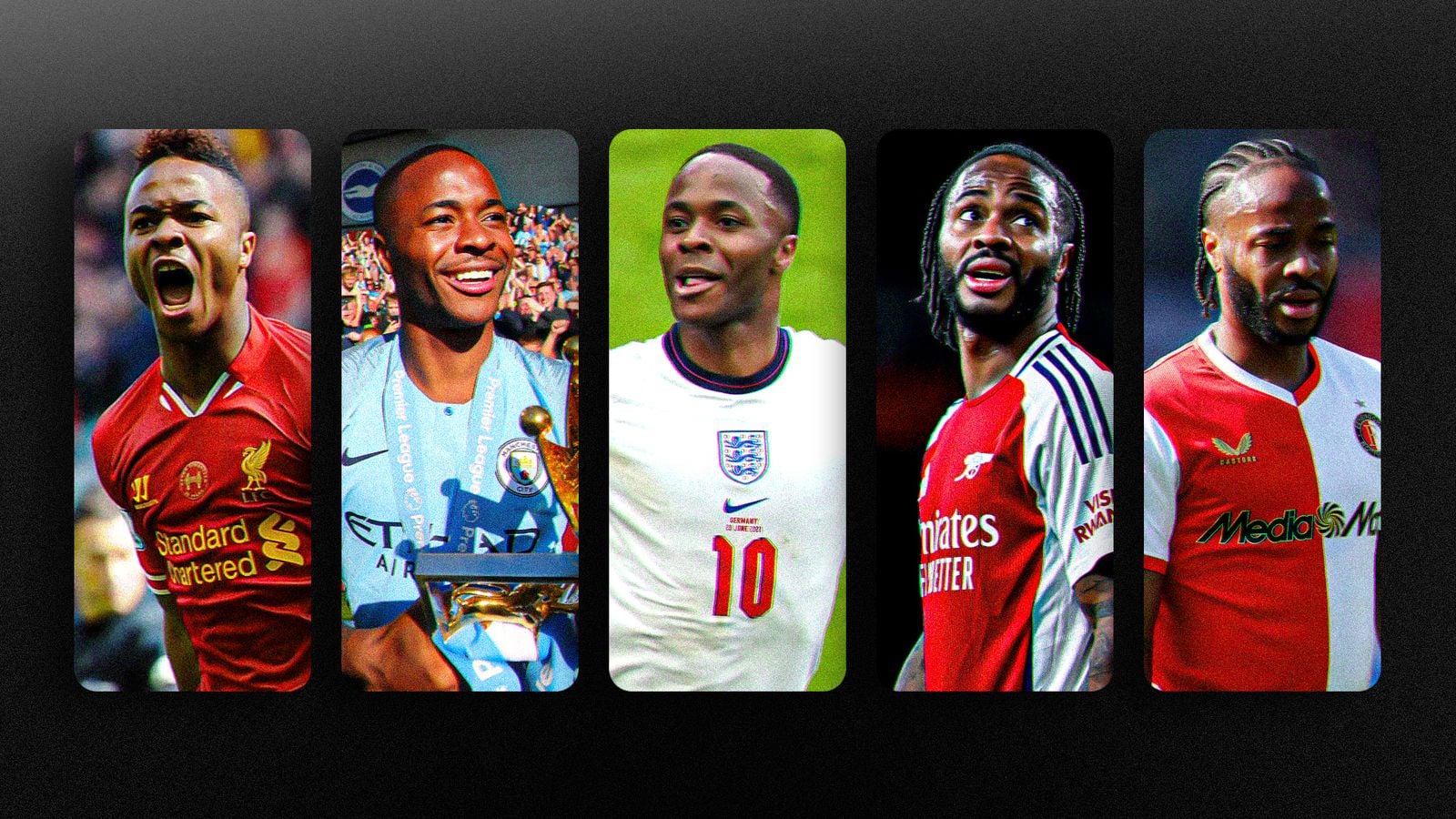
Raheem Sterling’s career has reached a troubled crossroads after the former England and Manchester City forward received a suspended sentence for dangerous driving and possession of nitrous oxide. At 31, the player who once appeared destined to remain at the summit of the game is facing renewed questions over whether there is a route back.
Sterling’s fall has been gradual rather than sudden. His recent years have been marked by unsuccessful comebacks, diminishing performances and controversy, a stark contrast to the influence he wielded during Manchester City’s most successful period.
He emerged as a teenager at Liverpool, making his debut at 17 before winning his first England cap shortly before his 18th birthday. By his peak, Sterling was being compared with Lionel Messi and Cristiano Ronaldo, while Barcelona great Xavi described him as a player capable of “winning the race” to become the world’s next best thing.
That potential was realised in large part at Manchester City. Sterling won four Premier League titles, scored twice in the FA Cup final during the club’s domestic treble-winning season and produced double figures in every campaign with the club.
“One reason why we are here is Raheem,” Pep Guardiola said during Sterling’s City years. His dribbling and movement became central to the club’s attacking identity, with City reporter Ben Ransom recalling that his play “electrified the Etihad”.
Sterling also became one of England’s most important players. He was a decisive figure during the run to the Euro 2020 final and, after enduring a 27-match international goal drought and a torrent of online abuse, including racially motivated abuse, re-established himself with a memorable display in the 3-2 victory over Spain in October 2018.
His career was never free from scrutiny. An acrimonious departure from Liverpool in 2015 prompted Sterling to reject the description of him as a “money-grabbing 20-year-old”, while earlier setbacks with England included a dispute with Roy Hodgson over claims that he was “too tired” to play and criticism following Euro 2016.
Raheem Sterling’s difficult return to prominence
By the end of his time at City, Sterling had lost his regular starting place and believed he needed a fresh challenge. His move to Chelsea in 2022, backed by then-England manager Thomas Tuchel, was intended to prevent his career from going into decline.
“I felt my game time at Man City was getting limited for different reasons and I couldn’t afford to waste more time,” Sterling said in August 2022. “When I look back in the future, I never wanted to see a rise then a decline.”
Instead, Chelsea’s upheaval following the Clearlake-Todd Boehly takeover coincided with a downturn in Sterling’s form. His output had already begun to slow, and his time at the club became increasingly difficult before he was eventually pushed towards the margins.
The physical demands of his style may also have played a part. Sterling had made 500 career appearances by the age of 26 but has played only 157 times since, with the repeated strain of so many matches taking its toll on a forward whose game relied heavily on pace and explosive movement.
A loan spell at Arsenal offered the prospect of a revival but produced only one goal, in a Carabao Cup tie against Bolton. His subsequent period at Feyenoord was also described as unsuccessful, leaving that strike as what appears to be his final career goal.
There were also reports that Sterling’s conduct at Chelsea was not always exemplary. He was frustrated after being made to train alone, and the criticism suggested that he no longer maintained the standards expected of a player operating at the highest level. Chelsea’s treatment of him has also been questioned.
His appearance before Basingstoke magistrates’ court has added another difficult chapter. It would be wrong, however, to allow the latest episode to erase the scale of his achievements or his influence beyond the pitch.
Sterling used his prominence to challenge stereotypes surrounding Black athletes and publicly confronted what he saw as hypocrisy in the media. He was awarded an MBE in 2021, and Ransom said he “arguably made an even bigger impact off the pitch” than he did on it.
His recent conduct should not be excused, but neither should a career that brought Premier League titles, major England performances and a lasting social impact be reduced solely to its troubled ending.
