


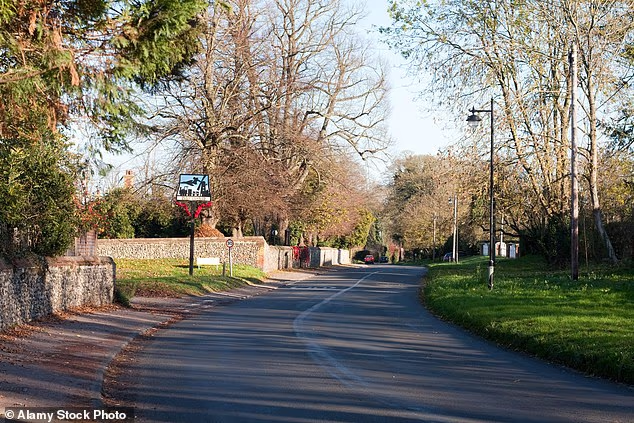
Residents of Barnham in Suffolk are preparing to send a delegation to Piddington in Oxfordshire to explore holding their own independence referendum over plans to accommodate 1,250 asylum seekers at nearby RAF Barnham.
The proposed poll would have no legal force, but villagers believe it could draw attention to concerns that the scheme would more than double the population of the community.
Piddington held a similar vote last week in response to plans to house migrants at MoD Bicester. Around 90 per cent of those who took part voted in favour of seceding from the United Kingdom.
John Bauer, chairman of Barnham Parish Council, is among those due to travel to Piddington on Tuesday. He has already been in contact with the Oxfordshire village’s parish council chairman.
Mr Bauer said the lack of interest shown by the Government in local concerns meant publicity could be an important way of defending Barnham’s way of life.
“They don’t care about the people of Barnham. They don’t care that it will increase by two-and-a-half times the population of a village, with single men mostly of fighting age not contained within the site,” he said.
Barnham has about 580 residents, as well as a primary school, church and village hall. It does not have a shop or pub, while residents have been told that asylum seekers housed at the former military site would be able to come and go as they pleased.
“There’s a number of children of varying ages. People are worried about that and the womenfolk as well,” Mr Bauer said.
He said Piddington had succeeded in attracting national and international attention, adding that he would not be surprised if 90 per cent of Barnham residents also voted to secede from the UK.
Concerns over RAF Barnham plans
Protests have been held outside RAF Barnham since plans for the site, MoD Bicester and a third facility at Linton-on-Ouse in North Yorkshire were announced in June.
Tensions were heightened after details of a private meeting involving Home Office officials and councillors in neighbouring Norfolk were leaked. The department was reported to have acknowledged that the facilities could house “a lot more” migrants than previously stated.
Violent disorder also broke out over several nights last month in Thetford, about two miles from Barnham, after the Home Office was reported to be considering quadrupling the number of asylum seekers placed in private accommodation.
Barnham residents met at the village hall last Wednesday, the day after Piddington’s referendum, to discuss how to oppose the plans. Their campaign has so far concentrated on planning and environmental concerns.
The RAF Barnham site was once used to store nuclear and chemical weapons, prompting concerns over possible contamination. It is also a nesting ground for stone curlews, an endangered bird whose presence means development within 1,500 metres is prohibited.
The Home Office is expected to announce its decision this autumn, with asylum seekers potentially moving into the site before Christmas. Some residents believe a referendum could provide a final, high-profile demonstration of opposition.
Collette Skelly, 58, who has lived in Barnham for 15 years, said: “It’s a good way of raising publicity. At the moment, there is nothing on the news about Barnham. So Piddington had to do it as a publicity stunt to raise attention.”
Another resident, a man in his 60s, said he would support the idea because the Piddington vote had prompted questions to the Prime Minister.
Adrian Whittle, the Reform UK leader on West Suffolk Council, said he supported Barnham’s right to hold a referendum. He said it would show that residents had not “just given up” and wanted “their country back” and “their lives back”.
Not everyone in the village is convinced. James Hollins said a referendum would have no legal standing and could distract from the formal planning process.
“The referendum is rubbish, it can’t go anywhere, it’s got no legal standing,” he said. “We can demonstrate but they’re not going to listen.”
Barnham was recorded in the Domesday Book of 1086 and last year was identified as the location where evidence of the earliest known human-made fire was found. Researchers uncovered baked earth and a flint believed to have been used with pyrite to create a spark, dating back 400,000 years.
