


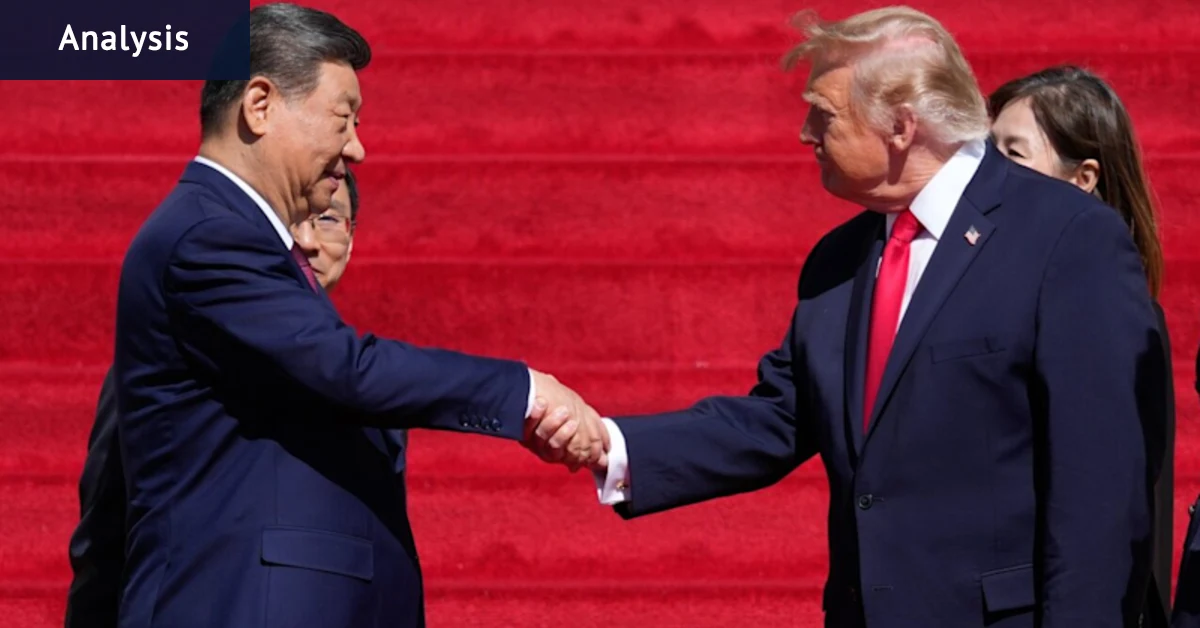
Donald Trump and Xi Jinping used their Washington summit to project sharply different visions of the US-China relationship, with the American president emphasising personal rapport and ceremony while his Chinese counterpart focused on national power and geopolitical status.
The meeting produced limited immediate results, including a two-month extension to the trade truce agreed last year in Busan and a renewed dialogue on artificial intelligence. Further announcements were promised, but there was no clear outcome on AI regulation and the White House had not issued an official readout.
Trump also suggested there would be positive news for American farmers, although he has made similar claims previously. He continued to promote his preferred term “super intelligence” for artificial intelligence.
The summit was widely expected to be stronger on symbolism than substance. Evan Feigenbaum, vice-president of studies at the Carnegie Endowment for International Peace, described it as “long on performance, short on substance”.
However, he said that did not rule out future progress, noting that the leaders are due to meet twice more this year – at the APEC summit in Shenzhen in November and at the G20 in Miami before Christmas.
Trump’s approach was centred on hospitality and personal diplomacy. He praised Xi and his wife, Peng Liyuan, with a series of superlatives, highlighted the White House’s facilities and showed off the new helipad, including its granite finish.
He also presented the Chinese couple with a bald eagle statue, a gift he has given to others during his current term.
The contrasting messages from Trump and Xi
Xi was also complimentary, but used his public appearances to reinforce Beijing’s preferred description of the relationship as one of “strategic stability”. During a tea ceremony in the White House’s Red Room, he spoke of “two people charting the course for the great ship of China-US relations”.
He repeatedly described the United States and China as “major countries” with a special responsibility to manage not only their bilateral relationship but the direction of the wider world. The language implicitly placed Beijing and Washington on an equal footing.
Ryan Hass, a China scholar at the Brookings Institution, said the difference between the two leaders was “pretty striking”. For Trump, he wrote, “the pageantry appears to be the point”, with the focus on creating a personal bond with Xi and signalling that rivalry could be controlled.
Xi, by contrast, spoke mainly about “state-state relations and national power”, Hass said, adding that he “seemed bemused by Trump’s entertaining approach to hospitality”.
Zhao Minghao, a professor of Sino-US relations at Shanghai’s Fudan University, said Beijing would regard the summit as a success because it presented Xi as Trump’s equal. China would, however, have preferred the trade truce to be extended for six months or a year.
“If US–China summit meetings can help preserve channels and avoid a new shock, it is of great worth,” Zhao said. “Beijing measures success by process, symmetry and de-escalation, not by comprehensive agreements that were never expected.”
He said China did not believe its rivalry with the United States was over, with technology restrictions, Taiwan and military mistrust still unresolved. But Beijing believed the psychological balance had shifted and that it could afford to manage the truce gradually.
Feigenbaum said China understood that Trump could “say almost anything” and that his actions would not necessarily bind the next US president. Beijing’s aim, he argued, was to contain the most damaging consequences of the relationship while pursuing opportunities elsewhere.
The summit’s carefully staged images were particularly important for China, according to Dylan Loh, an expert on Chinese foreign policy at Nanyang Technological University in Singapore. They allowed Beijing to show domestic and international audiences that China was a peer of the United States and was receiving the respect it believed it had historically been denied.
Yet much of the ceremony was not broadcast to American audiences. Fox News, ABC, CBS, NBC and CNN did not participate in the pool responsible for filming presidential events and distributing footage, after Trump had barred CNN from the White House and the pool.
The ban was lifted on Friday and the networks resumed participation, but the dispute reduced coverage of an event designed around its visual presentation. China’s People’s Daily, meanwhile, devoted its front page to six photographs of Xi’s visit, including his arrival, the White House welcome and his meeting with Trump in the Oval Office.
