


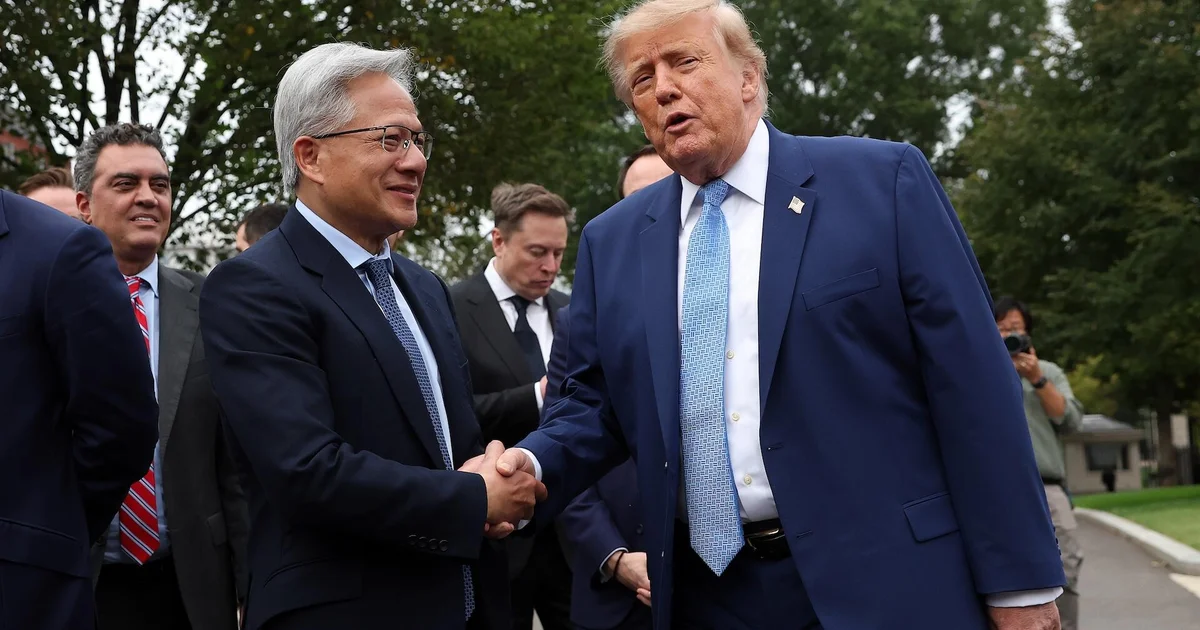
Donald Trump’s Nvidia stake rose in value by as much as $14.8 million after he intervened to persuade the chipmaker’s board to reinstate chief executive Jensen Huang, financial disclosures show.
Nvidia shares surged by more than 30% on Monday when Mr Huang returned to the company, reversing a weeks-long decline. The stock later gave up some of those gains as its price fell on Tuesday.
Mr Trump held between $13 million and $58 million in Nvidia shares across his investment accounts at the end of 2025, according to filings with the Office of Government Ethics. He bought or sold the company’s stock in more than 100 transactions worth between $27 million and almost $98 million between January 2025 and September 2026.
The precise size of his current holding is unclear, meaning the increase in the value of his shares can only be estimated. Based on his reported purchases and sales, Monday’s rise was worth between $1.3 million and $14.8 million to the president.
Mr Huang’s departure two weeks earlier followed reports of an alleged affair with a suspected Chinese spy who ran a company accused of diverting Nvidia chips to China, as well as another alleged affair with a subordinate. The claims have not been established.
Mr Trump said he had personally spoken to Nvidia’s board and “convinced them” to rehire Mr Huang, offering an “assurance” that there was no national security threat.
A White House spokesman said the president’s stock and bond portfolio was managed independently by third-party financial institutions, with investments designed to mirror indexes such as the Schwab 1000.
“Neither President Trump nor any member of his family has any ability to direct, influence, or provide input regarding how the portfolio is invested or when investments are bought or sold,” the spokesman said. “All investment decisions are made entirely by independent managers.”
Questions over Trump’s Nvidia shares
Ethics experts questioned whether Mr Trump’s continued ownership of Nvidia shares created a conflict of interest, particularly after his intervention benefited the company’s market value.
“This goes beyond a conflict of interest,” said Kathleen Clark, a government ethics expert at Washington University in St Louis. “He is squarely, explicitly using his power as president to benefit himself financially. He has prioritized his finances over the security of the nation.”
Donald Sherman, president of the government watchdog Citizens for Responsibility and Ethics in Washington, said the president’s “continued ownership of stock in this company is the clearest example of how the president’s personal financial interest makes everything he does suspect”.
Mr Trump has defended his decision, saying “we have to protect our geniuses” and arguing that Nvidia, the world’s leading designer of advanced chips, was important to maintaining America’s lead over China in artificial intelligence technology.
He has also frequently pointed to the performance of the stock market as evidence of his success in office. After Mr Huang’s reinstatement, Mr Trump said the market’s “response” had been “very positive” and that it “really shows the decision was right”.
Richard Painter, a former White House chief ethics attorney, said federal conflict-of-interest laws did not apply to the president, vice-president or members of Congress. He called the intervention with Nvidia’s board “a huge conflict of interest” and said: “It’s not the job of the government to call up and say who the CEO of a company should be.”
Mr Painter said legal changes were needed to prevent senior elected officials from trading individual stocks while in office. Officials are generally permitted to buy and sell such investments, although lawmakers from both parties have called for the practice to be banned.
Several Trump appointees have also reported Nvidia holdings, although many have since sold them. Homeland Security Secretary Markwayne Mullin disclosed between $250,000 and $500,000 in Nvidia stock in March 2026 before selling between $500,000 and $1 million in shares in June.
Other officials with reported holdings included Charles Kushner, the US ambassador to France, who disclosed between $1.5 million and $6 million in Nvidia shares, and Warren Stephens, the US ambassador to the United Kingdom, who reported between $750,000 and $1.5 million before selling them in 2025.
Erin Browne, the Treasury under-secretary for international affairs, sold Nvidia shares worth between $250,000 and $500,000 before her confirmation. Todd Newnam, the IRS chief financial officer, reported holdings of between $115,000 and $250,000.
An IRS spokesman said officials who file disclosures with the Office of Government Ethics were required to declare equity positions and were advised of their obligations to recuse themselves under ethics rules.
Vice-President JD Vance also reported between $1 million and $5 million in a fund tracking the S&P 500, of which Nvidia is one of the largest components, providing indirect exposure to the company’s share price.
