


Ukraine has pushed Russian forces back in the eastern Donetsk region, reclaiming territory around Lyman as Moscow’s troops struggle to advance towards the key cities of Sloviansk and Kramatorsk.
The Ukrainian counteroffensive, known as Operation Vivaldi, has recovered 175 square kilometres of previously occupied land around Lyman this year, according to Ukrainian authorities. President Volodymyr Zelenskyy has described the operation as successful but incomplete.
Even the Kremlin-aligned military channel Rybar acknowledged that Russian forces were losing villages south of Lyman, where Moscow had hoped to establish a platform for a wider assault on the so-called fortress belt.
“The enemy is using successes in the Lyman direction to develop attacks [east of Sloviansk], where Russian troops are forced to defend previously occupied positions and expend resources on restoring control, instead of launching their own offensive,” Rybar said.
It added that the prospect of an assault on Sloviansk’s urban area was “receding into the more distant future”.
A major battle appears to be developing around Kryva Luka, a village east of Sloviansk on high ground on the Russian-held side of the Siversky-Donets River. Its position could allow Ukrainian forces to launch further counterattacks to the east.
Russian military sources have admitted that Ukrainian troops recaptured settlements west of Kryva Luka before reaching the village. Rybar blamed premature Russian announcements of territorial gains for helping Ukraine prepare its response.
“Some villages were declared liberated even before Russian units arrived, which allowed the enemy to accumulate forces there and launch counterattacks,” the channel said.
Ukraine’s gains come as casualties rise
Ukraine’s Defence Ministry said it had intensified efforts to disrupt Russian supplies of ammunition and fuel, striking a record number of air-defence assets and targets more than 50 kilometres from the front in September.
Russia has offered a sharply different account of the battlefield. President Vladimir Putin claimed that Russian forces captured 1,300 square kilometres of Ukrainian territory during September.
The Institute for the Study of War, which tracks territorial changes using geolocated open-source material, said Russia had instead lost 80 square kilometres during the month.
Ukraine’s military said Russian casualties reached a 2026 high of 46,230 in September, including 33,087 people it said had been killed. The figures have not been independently verified.
Robert Brovdi, commander of Ukraine’s Unmanned Systems Forces, said Russian casualties were 40 per cent higher during the first five days of October than in the same period of September.
Ukraine’s military put Russia’s total dead and wounded since the beginning of the full-scale invasion in 2022 at 1,545,950 as of October 7.
Russian strikes intensify
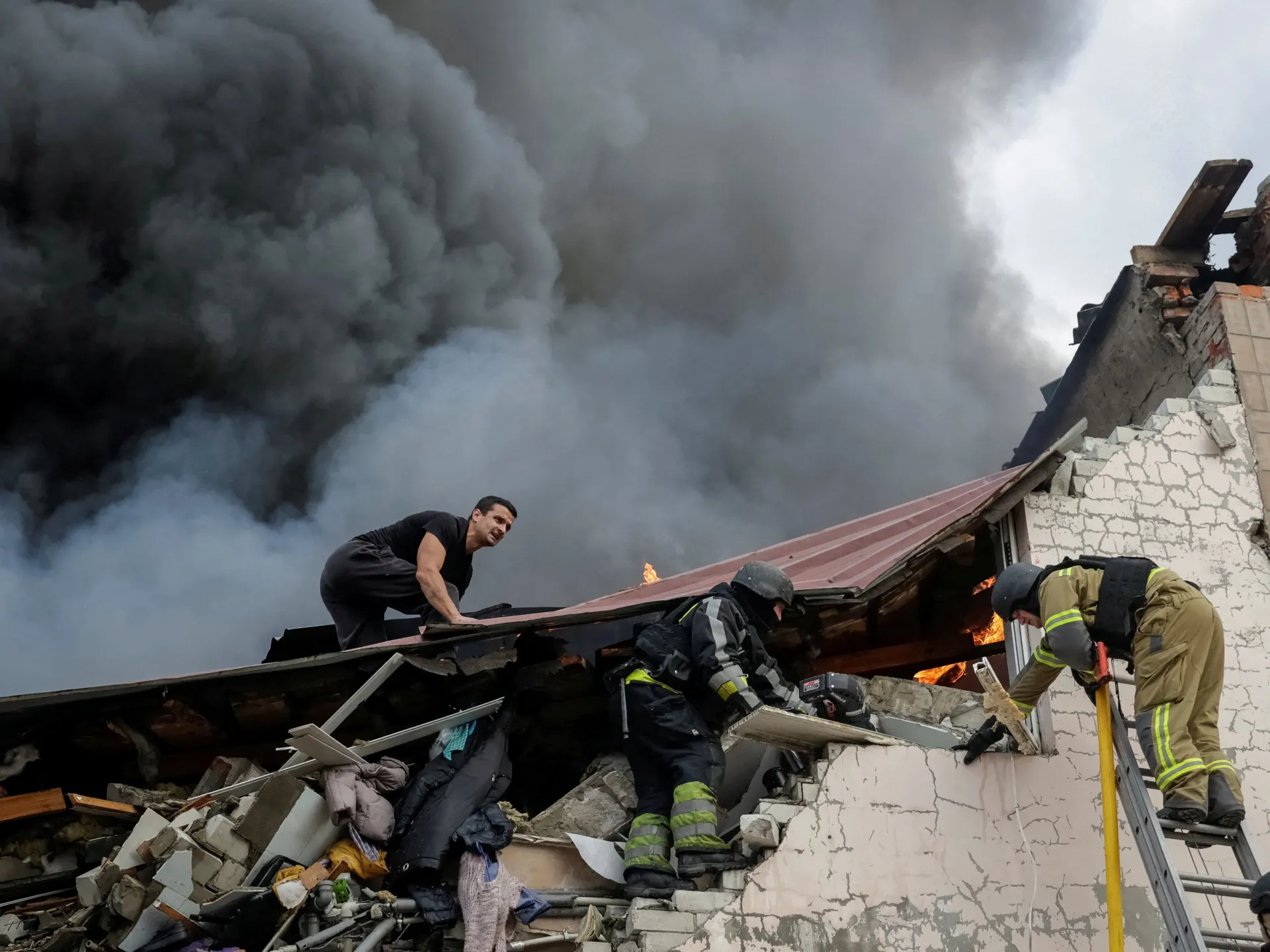
As its forces come under pressure in Donetsk, Russia has intensified aerial attacks on Ukrainian cities, causing mounting civilian casualties.
Twenty-two people, including five children, were killed on October 7 when a Russian cruise missile destroyed a five-storey apartment block in Pryluky, in the northern Chernihiv region.
Ukraine’s Air Force said Russia launched 130 drones and 48 cruise missiles against 12 regions that day, along with ballistic missiles. Two people were also killed in Kyiv and two in Oleksandria.
At least 30 people died in Kramatorsk on October 8 when a Russian bomb struck two city buses, according to the Ukrainian authorities.
Ukraine’s military intelligence said Russia’s increasingly used Geran-4 and Geran-5 jet-powered drones were equipped with satellite and inertial navigation systems, as well as cameras able to identify landmarks. It said the systems enabled accurate navigation, a claim that raises questions over attacks on non-military targets.
Zelenskyy said F-16 aircraft supplied by Ukraine’s allies were destroying between 50 and 60 per cent of drone attacks. Ukraine is also testing five types of interceptor drone and deploying artificial-intelligence-controlled heavy machine-gun turrets to protect sites including bridges, factories and power substations.
Ukraine has continued striking targets inside Russia, including oil facilities in Volgograd and Bashkortostan. Its military said more than 51 per cent of Russian oil-refining capacity had been disabled, although that claim has not been independently verified.
It also reported attacks on the Samara oil production and dispatch facility, the Astrakhan gas processing plant and Russian airfields. The strikes form part of a wider campaign to disrupt the fuel supplies supporting Moscow’s war effort.
