


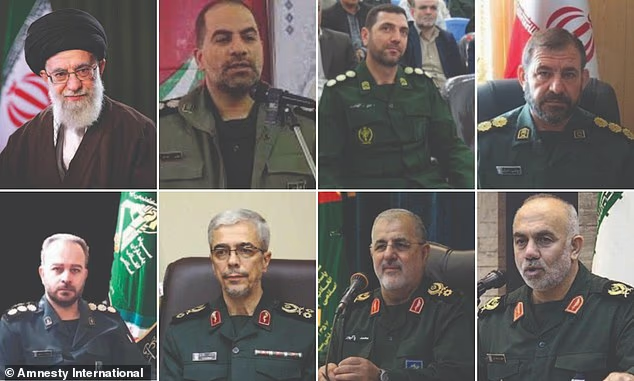
Amnesty International has named 87 Iranian officials it says oversaw killings, torture and sexual violence during the authorities’ crackdown on the 2022 “Woman, Life, Freedom” protests.
The human rights organisation is calling for the officials to be investigated for crimes against humanity in a 1,000-page report based on testimony from 270 witnesses and survivors, alongside an examination of more than 2,000 videos recorded between 16 September and 31 December 2022.
Amnesty said the Islamic Revolutionary Guards Corps (IRGC) and the Police Command of the Islamic Republic of Iran (FARAJA) led operations to disperse protesters. Official statements and leaked documents reviewed by the organisation included instructions for a “firm and severe” response, including one order to “respond mercilessly and go as far as causing death”.
According to the report, security forces repeatedly fired on crowds with military-grade assault rifles, handguns and shotguns loaded with metal pellets. Protesters and bystanders fleeing the demonstrations were allegedly pursued and shot at close range despite posing no threat.
Mahshid, who protested in Mahabad, told Amnesty: “I had never seen such scenes before… The situation was very frightening and felt like a war zone. The security forces just kept shooting.”
Another witness, Iman, who protested in Sanandaj, said agents “would shoot anyone in their sight, not caring if they were women, children, passers-by or protesters”. He said many people were struck by metal pellets in their legs, bodies, chests and faces.
Allegations of torture and sexual violence
The report alleges that protesters were beaten, kicked, dragged, stamped on and subjected to electric shocks, batons, kinetic impact projectiles and tear gas.
Amnesty said many people died from their injuries, in some cases after being denied medical treatment. Survivors were left with injuries including permanent loss of vision, fractures, traumatic brain and spinal injuries, internal bleeding and damage to organs.
Some victims reportedly suffered chronic pain, impaired mobility or speech, recurring infections and severe headaches. Doctors were allegedly unable to remove metal fragments from some bodies, leaving victims at risk of infection, brain damage or organ failure.
The organisation also documented torture in state custody, including beatings with batons and chains, flogging, electric shocks, solitary confinement, exposure to extreme temperatures, forced administration of chemicals and painful stress positions.
Detainees reportedly faced denial of medical care, food and water, as well as mock executions, threats of rape or death, forced nudity and degrading treatment. Amnesty said prisoners were held in overcrowded and unsanitary conditions, with infestations of cockroaches and mice and limited access to washing and toilet facilities.
The investigation recorded 16 cases of rape involving people detained in connection with the protests. They included six women, seven men, a 14-year-old girl and two boys aged 16 and 17.
Amnesty said 29 other people experienced sexual violence short of rape, including groping, beatings to the breasts, genitals or buttocks, stripping and threats of rape. Men and boys also reported genital electric shocks, injuries and threats of sexual assault.
Families of people killed during the crackdown were allegedly pressured to accept official accounts of their deaths and subjected to restrictions on funerals and memorial ceremonies. The report said authorities denied access to autopsy reports, concealed evidence and issued incomplete or inaccurate death and burial certificates.
Officials named in the Amnesty report
The list comprises 62 security force commanders, including 33 from the IRGC and 27 from FARAJA, as well as 25 officials from the Ministry of Interior, including provincial and county governors.
Those named include the late Supreme Leader Ali Khamenei and Mohammad Bagheri, the late head of the General Staff of the Armed Forces. Both were killed in the February 2026 attacks on Iran carried out by the United States and Israel.
Also named are Ahmad Vahidi, who was interior minister during the protests and later became general commander of the IRGC, and Majid Mir Ahmadi, then deputy interior minister for police and security.
Agnes Callamard, Amnesty International’s secretary general, said the investigation exposed “the layers of command and coordination behind the Iranian authorities’ deadly protest crackdowns”.
“The agents on the streets operated within a hierarchical and coordinated chain of command linking them to officials who directed, enabled, facilitated and supported crimes committed on a massive scale,” she said.
Ms Callamard said those named remained beyond the reach of justice in Iran and that some had risen further through the chain of command since the alleged crimes against humanity in 2022.
“The cost of continued impunity has been devastating,” she said. “It is beyond time to establish an international criminal justice mechanism for Iran before another protest massacre.”
