


Broadcasting House is awash with rumours that BBC2’s Newsnight is for the chop.
In its heyday it was widely regarded as the flagship of BBC TV current affairs, a daily, in-depth look behind the news headlines. It’s struggled in recent years to retain that accolade as audiences declined and numerous budget squeezes starved it of resources.
These days it’s basically a late-night talk show covering the news of the day. Almost everything that made Newsnight special – filmed reports and investigations, journalistic expertise, scoops, agenda-setting interviews, decent coverage of foreign affairs – has gone.
But then everything that made Newsnight special was also expensive – and despite current annual revenues of £5billion (licence fee plus commercial income) the BBC, in its wisdom, has decided that’s not what it wants to spend its money on anymore.
Which might be thought a strange decision for a broadcaster always touting its public-service credentials. For if the BBC is no longer prepared to invest in high-quality current affairs journalism it does raise a rather fundamental question: what exactly, then, is the BBC for?
We don’t yet know the fate of Newsnight for sure. The rumour-mill suggests it might have a stay of execution until the end of next year. Perhaps its potential demise has been leaked to fire up a ‘Save Newsnight’ campaign. But, of course, it’s already a shadow of its former self.
Its bespoke team of expert journalists – respected independent-minded specialists like Mark Urban (defence) and Michael Crick (politics) – has long been disbanded. There are no more filmed investigations and foreign coverage has been canned (too expensive). It’s now a cheap-as-chips studio-based production. But still too costly, it would seem, for today’s BBC.
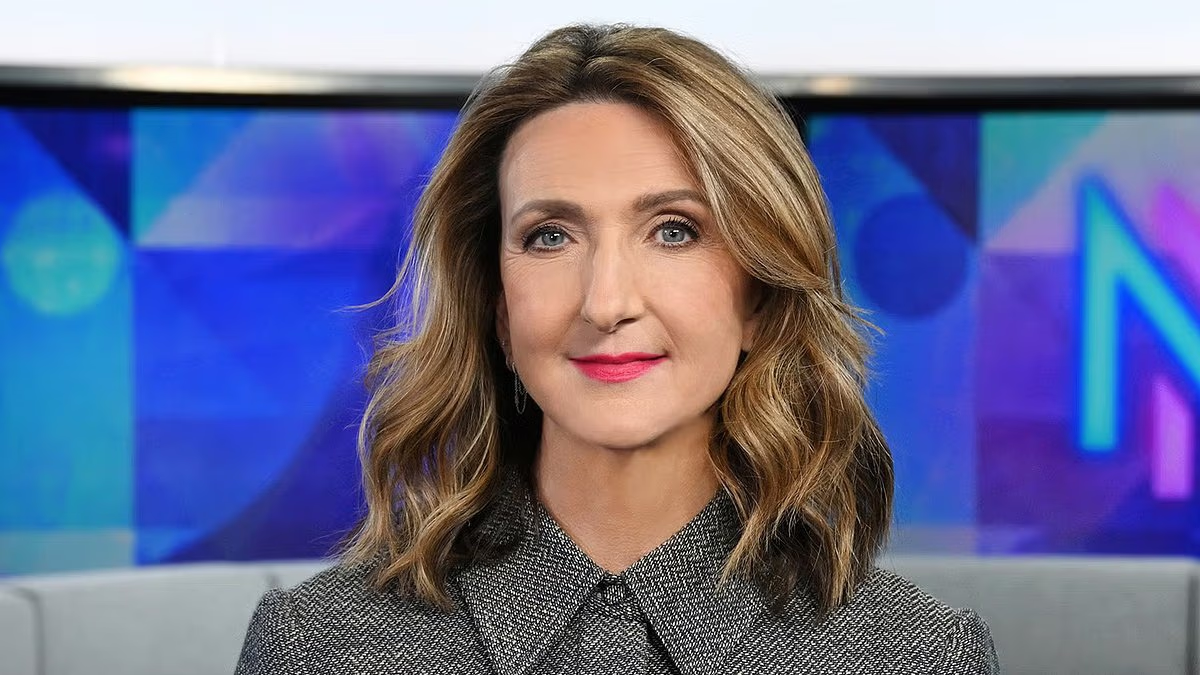
Given the relentless rundown of its resources, lead presenter Victoria Derbyshire has done a decent job keeping the show on the road. Its ratings have recovered from lows of under 300,000 to around 500,000 on a good night.
Jeremy Paxman famously asked former home secretary Michael Howard the same question 12 times in 1997. The pair looked back on the exchange for the show’s 20th anniversary in 2000
The discussions can be lively and entertaining, even if they lack the insight and analytical rigour of the old Newsnight. Her interview with Andy Burnham en route to his coronation was one of the few that really held his feet to the fire (as you could tell from his anguished replies).
Of course, there was a time when that was par for the course on Newsnight. It wasn’t just fronted by the big beasts of British broadcasting at the time – John Tusa, Peter Snow, Donald MacCormick – but carried cutting-edge interviews of our political masters conducted, above all, by Jeremy Paxman, the prime broadcasting interlocutor of the day.
This was a time when politicians agreed to be held accountable in live interviews. Our democracy was all the stronger for it. Some, of course, came to regret it, most notably then Tory Home Secretary Michael Howard when in 1997 Paxman asked him the same question 12 times – and 12 times he failed to answer. Excruciating to watch. But now in British broadcasting’s metaphorical hall of fame.
In a sense, Newsnight was victim of its own success. Politicians decided to give it a miss rather than risk going down in flames. Paxman started to run out of big names to interview. I experienced the same on my own BBC shows.
I gave up presenting BBC1’s Sunday Politics because cabinet ministers were avoiding me like the plague. This penchant for swerving the tough interview reached its peak in the December 2019 general election, when then Prime Minister Boris Johnson, alone among party leaders, refused to sit down with me for a BBC1 prime-time interview. But long before that both Paxman and myself were regularly reduced to interviewing ministers for paper clips.
No broadcaster can compel politicians to submit to interrogation. But no politician in a democracy can stop broadcasters from fearless, independent, analytical journalism. This is what the old Newsnight excelled at.
I understand, as someone fully involved in the digital age, how 24-hour news and social media can undermine once-admired TV strands from the age of linear television. We all need to adapt.
But in a world awash with news and (increasingly) fake news, there must surely still be a market for impartial, intelligent, authoritative analysis of the news – and if a public-service broadcaster like the BBC is not in the business of providing it, at scale and properly funded, then what exactly is its purpose?

Victoria Derbyshire has recovered the ratings from lows of under 300,000 to around 500,000 on a good night
These are strange times at the BBC, which is increasingly struck with a death-wish of its own making. It seems determined to stick with a funding model (the licence fee, or new compulsory variant thereof) in which you have to pay for stuff you don’t watch whether you want to or not. In the age of streaming and multi-channel TV, with a younger generation only prepared to pay for what they actually watch, this simply won’t fly.
It leads the BBC to a second mistake: that it must increasingly provide programmes that are popular, regardless of their public-service value. It was significant that the BBC’s latest propaganda video, ‘What has the BBC ever done for me?’, fronted by comedian Romesh Ranganathan and broadcast during the World Cup final, highlighted shows like Eastenders, Strictly Come Dancing, The Traitors, Dr Who and Casualty, none of which can be regarded as public service broadcasting, all of which could be made by commercial broadcasters.
Yet news was given only a passing reference, serious radio none, documentaries might as well not exist and even the BBC Proms, whose 2026 programme had just started, didn’t merit a mention (even though the BBC rightly describes it as the greatest musical festival on earth).
Yet all of that and more is what we properly regard as public-service broadcasting and, if we are to have a special funding mechanism for it (a big ‘if’ in this age of limitless choice), then surely it is that kind of broadcasting that should have first dibs on public funds. Instead, the BBC penny-pinches on news and current affairs while pumping more money and resources into fripperies.
A further point. Even if you get the importance of news and current affairs in the public-service broadcasting firmament, you cannot take money from us by compulsory levy and then present that news from only one, inevitably leftist standpoint. We’re all ponying up the money. So you have no right to use it to peddle a particular ideology.
On this the BBC fails lamentably. Just look at its sycophantic coverage of the rise of the late Jason Arday, which ended in such tragedy. Even the old Newsnight couldn’t hide its left-leaning instincts. I saw that at first hand.
Over 20 years ago, a BBC panjandrum thought it a good idea if I joined Newsnight’s team of presenters. This was not popular with the left-wing producers. Even so, I was given a couple of trial shows to front. I bounded in with Tigger-like enthusiasm and bonhomie, to be greeted like a Hamas commander looking in on a bar mitzvah.
Yet my guest spots went well (even the Guardian wrote that the ratings had been the best for some time). Things were looking good. But as I turned to say goodbye on the final trial show, for some reason the autocue had reverted to the opening to the show.

‘The BBC penny-pinches on news and current affairs while pumping more money and resources into fripperies,’ writes Andrew Neil
‘Hello and welcome to Newsnight,’ I read off the script, before freezing in embarrassment. A technical glitch? Sabotage? Who knows? But the young, leftie production team was delighted. My Newsnight career was over before it began.
Somehow Newsnight survived without me. Perhaps not for much longer. Yet questions about its future come at a good time – for this is about so much more than Newsnight. Do we really need so-called public service broadcasting in the digital age? If so, how should it be funded? And on what priorities should these funds be spent?
Until these questions are honestly addressed it’s not just the future of Newsnight at stake. It’s the future of the BBC.
