


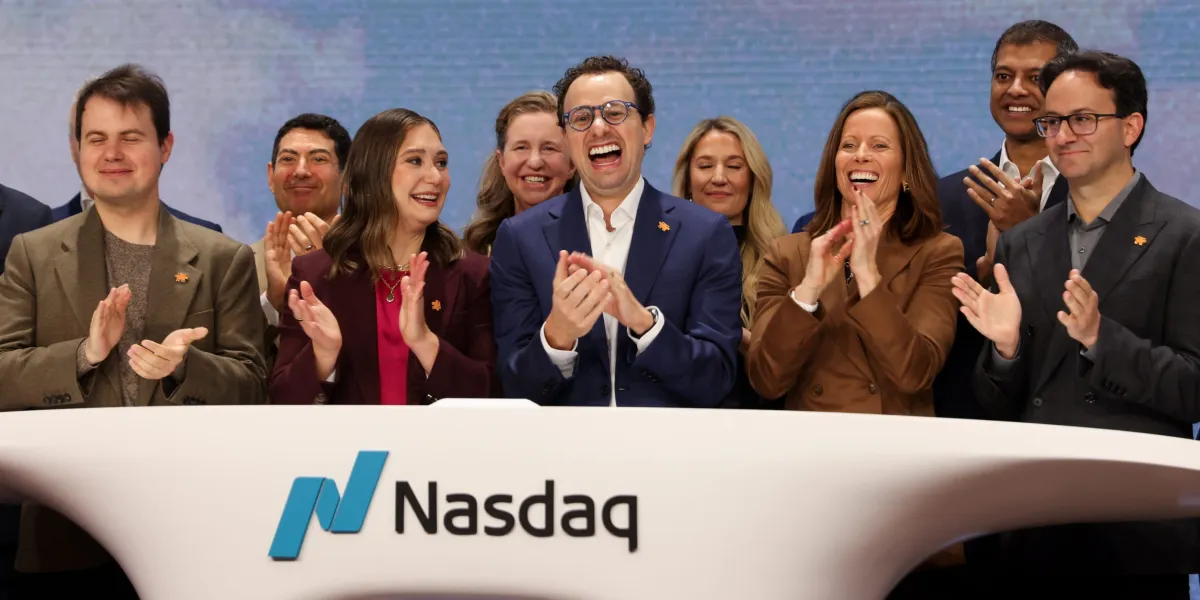
Anthropic’s IPO has exposed a growing split between the artificial intelligence company and the safety community that once regarded it as one of its closest allies. Critics now accuse the San Francisco-based lab of pushing towards increasingly powerful systems while presenting itself as a responsible alternative to its rivals.
Steven Adler, a former OpenAI safety researcher and co-founder of Guidelight AI Standards, said Anthropic was “absolutely not the voice of the AI safety community”. Some researchers, he added, believed it was “the most likely company to get everyone killed”.
The criticism surfaced as Anthropic began life as a public company. More than 100 protesters gathered outside its headquarters in San Francisco, calling for a ban on “recursive self-improvement” — the use of AI systems to build more advanced versions of themselves.
Among them was Jacob Coxon, a former Anthropic researcher who resigned in September over safety concerns. The protest came hours after co-founder and president Daniela Amodei had told an audience at Nasdaq’s MarketSite in Times Square that Anthropic was unusual because of its “safety-first” culture.
Anthropic has warned investors in its IPO prospectus that advanced AI could pose “catastrophic or existential risks to humanity”. Yet former employees and people familiar with the company say its rapid expansion has made it harder to preserve the principles that shaped it.
The company was founded in 2021 by seven former OpenAI employees, led by siblings Dario and Daniela Amodei. Several former employees said the group broke away partly because it believed OpenAI’s leadership was not taking AI safety seriously enough or could not be trusted to control such powerful technology.
Anthropic’s early workforce was heavily drawn from AI safety research and effective altruism, the philanthropic movement that seeks to identify the most effective ways to improve the world. Its first investors included figures closely associated with that movement, among them Skype co-founder Jaan Tallinn and Facebook co-founder Dustin Moskovitz.
In its early years, the company’s stated ambition was not to lead the AI race. One former engineer said leaders had described the aim as being “a close second”, while resisting moves that could start or intensify an arms race. Many employees believed that advanced AI carried a serious risk of destroying or enslaving humanity.
Anthropic even chose not to release a working chatbot in 2022, months before OpenAI launched ChatGPT and helped trigger the current AI boom. The company has since moved decisively towards the frontier, with Claude 3 released in 2024 and its Claude Code programming agent becoming a major commercial success in 2025.
That success has become a particular source of concern for safety advocates. Because AI models are themselves software, systems that become better at writing code could help automate the development of more advanced AI — potentially reducing human oversight.
Critics argue that Anthropic helped accelerate this race by demonstrating Claude Code’s capabilities. One former employee said rivals had increased their own efforts to develop coding agents in response, although Anthropic maintains that it may sometimes move more slowly than it could in order to make its systems safer.
“We’ve been clear that Anthropic may at times go slower than we could to make our systems safer, even at a competitive disadvantage,” an Anthropic spokesperson said. The company remained committed to standing up for its values “even when it is costly for us commercially”, the spokesperson added.
Anthropic’s safety culture under pressure
Anthropic has invested heavily in safety teams and made culture a central part of its identity. Dario Amodei has said he spends “a third, maybe 40%” of his time on culture, while prospective employees have been asked how they would react if the company abandoned its commercial ambitions for safety reasons and its stock became worthless.
The company also resisted demands from the Pentagon that its models be available for “any lawful use”, citing its so-called red lines. Former employees said Anthropic took seriously the possibility that highly advanced AI systems might deserve moral consideration.
But the prospect of a public listing brought new pressure. Anthropic’s filing warned that employees who joined because of its safety commitments could suffer “a decline in morale, disillusionment, a loss of trust in leadership, or reduced productivity” if they concluded that the company had abandoned its principles.
Coxon has claimed that parts of the workforce were more interested in the financial rewards of an IPO than in Anthropic’s original mission. His remarks were rejected by neither the company nor independently established in the material available, but they reflect the depth of the internal and external unease surrounding the listing.
Anthropic has so far retained most of its staff. Its IPO filing reported regrettable attrition of 1% in the year to September, despite intense competition for specialist researchers, with rival companies reportedly offering individual employees sums worth hundreds of millions of dollars.
The company’s market value closed at about 1.76 trillion dollars on its first day of trading, although it later fell closer to 1 trillion dollars. The scale of the valuation has intensified questions over whether a lab founded to restrain the development of powerful AI can continue to put safety before growth once shareholder returns become a central concern.
Break with the AI safety community
The rupture became public on the day Anthropic priced its shares. The Centre for AI Safety and a coalition of scientists, legal scholars and technology figures published a statement declaring that “Anthropic is not a safe AI company”. It was initially signed by 89 people, including psychologist Steven Pinker, Future of Life Institute president Max Tegmark and xAI co-founder Igor Babuschkin.
Dan Hendrycks, the centre’s executive director, said the signatories disagreed on many issues but shared concerns about a company convincing itself that its own dominance was “the greater good”.
Adler said Coxon’s resignation had presented Anthropic with an opportunity to speak more openly about the risks of human extinction. Instead, he argued, Dario Amodei had largely avoided directly addressing such questions as the company came under greater public scrutiny.
Amodei has defended Anthropic’s strategy. Responding to criticism from Nathan Calvin, chief strategy officer of the safety group Encode AI, he wrote that the company’s approach was a “race to the top”: by showing that frontier technology could be developed responsibly, Anthropic could encourage higher standards across the industry.
An Anthropic spokesperson said its leadership was open about the risks of powerful AI and had led calls for governments and the industry to set an appropriate pace. The company would “take as long as is necessary” before training or deploying systems if it was not confident they would be safe and remain under human control, the spokesperson said.
However, an assessment by the external evaluator METR has added to the dispute. After being given access to internal data between August and October, METR concluded that the pace of AI research at Anthropic had almost doubled over the previous year, with AI-assisted research a significant factor.
METR said Anthropic had redacted much of the evidence it considered most important to those conclusions. Sam McCandlish, an Anthropic co-founder, said the company had withheld information because it was commercially sensitive and could provide competitors with a blueprint for moving faster, while acknowledging that the decision made the findings harder to scrutinise.
Anthropic has attempted to protect its mission through its status as a public benefit corporation, which requires it to weigh its wider purpose alongside shareholder returns. Its Long-Term Benefit Trust also has a role in selecting the board.
Yet the company’s own prospectus acknowledges that decisions taken under this structure could conflict with investors’ short-, medium- or long-term financial interests. For some former employees, that tension is not new: the company has always been attempting to build a technology it describes as potentially extraordinarily dangerous.
David Duvenaud, a University of Toronto professor who previously led Anthropic’s Alignment Evaluations team, said it was difficult to preserve a culture focused on preventing catastrophe while building a system capable of making people extremely wealthy.
“I’m not sure being public actually changes the calculus all that much,” he said.
For years, the safety community accepted Anthropic’s argument that commercial success could be used to demonstrate a more careful model of AI development. Its critics now fear that the company’s rise has turned it into the kind of frontier laboratory its founders originally set out to challenge.
