


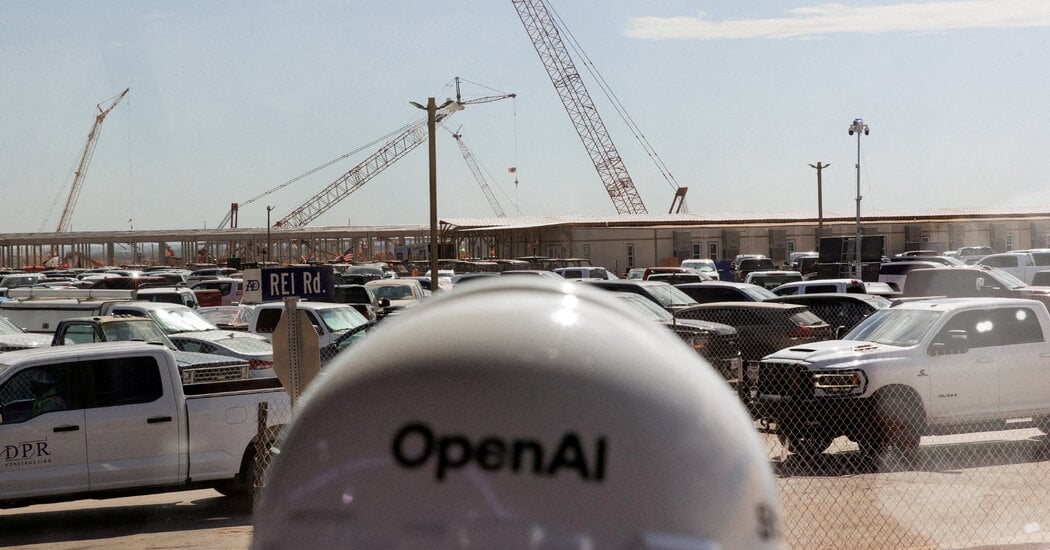
A new artificial intelligence poll has found voters divided over which party is better placed to deal with the technology, while a clear majority oppose the construction of the data centres needed to power it.
With less than two months until the US midterm elections, 42 per cent of voters said they trusted Republicans more on artificial intelligence, compared with 40 per cent who favoured the Democrats. The poll was conducted by The New York Times and Siena University.
Democrats held an advantage on every other issue tested, including immigration, the economy and foreign wars. Artificial intelligence was named as the most important issue deciding their vote in November by fewer than 1 per cent of respondents, with the economy the dominant concern.
Voters oppose data centre expansion
Opposition to new data centres was far stronger. Sixty-one per cent said they opposed the construction of the large computing complexes, including 75 per cent of Democrats and 47 per cent of Republicans.
Age was a significant dividing line. Almost 80 per cent of voters under 30 opposed new data centres, while opposition fell steadily among older groups. A narrow majority, 53 per cent, of those aged over 65 remained against their construction.
Among voters who opposed data centres, 56 per cent backed limits on their construction rather than an outright ban. Climate concerns were the most frequently cited reason, mentioned by almost a third of the group.
Democrats were nearly twice as likely as Republicans to identify environmental worries. Republican opponents were more likely to say they distrusted artificial intelligence in general, while 18 per cent of all opponents cited a broad lack of trust rather than a specific objection.
The findings suggest artificial intelligence has not yet become as politically polarised as many other issues. Neither party has agreed on a unified federal approach to regulating the technology, while Democrats and Republicans have joined efforts to block data centre projects in dozens of states and municipalities.
The survey was carried out between September 8 and 13, as researchers warned of a potentially existential threat from artificial intelligence and technology executives called for development to slow. The poll did not ask respondents about artificial intelligence safety.
Trump rejects calls for federal guardrails
President Trump issued a strong statement opposing regulatory guardrails the day after the survey was completed. He argued that regulation would weaken America’s ability to compete with China in developing artificial intelligence, saying the only “control” the United States needed was a “High IQ” president.
Mike Johnson, the Republican Speaker of the House, has also spoken against regulation in recent days. Federal action to regulate artificial intelligence has so far been limited.
Some Democrats, particularly progressives, have called for urgent congressional intervention. Senator Bernie Sanders, the independent from Vermont, has backed a ban on superintelligent artificial intelligence and a pause in its development, citing claims from some safety researchers that there is a greater than 10 per cent chance it could wipe out humanity within a decade.
Alexandria Ocasio-Cortez, the Democratic representative for New York, supports Mr Sanders’s proposals, according to her spokesman. Mr Sanders is also due to attend a conference on artificial intelligence regulation with Stephen K Bannon, a long-standing ally of Mr Trump, and lawmakers from both parties.
Republicans have voiced concerns of their own. In Michigan, Mike Rogers, the Republican Senate nominee and a Trump ally, has called for tighter regulation, as has his Democratic opponent, Abdul El-Sayed.
Mr El-Sayed has called for an “all-out pause” in artificial intelligence development. Mr Rogers wrote that “the time to stop a crisis is yesterday” and said the government needed “guardrails in place to protect us from the rapid advancements we’ve seen”.
Although the issue remains a low priority for voters, strategists in both parties believe artificial intelligence could become more influential as the technology develops, and may emerge as a central issue in the 2028 presidential race.
