


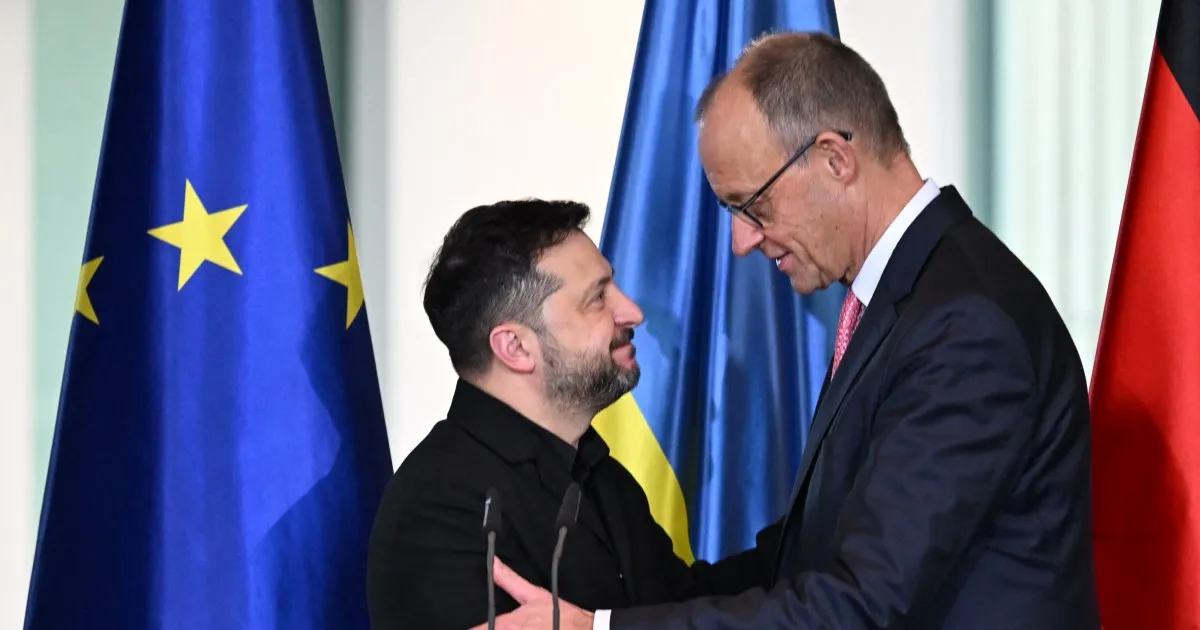
European leaders are gathering in Berlin for a summit focused on funding Ukraine’s defence and securing a role in the next round of Russia-Ukraine peace talks, as US President Donald Trump meets Vladimir Putin in China.
German Chancellor Friedrich Merz is hosting the Coalition of the Willing meeting with French President Emmanuel Macron and UK Prime Minister Andy Burnham. More than 30 leaders are expected to attend, including Ukrainian President Volodymyr Zelenskyy.
The Berlin summit on Ukraine will address long-term security guarantees and continued military and financial assistance. Kyiv’s immediate priority is air defence, with the threat of Russian drone attacks looming as winter approaches.
Trump administration envoys Steve Witkoff and Jared Kushner are expected to meet Ukrainian officials and Europe’s newly formed negotiating team in Berlin, according to media reports.
The team includes France, Germany, the UK, Italy and Poland, alongside European Commission President Ursula von der Leyen and European Council President Antonio Costa. Washington has supported European involvement in the next talks, although Moscow has not agreed to it.
The dispute risks leaving Ukraine’s principal financial backer on the sidelines while European Union countries prepare to take on a greater share of the cost.
Europe faces growing financial demands
The European Commission has proposed a further 45 billion-euro loan for 2027, including up to 25 billion euros for military assistance and 20 billion euros for budget support.
The proposal follows a 1.71 billion-euro payment made on Monday under an existing EU loan programme supporting drones, ammunition and air defence. Even if the new loan is approved, Ukraine would still face a financing gap of 25 billion euros next year.
Zelenskyy has said the US envoys promised to brief Kyiv on Trump’s discussions in China, where he is meeting Chinese President Xi Jinping and Mr Putin.
The summit also follows a public disagreement between Washington and European governments over Ukraine’s military strategy. At a Nato meeting on Tuesday, Elbridge Colby, the Pentagon’s undersecretary for policy, argued that some Ukrainian strikes deep inside Russia had done little to slow Moscow’s advances and that attacks on civilian infrastructure might have strengthened Russian resolve.
German Defence Minister Boris Pistorius rejected the assessment as “quite a stupid thing”, pointing to Russia’s repeated attacks on Ukraine’s electricity and heating infrastructure. UK Defence Secretary Wes Streeting backed Berlin, saying Ukraine should decide how to conduct the war and that its long-range strikes had weakened Russia’s military capabilities.
Further military support pledged
European governments have promised additional winter assistance ahead of the meeting, including fighter jets and air defence missiles. Mr Zelenskyy has urged allies to release Patriot and IRIS-T interceptors from their stocks, offering to replace them with missiles Ukraine already has on order.
He has also said Ukraine needs a further 40 F-16s. Germany and Norway have each announced 300 million dollars for the Nato-coordinated Prioritised Ukraine Requirements List, which buys US weapons for Kyiv and includes Patriot missiles.
The UK, Denmark, the Netherlands, Finland, Belgium, France, Sweden, Lithuania, Estonia and Portugal have either reiterated or pledged further funding in the run-up to the Berlin summit.
However, European unity faces limits. Polish Prime Minister Donald Tusk has said Warsaw will not provide additional money to the weapons programme at this stage, while Bulgaria, Hungary, the Czech Republic and Slovakia have indicated they will opt out of the next round of EU financing.
Hungary continues to oppose military assistance for Kyiv. Kinga Koranyi, an assistant professor at the University of Wroclaw, said the view that Hungary should “stay out of the war” remained widely held after years of political campaigning by Viktor Orban’s Fidesz party, making direct funding for Ukraine unpopular.
She also said Budapest’s caution was linked to years of restricted access to EU funds over rule-of-law disputes, as the cost of the war continued to rise without a clear end.
