


Donald Trump’s China visit has begun with the US president seeking to project American technological strength, while a string of outages at home has forced his administration to defend the reliability of critical systems.
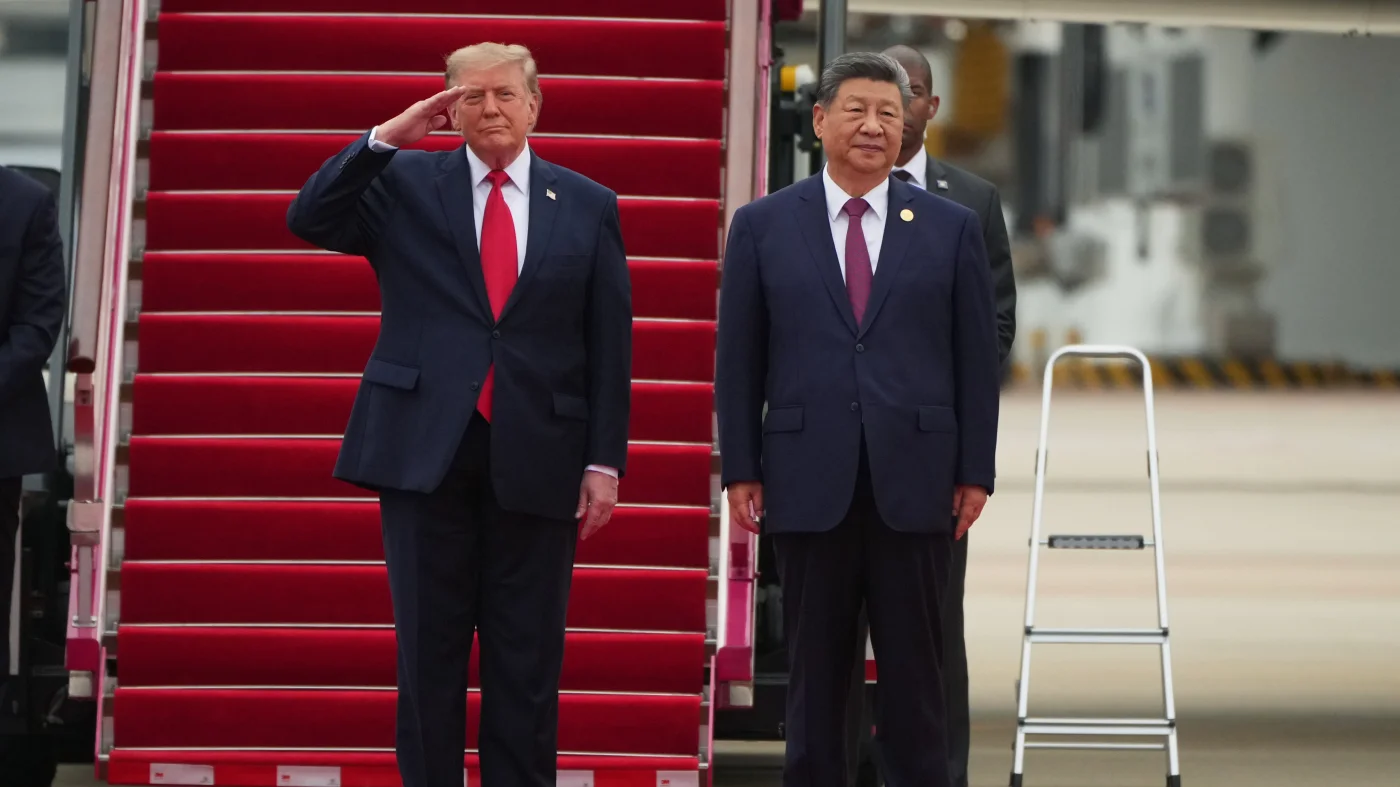
Trump arrived in Shenzhen on Wednesday for the Asia-Pacific Economic Cooperation summit, where he was greeted on the tarmac by Chinese President Xi Jinping. The meeting came a day before an unprecedented trilateral discussion with Xi and Russian President Vladimir Putin.
The outages affecting Microsoft, the Federal Aviation Administration, JPMorgan Chase and communications systems used by the National Security Agency have unsettled Americans concerned about accessing email and bank accounts, or travelling safely by air.
Trump had initially dismissed the disruption while visiting the Philippines, saying: “It’s fine.” He suggested it was simply a consequence of being a nation that was “big and powerful”.
But the problems increasingly overshadowed his Asian tour, raising questions about the vulnerabilities created by rapidly developing artificial intelligence and the need to continually update software to address security flaws.
Secretary of State Marco Rubio, who is also the president’s national security adviser, sought to reassure the public on Wednesday. He said there was “zero” evidence that the outages were connected to rival nations, hackers or criminals.
“Sometimes when you are going in to fix your system because you’ve identified a vulnerability, it creates a short-term disruption,” Mr Rubio said.
Trump’s China visit puts technology and security in focus
Xi’s welcome for Mr Trump echoed a gesture made by the US president during the Chinese leader’s state visit to Washington in September. The pair shook hands at the foot of Air Force One before embracing as dancers waved flowers and flags.
Putin also arrived in Shenzhen on Wednesday, although Xi did not greet him at the airport. The Russian and Chinese leaders have maintained a longstanding friendship.
Mr Trump has indicated that he wants to rely on personal diplomacy during his time in the Chinese technology hub, in the hope that informal discussions can produce a lasting impact on world affairs during the final two years of his presidency.
At Thursday’s meeting, he is expected to discuss nuclear weapons and the war in Ukraine with Xi and Putin. Although aides had previously said the conflict would not be on the agenda, Mr Trump said the scale of Russian losses had created an opportunity to bring the fighting to an end.
“I think it’s very close to getting it done,” he said. “We’re going to have a good meeting on that.” Analysts are not expecting a substantive breakthrough despite the significance of the three-way gathering.
Artificial intelligence is also expected to feature in the wider discussions, as governments weigh its potential to drive economic growth against national security risks. Mr Trump has described technology as central to American power but has acknowledged divisions within his administration over how aggressively to restrict China’s access to advanced computer chips.
When asked why the US had not imposed tougher restrictions, he said: “We have a very good relationship with China, and you don’t want to insult them.”
Mr Trump has said he does not intend to raise Taiwan, the self-governing island claimed by China, although he expects Xi to bring up the issue. “I’m sure he’ll raise it,” he said. “I won’t have to raise it.”
