


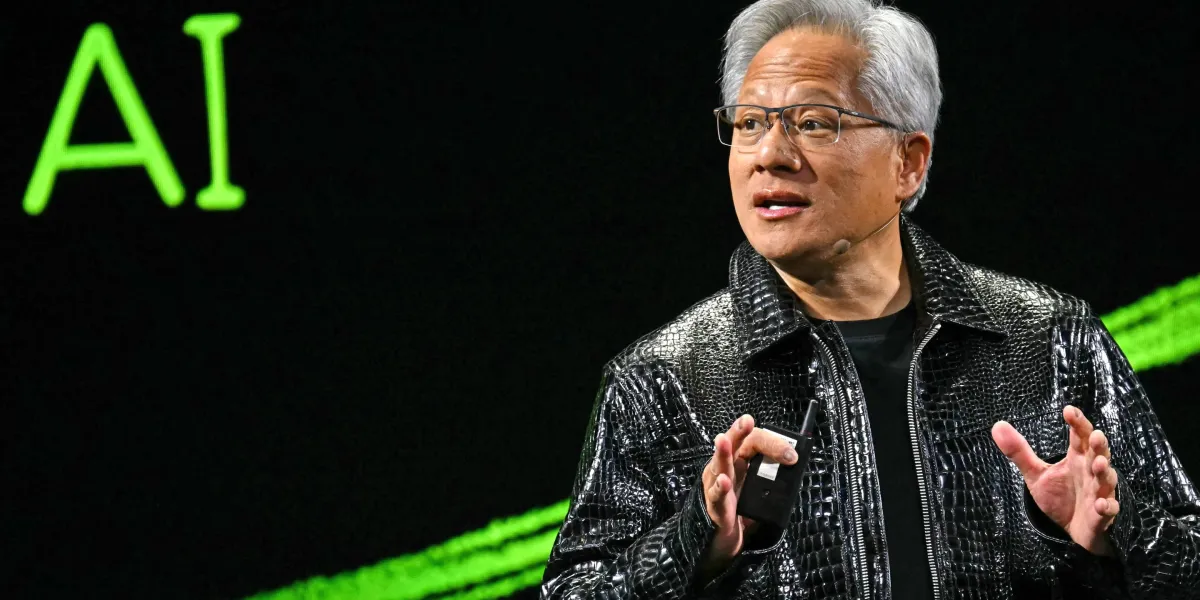
Nvidia’s strong third-quarter results have offered reassurance to Gulf investors whose artificial intelligence ambitions depend heavily on the US chipmaker, even as the resignation of chief executive Jensen Huang and tighter export controls threaten to complicate the company’s regional relationships.
Revenue reached $116 billion in the three months to October, up 103% on the same period a year earlier and ahead of Wall Street forecasts of $109 billion. Nvidia has exceeded analysts’ estimates in each of the past five quarters.
Net profit for the quarter was $65.3 billion. The company expects fiscal fourth-quarter revenue of $130 billion, representing annual growth of about 75%, as demand for advanced computing chips remains strong.
The figures will be closely watched across the Gulf, where governments and sovereign wealth funds are investing heavily in artificial intelligence as part of efforts to diversify their economies away from oil. Nvidia hardware is central to plans by Saudi Arabia and the United Arab Emirates to build large-scale AI and data-centre industries.
Export controls threaten Gulf AI ambitions
However, political pressure in Washington is building over the risk that advanced American chips supplied to the Gulf could reach China through intermediaries. The controversy surrounding Huang’s reported affair with a Chinese businesswoman who faces accusations of spying has added to calls for tougher controls.
The issue is likely to bring greater scrutiny of Nvidia’s dealings with Gulf states, particularly because both Saudi Arabia and the UAE maintain strong commercial relationships with Chinese technology companies.
In September, Alibaba Cloud announced plans to increase data-centre capacity and expand localised AI services in the UAE. In Saudi Arabia, Lenovo unveiled its first laptop made locally at a manufacturing facility developed through a $2 billion partnership with Alat, a subsidiary of the Public Investment Fund.
Washington eased export restrictions on the UAE in July, allowing approved government bodies and entities including the technology group G42 to receive advanced computing hardware under broader licensing exemptions. The rules did not impose a cap on the number of chips or other sophisticated goods that could be sold to those organisations.
Democratic lawmakers have nevertheless warned that large-scale sales of AI chips to the Gulf could create a back door for China to access restricted US technology. Senators called in May for safeguards in proposed chip deals with Saudi Arabia and the UAE, and congressional scrutiny is expected to intensify when Democrats take control of both chambers in January next year.
The US Commerce Department has since introduced an interim rule requiring licences for global transfers of AI chips and servers to companies in 22 embargoed countries, including China. The measure is intended to close a loophole that allowed Chinese companies to lease Nvidia computing capacity from other locations.
Gulf funds remain exposed to AI market volatility
Huang’s resignation has also increased uncertainty for Gulf investors amid a broader sell-off in AI and related technology shares, driven by concerns over valuations and the possibility of an investment bubble.
Public filings indicate that sovereign wealth funds such as Mubadala have relatively limited direct exposure to Nvidia shares compared with their investments in other technology companies. But their wider AI portfolios remain closely tied to the fortunes of the sector.
MGX, an artificial intelligence and advanced technology investment firm backed by Mubadala, has stakes in or has participated in funding rounds for OpenAI, Anthropic, xAI, Databricks, GlobalFoundries, Isomorphic Labs and SpaceX. Saudi Arabia’s PIF-backed AI venture HUMAIN invested $3 billion in xAI’s $20 billion Series E funding round in February.
Global SWF estimates that Mubadala’s portfolio may have fallen by $17.5 billion since the AI sell-off began at the end of June, largely because GlobalFoundries’ share price dropped by more than 50%. The value of PIF’s AI-related holdings is estimated to have declined by $5.6 billion, mainly because of its stake in SpaceX.
Sam Winter-Levy, a senior fellow in the Technology and International Affairs Program at the Carnegie Endowment for International Peace, said the Gulf was “indirectly and strategically” exposed to the market turbulence.
“MGX and other Gulf vehicles hold large stakes in AI labs, data centre platforms, and other companies whose valuations depend on the AI boom—and Nvidia, of course, is central to that boom,” he said. “The Gulf’s national AI strategies are built on Nvidia hardware. I think a prolonged loss of confidence in Nvidia would hit the Gulf relatively hard.”
Nvidia’s results are expected to steady sentiment across the AI sector ahead of the planned stock market listing of Anthropic, the developer of Claude. Backed by MGX and the Qatar Investment Authority, Anthropic is expected to be valued at $1.4 trillion, with reports suggesting its shares could be six times oversubscribed.
