


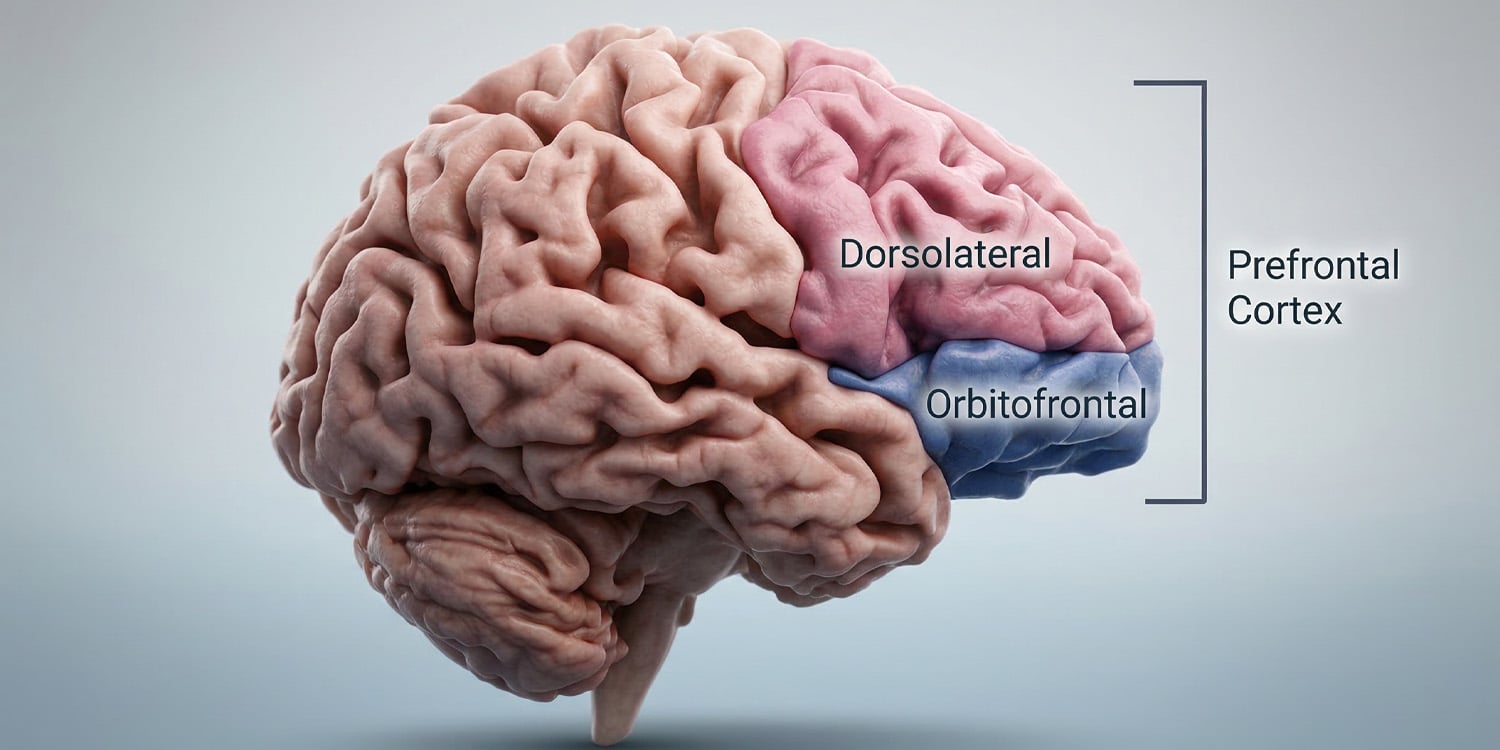
A new neuropsychological study suggests that damage to the ventromedial prefrontal cortex (vmPFC) does not automatically curb a person’s willingness to engage with others’ feelings. In a lab-based investigation, individuals with localized vmPFC injuries chose empathy-inducing tasks at similar rates to healthy controls and to patients with damage in other brain regions, indicating that empathic motivation may be preserved even when emotion-reading or social judgement is affected.
The vmPFC sits in the lower front part of the brain’s frontal lobes, behind the forehead and above the eye sockets. Clinicians have long noted that injuries here can trigger personality shifts and altered social judgment while leaving intelligence, memory and speech largely intact, a phenomenon historically linked to cases such as Phineas Gage. Modern case literature, including patients like EVR, has drawn comparisons with psychopathic traits in adults after frontal damage.
Empathy is often parsed into two elements: the ability to read and share another’s emotions, and the motivation to enter situations that involve another’s feelings. Previous research, including a 2013 brain-imaging study of incarcerated individuals with psychopathy, has shown that empathy can be split into these components, with diminished spontaneous motivation sometimes coexisting with preserved capacity to feel with others when prompted.
Lead author Julian A. Scheffer, an assistant professor of psychology at the University of Western Ontario, explained that the study aimed to isolate whether vmPFC-related empathy problems stemmed from motivation or ability. “Case studies like Phineas Gage and patient EVR highlighted that after damage to the vmPFC, these individuals experienced profound personality and socioemotional changes that made them appear to lack empathy by no longer being concerned for the feelings of others,” he said. “However, we wanted to isolate whether these deficits of empathy were due to issues of motivation (i.e., ‘won’t empathize’) or ability (i.e., ‘can’t empathize’).”
The research team reasoned that the vmPFC’s role in weighing rewards against mental effort could also shape empathy motivation. A 2019 multi-study paper by Scheffer and C. Daryl Cameron suggested healthy adults often avoid empathy-inducing tasks if they perceive them as mentally taxing. In this study, the researchers recruited three groups: 13 patients with vmPFC damage, 13 brain-damaged controls whose injuries spared the vmPFC and other emotion-related regions, and 16 healthy adults.
Participants completed two 40-trial computerised tasks. The affective empathy task required choosing between a “FEEL” deck and a “DESCRIBE” deck before viewing an image of a child refugee; selecting FEEL meant writing about the child’s internal emotions, while DESCRIBE involved a neutral description of appearance with a mandatory wait before submission.
In the cognitive empathy task, participants were paired with a fictional partner and chose between a “FEEL-OTHER” deck and a “FEEL-SSELF” deck after viewing a moderately emotional photo and waiting 10 seconds. They then indicated whether the picture made the partner or themselves feel positive or negative. Some responses were excluded due to missing data, leaving 41 participants for the affective task and 40 for the cognitive task.
After each round, participants rated the decks on a mental workload questionnaire, assessing perceived effort, aversiveness and efficacy. Across all participants, people tended to avoid empathy decks, choosing the affective option on 42 percent of trials and the cognitive option on 32 percent.
Contrary to the researchers’ main hypothesis, group differences in how often empathy decks were chosen were not statistically significant. In the affective task, vmPFC-damaged patients chose the empathy deck on 47 percent of trials, with brain-damaged controls and healthy adults averaging 44 percent and 37 percent respectively.
In the cognitive task, the two brain-injured groups chose the perspective-taking deck on 33 percent of trials, while healthy adults chose it on 31 percent. Bayesian analyses supported the absence of meaningful group differences in both tasks, though the authors cautioned that the cognitive task’s results should be read conservatively due to non-normal data distribution.
Regarding mental workload, participants generally found empathy decks more effortful than non-empathic ones in both tasks, and the cognitive task also aligned with higher unpleasantness and lower efficacy. Yet vmPFC patients did not report empathising as more costly than the comparison groups. In the affective task, the control groups found sharing the refugees’ feelings more effortful than describing appearances, while this difference was not statistically significant among vmPFC patients. Follow-up Bayesian checks suggested the vmPFC group perceived the affective deck as somewhat less effortful than healthy adults did.
In the cognitive task, standard analyses showed no significant group differences in the costs, unpleasantness or efficacy of empathy choices. However, secondary Bayesian analyses hinted at a small-to-moderate tendency for vmPFC patients to rate the perspective-taking deck as more unpleasant than the comparison groups.
Across the sample, correlations between perceived mental costs and choosing empathy were not statistically significant, though the study involved around 40 participants, short of the 120 typically needed to reliably detect moderate individual effects. Separate checks found no consistent group differences in how workload related to card choices, despite earlier findings that vmPFC damage can influence decision-making in other contexts.
“We were surprised that we did not observe a decrease in empathy motivation in people with vmPFC lesions compared to brain-damaged and healthy comparison participants,” Scheffer commented. “But, this may have further highlighted that prior issues of empathy were on how people with damage to this region successfully deploy empathy.”
He added that vmPFC damage has previously been linked to how the brain encodes the value of options for future decisions, such as satiation in eating, and the current results did not reveal differences in how participants encoded the cognitive costs of empathy either. The researchers propose two ways to reconcile normal lab-based empathy motivation with everyday social struggles reported in these patients: either the damage disrupts emotion-reading or arousal necessary to prompt helping, or individuals with vmPFC injury can perform well in structured tasks but struggle in open-ended social situations.
The authors emphasised that the distinction between empathy ability and motivation has practical implications for clinical care and caregiving, noting that some individuals may not empathise because they cannot, rather than because they will not. They also acknowledged that the lab design – forced deck choices in a structured setting – may not capture the complexities of real-life interactions and emotion-reading in daily life.
Future work could explore empathy choices on an accept-or-reject basis and assess empathy alongside emotion-reading accuracy within the same participants, to further clarify how ability and motivation interact. The researchers also plan to study caregivers of people living with dementia to understand how frequent interactions with individuals who struggle with empathy affect caregiver compassion fatigue and the dynamics of care.
The study, Is damage to the ventromedial prefrontal cortex associated with impaired empathy? A neuropsychological study using an empathy motivation task, is authored by Julian A. Scheffer, Justin Reber, C. Daryl Cameron, and Daniel Tranel.
