


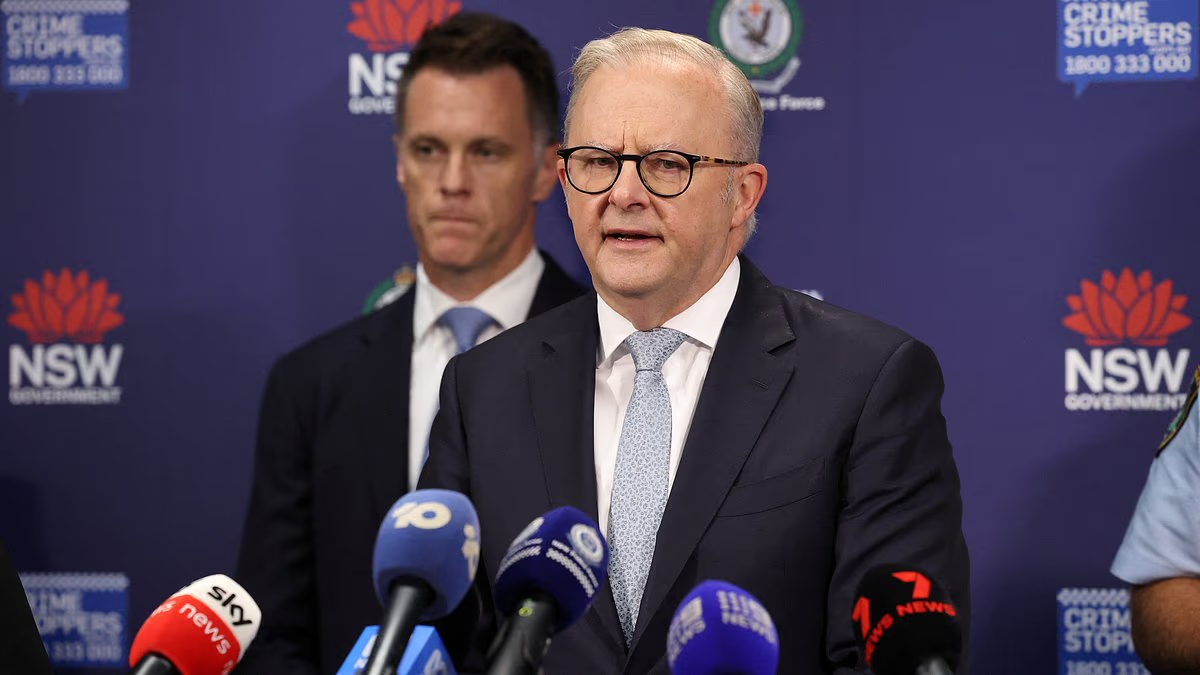
Anthony Albanese has secured a major federal–state gun buyback deal for New South Wales following the Bondi Beach shooting, but the national proposal will become an election issue after opposition from One Nation’s Pauline Hanson.
The agreement was announced by the Prime Minister and Premier Chris Minns on Sunday morning in Sydney.
National cabinet had agreed to action the fight against anti-Semitism and strengthen firearms restrictions across the nation following the deadly December 2025 shootings.
Compensation will be paid from November 2 for firearms beyond the new ownership limits and for newly reclassified firearms, along with a flat fee for associated ammunition.
The scheme, which has not been picked up by some states or territories, will also provide financial assistance for businesses and industry to adjust to the reforms.
‘Australians are quite rightly proud of our gun laws,’ Albanese said during a press conference in Sydney on Sunday.
‘But the fact is, there are more guns in Australia today than there were at the time of dealing with the Port Arthur gun fireback that occurred under the Howard government.
‘This is about strengthening Australia’s gun laws, and keeping our community safer.’
The Albanese government has confirmed an agreement has been struck on a major federal-state gun buyback in New South Wales following the Bondi Beach shooting
A fixed price schedule will apply for individual licence holders beyond the new legal limit to return their firearms in exchange for compensation.
Eligible businesses and dealers will be offered up to $25,000 in grants and one-off licence fee relief worth $500 over two years per dealer.
Early 2027 will see a pathway to compensation, for a fee, for eligible higher-value firearms with an indicative market value above $3000 and capped at $10,000 per firearm.
It’s estimated up to 274,000 registered firearms, or about 24 per cent of the total number of registered guns in NSW – and some 50,000 licence holders – are affected by the new limits on ownership.
The Commonwealth will contribute 50 per cent for administration costs and fully fund the destruction of surrendered weapons. The rest will be covered by the NSW government.
Minns was asked during the press conference whether he is prepared to fight an election on the issue of gun buyback schemes after Pauline Hanson shared her opposition to the policy.
‘I think we’re going to… It’s expensive and the logistics behind it are extensive but we’re ready to fight an election on it,’ he said.
‘Clearly, One Nation has said it will scrap all of this, and they’ll remove the regulations, the laws and the anti-terrorism legislation that we passed last year in Parliament.

Pictured, guns with barrels crushed in Sydney in 1996 after the Port Arthur massacre are stacked after they were handed over
‘So it is on the ballot whether you want it or not. But this is too important for New South Wales.’
When Albanese was asked whether he was disappointed that Queensland, the Northern Territory and Victoria are yet to make any agreement for the scheme, he did not answer directly but said the reform is available to their governments.
‘It is, I think, somewhat remarkable that some states were still, in terms of firearm licences, having paper licences that therefore couldn’t be traced,’ he said.
‘That damages the work and the capacity of our police and security agencies, whose job it is to keep Australians safe, to do their work.
‘I’ll continue to work constructively with states and territories. They will make their own decisions under our federation system. They are responsible.
‘But what I would say, and reiterate, is that in the Commonwealth they have a willing partner.’
NSW tightened its laws in the days following by introducing gun ownership limits, reclassifying some types of weapons, boosting background checks and reducing firearms licences from five years to two.
However, the buyback is considered the next step in the reforms.
‘We know this isn’t universally supported. In some quarters, this is controversial and it will be opposed,’ Minns acknowledged during the press conference.
‘Notwithstanding that public opposition, notwithstanding those who have criticised the government for these reforms, this is what this state needs to keep people safe.’
The premier outlined how the buyback scheme will work in practice, with registries are opened from November 2 for a maximum 12-month period.
‘We will nominate the locations where people can go to a registry office, largely speaking police stations,’ he said.
‘There’ll also be some police operations, which I won’t go into now, for certain categories of holders and certain licence holders.
‘But we anticipate that the vast majority of lawful gun-owning licence holders in New South Wales will do the right thing. Whether they agree with the law or not, they’ll comply with the law.’
This scheme is informed by the recommendations of the antisemitism royal commission.
