


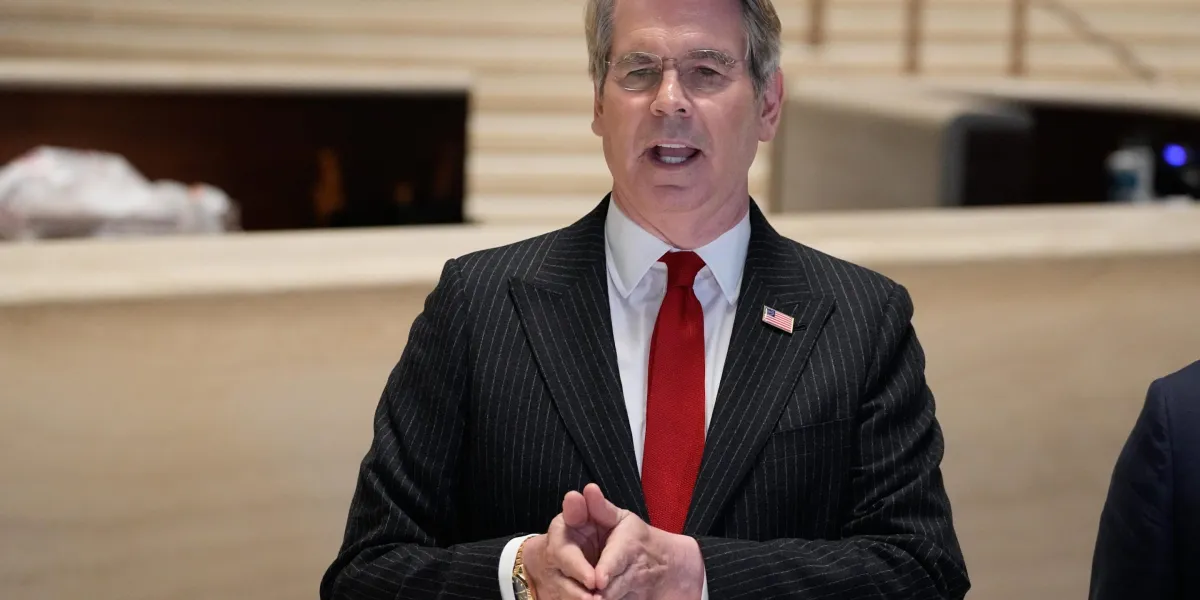
US Treasury Secretary Scott Bessent has criticised Nvidia over its export compliance after accusing the company of potentially using shell companies to sell advanced artificial intelligence chips to China.
Bessent said the Treasury Department, along with the departments of War and State and the US Trade Representative, had supported placing Singapore-based cloud computing company Megaspeed on the US “entity list” for months. The list imposes trade restrictions on designated organisations.
“Treasury, War, USTR, and State were in favor of putting Megaspeed on the entity list for months,” Bessent told CNBC. “But Commerce has the pen.”
The Trump administration has restricted exports of some high-end chips, including Nvidia products, as it seeks to maintain the US lead over China in artificial intelligence while permitting sales of less powerful models.
Megaspeed and a Malaysian subsidiary are alleged to have shipped at least 7.5 billion dollars’ worth of Nvidia chips to China over two years. Asked why the company had not been blacklisted, Bessent shifted the focus to Nvidia’s internal controls.
“What’s more important is, did Nvidia have a culture of compliance around the U.S. export restrictions?” he said in an interview with Fox News.
Bessent said investigators would need to establish whether any failures occurred at a junior level, within middle management or in Nvidia’s senior leadership. He questioned whether the company had used shell companies as a way around export restrictions.
“These shell companies were obvious. They were being investigated, and did Nvidia use them as a workaround to sell chips to the Chinese?” he said. “And I think we’re going to see answers.”
He said Nvidia had an independent lead director and had appointed external legal counsel, adding that he expected an explanation of what he called a culture of non-compliance.
Nvidia announced on Thursday that Jensen Huang had stepped down as chief executive. Chief financial officer Colette Kress was named interim chief executive while the company searches for a permanent successor, and Harvey Jones was appointed as Nvidia’s first board chair.
Kress and Nvidia engineer Ian Buck have been mentioned as possible successors, while AMD chief executive Lisa Su and Arm chief executive Rene Haas are among the potential external candidates.
Bessent said Nvidia’s board should appoint someone from outside the company and called for a “dramatic shakeup”. Although he described Nvidia as a “wonderful company” and Huang as an “incredible innovator”, he said those qualities did not remove the company’s obligation to follow export controls.
“I can tell you that if this were a bank and they hadn’t complied like this, the OCC would be in there right now and a lot of the executives would be removed,” Bessent said, referring to the Office of the Comptroller of the Currency.
He also said it was irrelevant to his concerns whether Alice Huang, who is alleged to have had a romantic relationship with Nvidia’s former chief executive, was a Chinese spy. The focus, he said, should be on whether Nvidia used “seemingly illicit sales to goose their revenues and their earnings”.
Megaspeed said it conducts legitimate and lawful business and had appointed external legal counsel to carry out an internal investigation.
“Megaspeed designs and maintains its global operational and supply-chain control frameworks to comply with all applicable laws and regulatory regimes, including United States export control requirements and local jurisdiction rules in every market where we operate,” the company said.
It added that Alice Huang left Megaspeed on August 30 2025 and no longer held any role there, while declining to comment on her personal affairs.
