


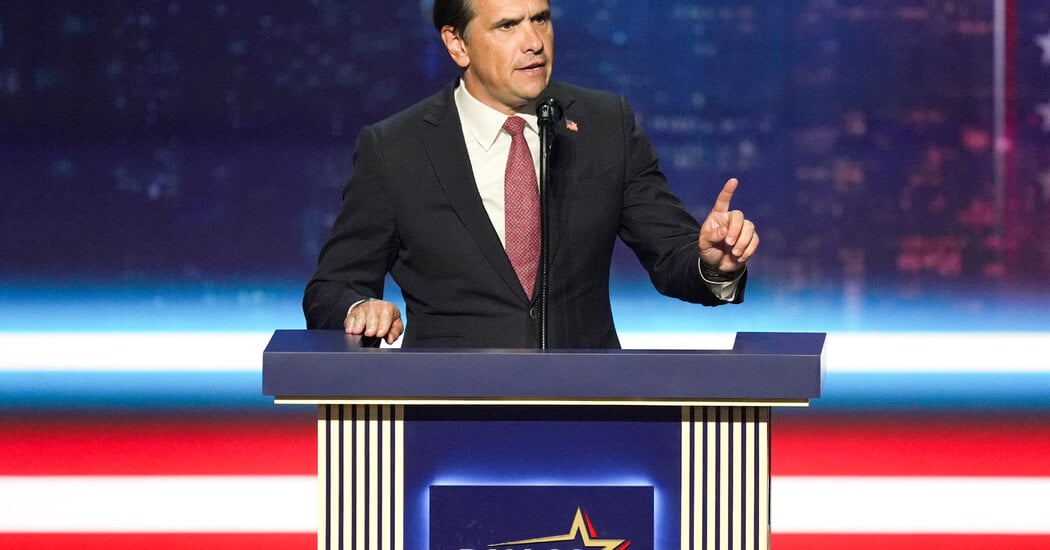
Attorney General Todd Blanche has intensified concerns over the Justice Department’s political neutrality by appearing at Republican campaign events and using partisan language about the coming midterm elections.
Blanche spoke at a rally for Michael Whatley, the Republican Senate candidate in North Carolina, on Wednesday. He also addressed the Republican Party’s midterm convention last week and appeared at a rally-style event on Long Island, where he praised Bruce Blakeman, the party’s candidate for governor of New York.
At the North Carolina event, Blanche linked falling crime rates to the Trump administration, describing them as “President Trump and Vice President Vance delivering on a promise”. Crime rates continued a long-term decline to reach new lows in 2025.
His political interventions continued on Tuesday, when he used a White House briefing to attack Democratic lawmakers and referred to the midterms while dismissing their concerns about artificial intelligence as “nothing but an effort to influence the midterms”.
The appearances have prompted criticism that the attorney general is abandoning a long-standing Justice Department convention that senior officials should avoid electoral politics. The department’s traditionally apolitical stance was intended to protect public confidence in federal law enforcement.
Joseph Tirrell, who served as the department’s senior ethics official until he was dismissed by the Trump administration in July 2025, described Blanche’s convention speech as concerning and called his participation in the North Carolina rally “terrible”.
“In my former role, I would have advised the attorney general not to go to the White House and not to make comments about members of Congress within 45 days of an election,” Mr Tirrell said.
Referring to the law restricting partisan political activity by government employees, he added: “I’d say, ‘That rally sounds like a Hatch Act violation to me, and I’d advise you not to do it.’ I would want to scare that person straight.”
Questions over Hatch Act rules
The legal position is disputed. The Hatch Act and related regulations allow some political appointees to attend partisan events, including fundraisers and campaign rallies, when acting off duty. However, some law enforcement officials face tighter restrictions, and it is unclear whether those limits apply to the attorney general.
Stephen Gillers, a New York University law professor specialising in legal ethics, said Blanche’s comments and activities were protected by the First Amendment and did not breach professional conduct rules, even if they were unwise.
“Any attempt to discipline him will fail,” Professor Gillers said. “That’s unfortunate. He has the ability to do what he’s doing, and he’s chosen to do it.”
The Justice Department did not respond to a request for comment. It has previously rejected a Hatch Act complaint brought over Blanche’s comments about Mr Blakeman as “baseless” and “a politically motivated complaint designed to weaponize the Hatch Act against the attorney general for his support of law enforcement”.
In response to criticism from Democrats on the House Judiciary Committee over Blanche’s convention appearance, the department said on social media that his attendance “in his personal capacity is legal (and has been approved by ethics)”.
Cynthia Shaw, who ran the Justice Department’s ethics office throughout Donald Trump’s first term, said senior officials could not simply avoid scrutiny by claiming to be acting privately.
“The bigger the job you get, the less personal capacity you have, because when you speak, people are going to see you in your official capacity and representing the agency that you are head of,” she said.
She said federal law enforcement needed not only to act fairly but also to be seen to be fair, for the long-term good of the department and society.
The Justice Department had previously imposed standards that went beyond the Hatch Act, discouraging officials from attending political fundraisers and campaign rallies. In 2022, Attorney General Merrick B Garland banned political appointees from taking part in partisan activities, including in a personal capacity.
That policy was rescinded in March by Blanche’s predecessor, Pam Bondi, allowing political appointees to attend such events privately under the less restrictive Hatch Act rules.
The change has drawn further scrutiny because the department’s ethics arrangements have also been altered. After Tirrell was dismissed, his position remained vacant for nearly a year before Kristina Spencer, a former aide to Vice President JD Vance with no previous department experience, was appointed.
The administration also transferred authority to overrule ethics office recommendations from a career official to political appointees.
The principle that the Justice Department should appear politically independent took hold after the Watergate scandal. Richard Nixon’s first attorney general, John Mitchell, was so closely involved in partisan politics that he resigned to run the president’s re-election campaign before later going to prison for his role in the scandal.
Edward Levi, the attorney general who followed him, helped establish the modern expectation that the department’s leader should not act as a political operative while in office.
Eric Holder, who served as attorney general under Barack Obama, said Blanche’s appearance at the Republican convention was “unprecedented” and “disgraceful”. Holder said attorneys general should not discuss political matters or attend campaign rallies.
Professor Gillers warned that changing expectations for the conduct of attorneys general could damage the rule of law if Blanche’s successors followed his example.
“This is new,” he said. “The changing image of what an attorney general should be seen to do, and how officials high in the Justice Department should behave, will not be good. We just don’t know yet how bad it will be.”
