


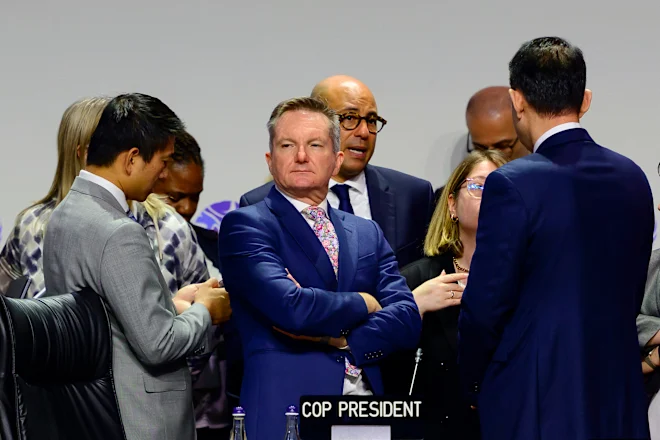
Australia’s Climate Change and Energy Minister Chris Bowen has defended his handling of failed international climate negotiations, blaming European countries and Saudi Arabia for refusing to compromise over wording on the transition away from fossil fuels.
Bowen, who oversaw the talks in Turkey, said negotiations remained viable until the final minutes after running 44 hours beyond their scheduled conclusion. The meeting eventually collapsed in a public dispute between delegations.
The central disagreement was over whether the final agreement should say that the world must “transition from fossil fuels”. The European Union insisted the phrase be retained, while Saudi Arabia, speaking for the Arab Group, refused to support it.
Bowen said the dispute was particularly frustrating because the same issue had been settled at the COP meeting in the United Arab Emirates in 2023.
“I said at, towards, the end, ‘Hang on, guys, you do realise what you’re calling for is entirely symbolic. We decided this. We settled it. It was a big fight. It was a miracle we got it at that time for a whole bunch of reasons. But we got it’,” he said.
He warned that insisting on repeating the wording could destroy the talks and damage the following COP meeting in Ethiopia.
As negotiations continued into overtime, Bowen sought alternative language. One draft referred to the UAE agreement in its preamble, a formulation he said Saudi Arabia was prepared to accept because it did not cross its red line.
But he said European negotiators rejected the proposal as too weak, arguing that they needed to be seen to stand firm after a summer marked by climate crises and wildfires.
“They said ‘we think a bad deal is better than no deal.’ I said I agree. A bad deal is better than no deal, but a good deal is better than a perfect deal that is unattainable,” Bowen said.
Bowen says US withdrawal weakened climate negotiations
Bowen also linked the failure to the decision by US President Donald Trump to abandon the international climate process. He said Saudi Arabia had agreed to the fossil-fuel language in 2023 only after pressure from John Kerry, then the US climate envoy.
“The only Western country they [Saudi Arabia] care about is the USA, and John Kerry was really squeezing them, basically to force them to do it. And the US is not there any more,” he said.
Saudi Energy Minister Prince Abdulaziz had already faced criticism for accepting language referring to fossil fuels in 2023 and was unwilling to do so again, Bowen said.
The minister now faces calls from Australia’s Opposition to resign over his role in the talks. He said he was “pretty pessimistic” about the future of international climate negotiations and acknowledged that, on the journey home, he had thought of several approaches he might have tried.
“I’ve got to say, I would have given them a go, but I don’t think they would have worked, given that everything else we tried didn’t work,” he said.
Despite the breakdown, Bowen said the shift away from fossil fuels remained inevitable because renewable energy and batteries were becoming cheaper, while fossil fuels were becoming more expensive.
“It’s happening, it’s irreversible. There is a transitional point for fossil fuels,” he said.
He said the failure was damaging because COP meetings were intended to encourage companies to continue investing in the transition. “By making this a red line, we’ve actually sent the opposite message,” he said.
Bowen rejected the suggestion that the collapse would prompt Australia’s government to change its support for batteries, electric vehicles and renewable energy. He said policies could be recalibrated through budgets and other fiscal decisions, but the failed talks would not fundamentally alter the government’s direction.
He also defended the cost to Australian taxpayers of taking on the role, saying Australia had strengthened its international standing. The country helped conclude 44 of the 60 mandated negotiating items and signed significant agreements with South Korea and China, he said.
“I don’t regret having a go. I don’t regret leaving nothing on the field. I don’t regret Australia stepping up as a middle power,” Bowen said.
