


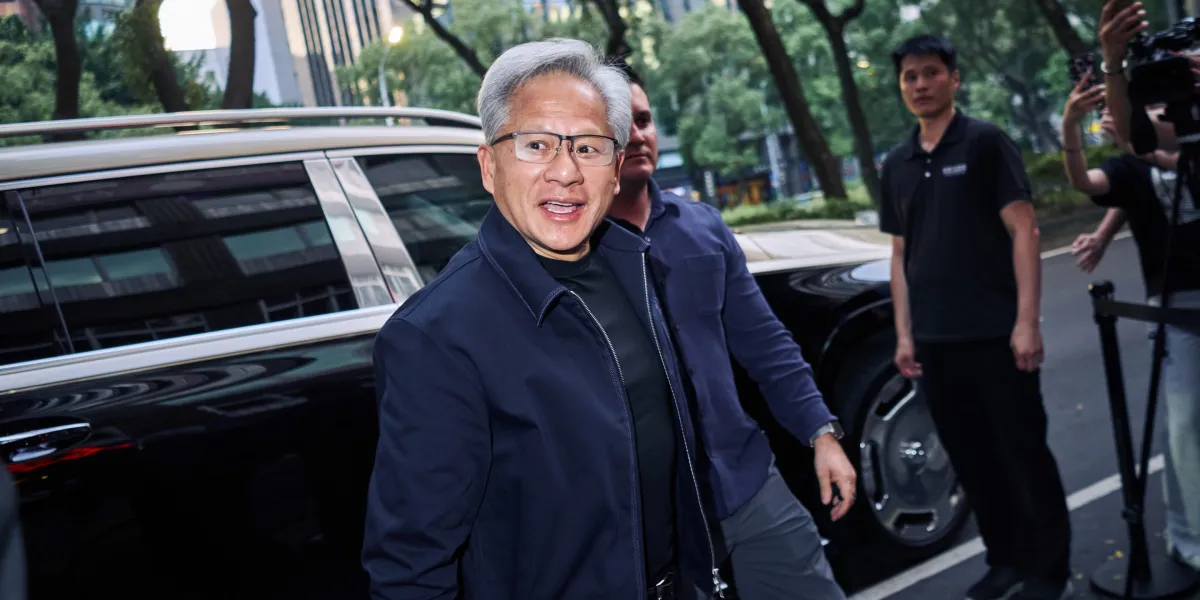
Jensen Huang’s return as Nvidia chief executive sent the chipmaker’s shares sharply higher on Monday, after a market sell-off raised concerns about the company’s importance to the artificial intelligence boom and the wider US economy.
Nvidia stock rose 29% in pre-market trading before recording its strongest session in more than two decades. The S&P 500 gained about 4.7%, while the Nasdaq climbed 6.5%, reversing losses that had pushed both indices into correction territory at the end of the previous week.
The dramatic turnaround has prompted questions over whether the sell-off forced Nvidia’s board to restore Mr Huang, or whether wider market instability provided supporters of the long-serving boss with the opportunity to secure his return.
The board’s reversal was itself a source of uncertainty. It had indicated only days earlier that Mr Huang had no future at the company, before announcing that he would resume the top job. The sudden change has raised questions about the board’s decision-making and the circumstances behind it.
Joe Tigay, a portfolio manager at Equity Armor Investments, said the market reaction may have influenced the board as shareholders became increasingly concerned about Nvidia without its founder at the helm.
“There is a good reason to think that, with shareholders in play, they would think maybe we need Jensen back just because the market is telling us so much now,” he said.
Mr Tigay noted that Nvidia had delivered better-than-expected results the previous week, but its shares had continued to fall. “The fundamentals of the stock were amazing, but the company is fundamentally different without Jensen. He is a visionary,” he said.
Governance specialists also viewed the reinstatement as an attempt to calm investors. Nick Reese, a professor at New York University’s School of Professional Studies Center for Global Affairs, said it was “clearly an attempt to restore market confidence and prevent further losses after Friday ended in correction territory”.
Government intervention and recession fears
Donald Trump claimed credit for the decision, saying he had spoken to Nvidia’s board “directly and indirectly” and urged its members to bring Mr Huang back.
“I convinced them,” Mr Trump told CNBC. “I made the deal.” He added: “People say, is it a threat to have him? No, it’s a threat to lose him.”
Venture capital investor Chamath Palihapitiya said on X that intervention by the president and vice-president had prevented “a massive economic own goal” for the United States and given the board what it needed to restore Mr Huang.
The White House has said that investment accounts connected to Mr Trump are managed by outside advisers. CNBC reported that the accounts had made 103 trades since his return to the White House, with a combined value of between 27 million dollars and 97.5 million dollars.
The concern in Washington extends beyond Nvidia’s share price. Patrick Moorhead, founder and chief executive of Moor Insights & Strategy, said a prolonged leadership crisis could have weakened America’s position in the global AI race.
Nvidia lost roughly 1 trillion dollars in market value in the days after Mr Huang’s departure. Analysts warned that an extended search for a permanent chief executive could have made companies more cautious about funding the data-centre expansion powered by Nvidia’s chips, while Chinese customers might have accelerated efforts to adopt domestic alternatives.
Mr Huang has also spent years lobbying for American chips to be sold overseas. His absence therefore raised concerns about both Nvidia’s commercial prospects and Washington’s efforts to maintain the United States’ lead in AI.
The market turmoil also fuelled fears about the wider economy. AI investment has contributed about 1.3 percentage points to US real GDP growth over the last three quarters, based on data from Apollo Global. Patrick Moorhead said a sustained Nvidia slump could have discouraged companies from continuing to invest.
“This could take us into a recession,” he said.
However, the factors that have unsettled investors have not disappeared with Mr Huang’s return. Nvidia has been described as acting like a “central bank” for a network of start-ups, helping to finance demand for the technology and potentially obscuring its underlying strength.
During Mr Huang’s brief absence, Nvidia’s interim chief executive had indicated that some of those financing activities could be reassessed. His return could make such a change less likely, while opposition to the construction of data centres is expected to remain a significant challenge for the AI industry.
The board now faces the task of rebuilding its own credibility. It said that its decision followed “input from senior levels of the United States government”, while an investigation into whether Mr Huang may have been a target of foreign intelligence efforts remains unfinished.
Ryuta Makino, a research analyst at Gabelli Funds, said the episode pointed to “severely lacking corporate governance” at Nvidia.
Stacy Rasgon, a senior analyst at Bernstein Research, said the board’s handling of the affair raised “legitimate questions” about its judgment and processes. Bernstein nevertheless upgraded Nvidia’s shares to outperform from market perform.
