


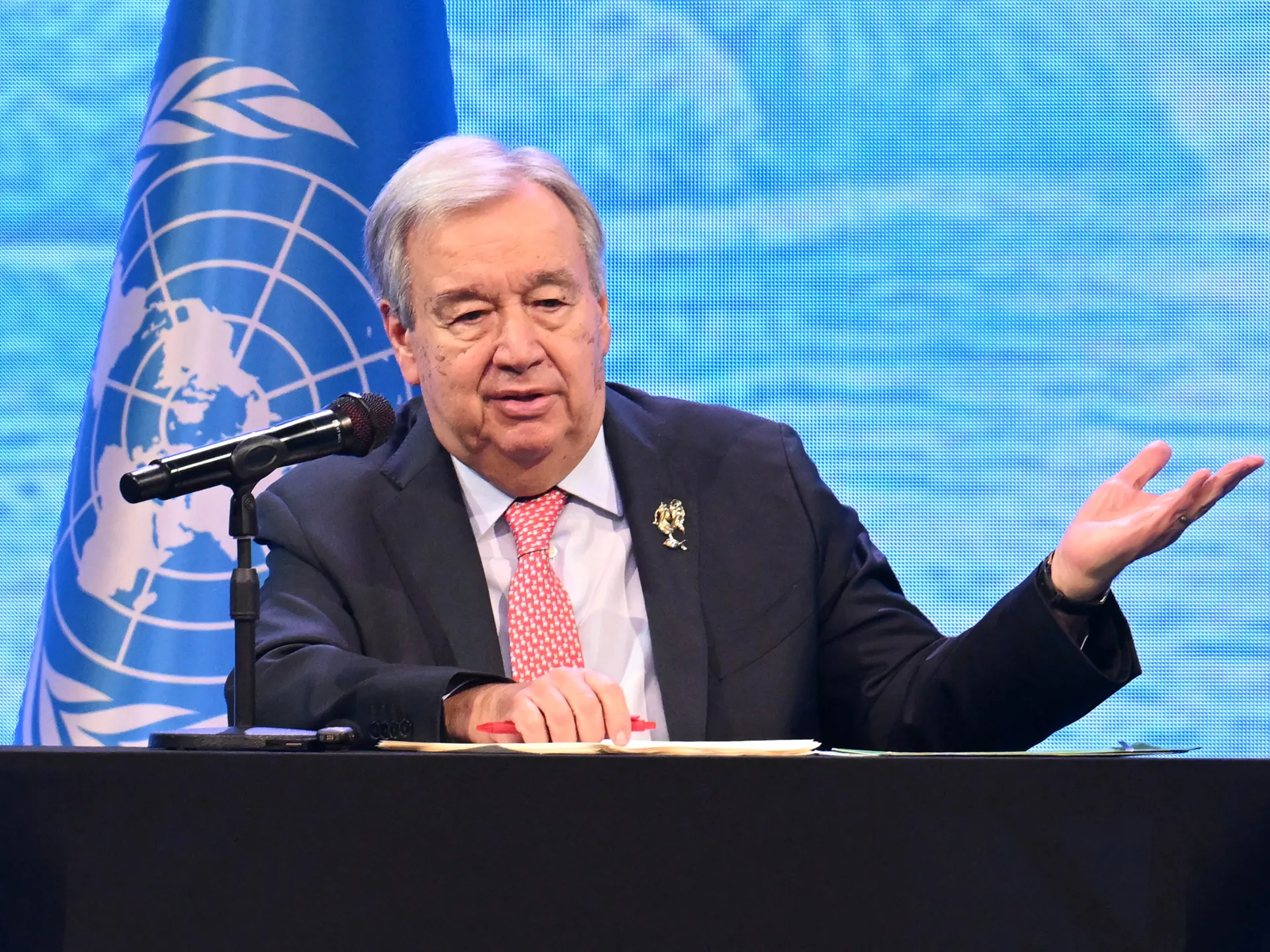
UN Secretary-General Antonio Guterres has called for countries to agree within a year on global AI oversight, including independent monitoring of the risks posed by advanced artificial intelligence.
Speaking at the Bridgetown Special Summit on AI Safety in Barbados, Mr Guterres urged member states to coordinate their efforts and establish a framework that is inclusive, based on shared principles and supported by “independent and credible oversight”.
He said the proposed system should include common safety measures, a testing regime and basic requirements for independent supervision.
Guterres calls for AI risk framework
Mr Guterres, whose term as UN secretary-general is due to end in December, has become increasingly vocal about the need for safeguards around advanced technology.
He has warned of a future in which “killer robots” could become a reality, and said control of AI would be essential for “humanity to maintain control of our world”.
The UN chief said he would advise his successor, who is due to take office in the new year but has yet to be selected, that properly managing artificial intelligence must be a priority.
Mr Guterres also argued that international institutions needed to reflect present-day conditions rather than the circumstances in which they were created.
“When one looks at different other institutions of global governance … they correspond to the reality of the world in 1945,” he said.
He added: “It’s clear that institutions need to be reformed in order to adapt themselves to the realities of today’s world. That applies to the UN, and that applies to the international financial architecture, that applies to the world trade system.”
US and China lead AI race
International agreement on AI regulation remains distant as the United States and China compete for an advantage in research and development.
Businesses and technology leaders are also divided over the pace of development. Anthropic chief executive Dario Amodei, OpenAI chief executive Sam Altman and SpaceX chief Elon Musk called in September for a slowdown, while Nvidia chief Jensen Huang and Meta chief executive Mark Zuckerberg have supported pressing ahead.
In the US, where AI development has advanced at the fastest pace, regulators appear unlikely to intervene immediately. President Donald Trump hosted American technology executives in September, when they agreed to follow a voluntary code of conduct on AI safety.
