


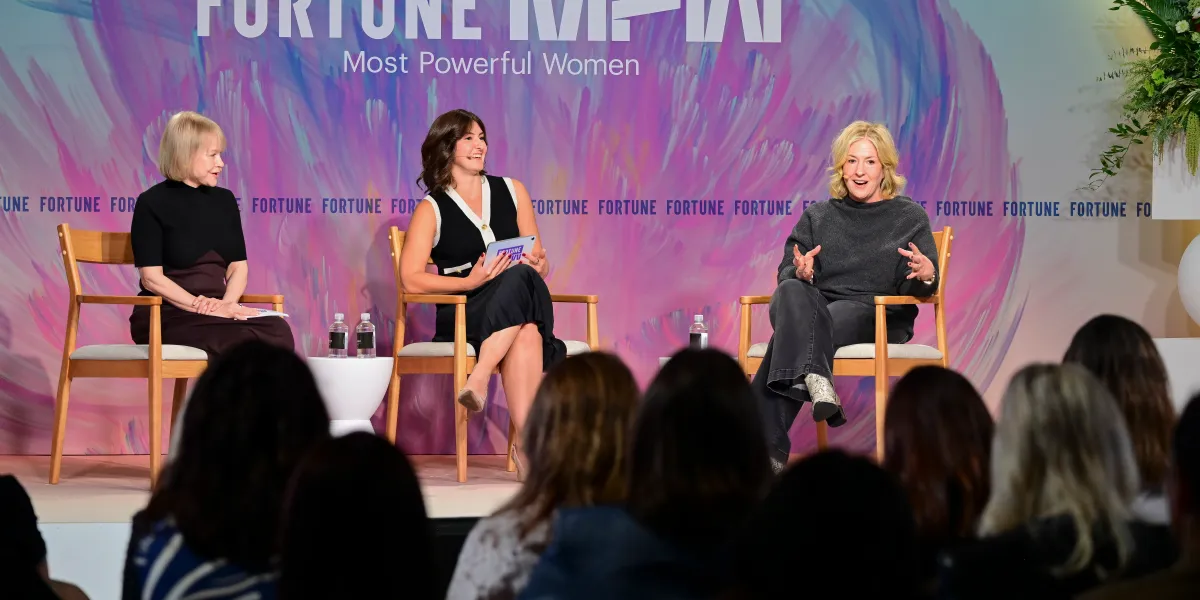
Brené Brown has warned that businesses must move away from fear-driven leadership as political uncertainty, changing markets and anxiety among workers place growing pressure on modern workplaces.
Speaking at the Fortune Most Powerful Women Summit in Washington DC, the author, researcher and professor said many people were struggling and that leaders needed to understand how uncertainty affects their ability to work and make decisions.
“It is extraordinarily difficult to be brave right now, for a lot of different reasons,” Brown said. “Politics is one, but [also] radically changing markets. A workforce that is—I’m going to tell you right now, people are not okay. If you’re leading people, you probably know people are not okay.”
Brown said people were neurologically more comfortable with certainty than with prolonged stress, fear and instability. She argued that effective leadership now required self-awareness, emotional regulation and the ability to reflect on how decisions were being made.
She also urged leaders to slow down when necessary, ensuring their actions remained aligned with their organisation’s mission and values.
Brené Brown challenges Jack Welch’s leadership model
Brown said the workplace was failing to make the most of qualities that were distinctively human, including vulnerability, empathy and meaningful connection.
“We’re s–t at being deeply human right now,” she said. “We can’t stand each other.”
She attributed part of the problem to the continued influence of Jack Welch, the late chairman and chief executive of General Electric, whose management principles were adopted by many major companies.
Welch promoted a “vitality curve” that divided employees into a top 20 per cent, a middle 70 per cent and a bottom 10 per cent, with those in the lowest group removed each year. Critics, including Brown, argue that the approach encourages fear, weakens collaboration and damages workplace culture over time.
Brown said the rigid, hard-edged style associated with Welch’s era was poorly suited to the needs of contemporary organisations, particularly as younger workers placed greater value on authenticity, vulnerability and emotional intelligence.
“Fear has a short shelf life. You cannot keep us afraid for long periods of time,” Brown said. “It’s not how our biology works. If we’re afraid, one of two things will happen: We’ll either kind of become numb to it, or we’ll hyper-normalize the feeling.”
She added: “There has to be a periodic reminder of capacity cruelty in order to maintain power over [other people].”
Brown became widely known after her 2010 TEDx talk, The Power of Vulnerability. Her research has focused on vulnerability, shame, empathy and courageous leadership, and she has written six number one New York Times bestsellers, including The Gifts of Imperfection, Daring Greatly and Dare to Lead.
She is a research professor at the University of Houston and a professor of practice in management at the University of Texas at Austin McCombs School of Business. Her work argues that confronting difficult emotions is necessary for resilience, courage, creativity and authentic leadership.
