


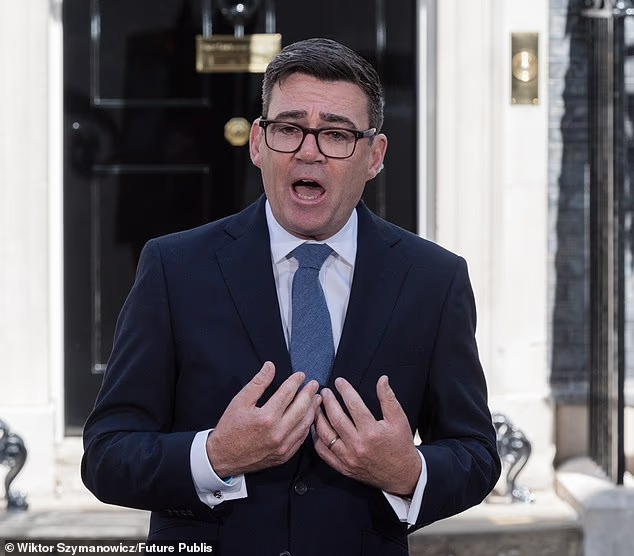
Andy Burnham has ruled out an early general election after a series of polls suggested Labour would lose its majority, prompting accusations that he had “bottled” the idea.
The Prime Minister had been under pressure to seek his own mandate after entering Downing Street in a Labour “coronation” following his coup against Keir Starmer. But the prospect of a snap election threatened to overshadow Labour’s annual conference, which begins in Liverpool on Sunday.
In a series of interviews on Friday night, Mr Burnham progressively closed down speculation about an early vote. He told ITV that 2029 was “when the next election will be” and said an election before then could be viewed as “self-serving”.
“All of this speculation on an early election? I can knock that dead,” he said.
“You know people want me, new in office, to be getting on with the job of delivering on the things that we’ve discussed in this interview rather than putting self-serving politics before that.”
The move was compared with Gordon Brown’s decision to abandon plans for a snap election in 2007 after polls turned against Labour. Mr Brown was subsequently branded “Bottler Brown”, a label opponents claimed damaged his credibility.
Kemi Badenoch, the Conservative leader, said Mr Burnham was “a gambler who folded”.
“Andy Burnham is a gambler. For weeks there has been speculation about an early election and even yesterday he was avoiding ruling it out,” she said.
“Now he has decided his cards aren’t good enough, so he’s folded. The country needs a serious party that actually has a plan – not just vibes.”
Reform leader Nigel Farage said: “It’s obvious Bottler Burnham doesn’t want this overshadowing his conference like Gordon Brown but Reform is ready for an election whenever it is called.”
The criticism comes as polling points to heavy Labour losses in an immediate contest. A YouGov poll forecast Labour would remain the largest party with 241 seats, but the Conservatives would take 130 and Reform 123.
The Liberal Democrats were projected to win 71 seats, almost unchanged, while the Greens were forecast to take nine. The result would leave Mr Burnham needing to negotiate a “rainbow coalition” involving Labour, the Liberal Democrats, the Greens and nationalist parties.
Ed Miliband, Yvette Cooper and John Healey were among Cabinet ministers predicted to lose their seats to Reform. One Labour Cabinet minister described the idea of holding an early election as “insane”.
Mr Burnham has also faced criticism over the strength of his mandate. The 25,000 Labour voters who backed him in the Makerfield by-election represented 0.05 per cent of the electorate, while allies have argued that he needs a personal mandate to deliver reforms extending beyond Labour’s manifesto.
Instead of using the Liverpool conference to launch an election campaign, the Prime Minister is expected to develop his policy programme. He said this would include further plans for bringing the privatised water industry under public control.
He told BBC South that the current performance of the water industry was “nowhere near good enough”. He also defended public ownership of the railways, acknowledging that performance at Southwestern Rail had worsened since it was taken under public control a year ago.
“It will get better,” he said. “I would be the first to acknowledge that the railways aren’t there yet and we need to get our hands on it, a grip on it. And change the way the railways are working.”
Mr Burnham also said he would set out longer-term plans to reduce the cost of living. Asked about Labour’s decision to increase employers’ National Insurance contributions, he accepted that it had put pressure on businesses but declined to promise a reversal.
“The country is in a challenging position when it comes to finance. What we’ve got to do is get growth going,” he said.
