


China’s new ambassador to Australia arrived in Canberra and immediately warned the Albanese government to respect Beijing’s ‘core interests and major concerns’ amid ongoing tensions over security, military activity, and the future of Darwin Port.
Liu Jinsong, a veteran Chinese diplomat, landed in Sydney on Monday and reportedly took the bus from the airport to the ACT, ‘with ordinary Australians on board, and thoroughly enjoyed the experience’.
He has stepped into the role after five years overseeing Asian affairs at China’s Foreign Ministry and previous postings across Asia, Europe, and the Middle East.
Beijing regularly uses the phrase ‘core interests’ to describe issues including Taiwan and sovereignty.
‘Looking back, both sides should respect each other’s core interests and major concerns, strive to expand the pie of mutual benefit and win-win cooperation, increase positive value for each other, and bring greater benefits to ordinary people in both countries,’ Liu said in his first statement following his appointment.
In a moment that will likely stir tensions in Canberra, Liu appeared publicly with two prominent leaders of Chinese ‘peaceful reunification’ organisations linked to the Communist Party’s United Front network at Sydney Airport.
Beijing’s policy of ‘peaceful reunification’ seeks to bring Taiwan under mainland China’s control through diplomacy, economic integration, and political influence rather than military force.
Chinese authorities maintain reunification is a national priority and promote closer cross-strait ties as the preferred pathway to achieving that goal.
Liu (centre) met with two prominent leaders of Chinese ‘peaceful reunification’ organisations
The Chinese embassy later published photographs of the meeting.
Liu’s arrival comes at a sensitive time for Australia-China ties.
Relations between Beijing and Canberra reached a low point under former prime minister Scott Morrison, as China slapped import bans and restrictions on Australian commodities including coal, barley and wine.
Several Australian moves had angered China, including legislation against overseas influence operations, barring tech giant Huawei from 5G contracts, and calling for an independent investigation into the origins of the Covid-19 pandemic.
Relations have stabilised under Prime Minister Anthony Albanese.
Beijing has rolled back trade bans on around $20 billion worth of Australian exports, and high-level dialogue has resumed.
Liu highlighted the growing economic and people-to-people links between the countries, saying the relationship remains fundamentally strong.
‘The two countries have no historical grievances, no fundamental conflicts of interest, highly complementary economies, and mutually reinforcing cultures,’ Liu said.

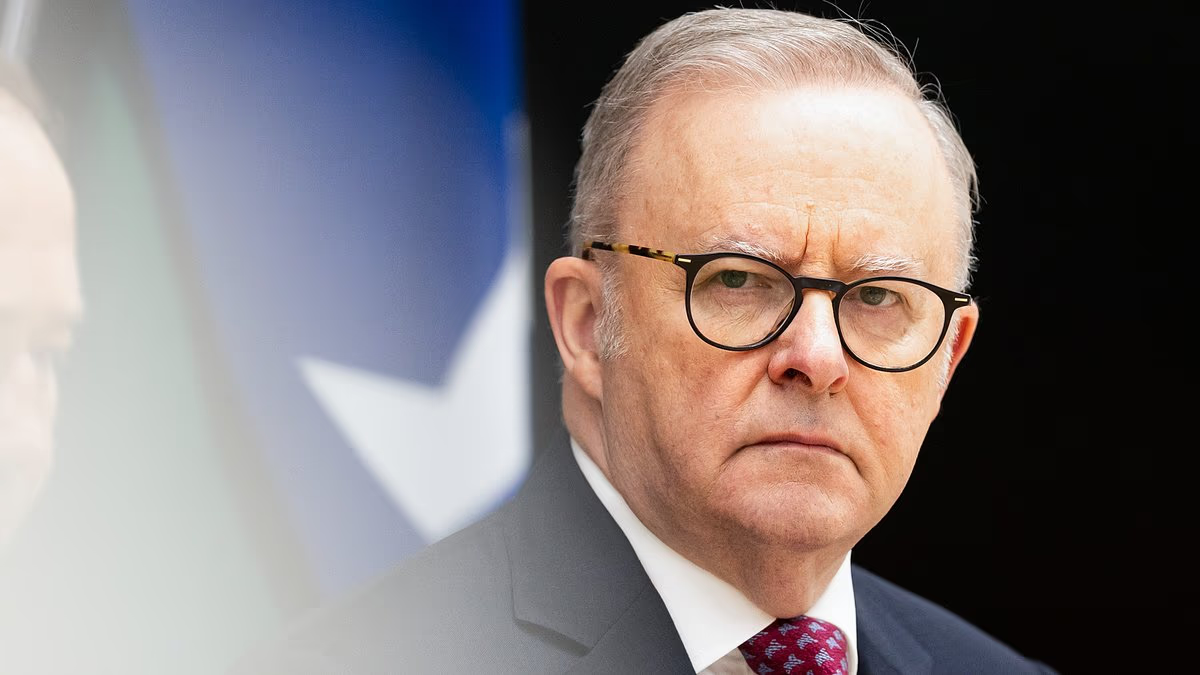
Liu Jinsong (pictured) urged the Albanese government to respect Beijing’s ‘core interests’
‘The prospects for cooperation are promising, but properly managing differences and expectations is also crucial.’
Albanese has visited China twice as Prime Minister, helping to repair a relationship that had deteriorated sharply in the previous decade.
But major strategic divisions persist.
Australia has repeatedly raised concerns about China’s military presence in the Indo-Pacific, while Beijing continues to criticise Canberra’s defence partnerships and close ties with the United States.
In July, Australia condemned China’s test of a nuclear-capable ballistic missile launched into the Pacific.
Foreign Minister Penny Wong described the launch as destabilising and against the wishes of Pacific nations.
‘[Pacific Island] leaders have made clear they want the Pacific to be an ocean of peace. We regard this proposed test as counter to that,’ Wong said.
The future of Darwin Port remains another flashpoint.

Chinese-Australia relations have improved since Albanese (pictured) was elected in 2022
The Northern Territory’s strategically important port is leased to Chinese-owned Landbridge under a 99-year deal, but both major Australian parties have signalled support for returning it to Australian ownership.
Beijing has warned against such a move.
Before departing, former ambassador Xiao Qian said any action affecting the lease could damage Chinese investor confidence and provoke a response from Beijing.
China remains Australia’s largest trading partner, with billions of dollars in resources, agriculture, and education flowing to the Chinese market every year.
Liu said stronger ties between ordinary citizens would be key to preserving the broader relationship.
‘Australia is an important country,’ Liu said.
‘The people of China and Australia share a common spirit of resilience and self-reliance, and a common desire for the steady development of China-Australia relations and tangible benefits.’
Liu has also previously made headlines following a tense diplomatic exchange with Japan over Taiwan.
In late 2025, Liu met with senior Japanese diplomat Masaaki Kanai after Japanese Prime Minister Sanae Takaichi made comments raising the prospect of Japan becoming involved in a conflict over Taiwan.
After the meeting, Chinese state media widely circulated a photograph of Liu standing with his hands in his pockets, looking down at Kanai.
The image quickly went viral, with Chinese media outlets using it as a symbol of Beijing’s diplomatic strength.
