


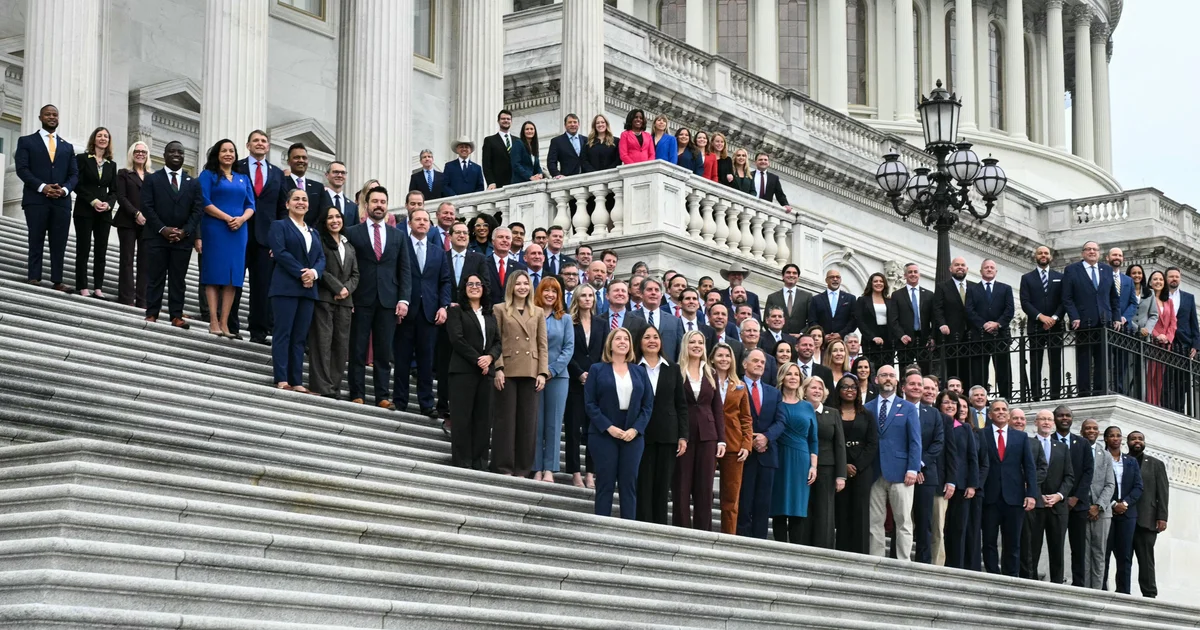
Democrats have secured a historic majority in the US House of Representatives after winning their 258th seat, their strongest performance in a general election since 1992.
Chuck Hubbard’s victory over Republican representative Virginia Foxx in North Carolina, confirmed after a recount, gave Democrats a gain of 44 House seats. He led by 330 votes.
The result leaves Republicans with at least 173 seats in the 435-member chamber, while four contests remain unresolved: one each in Minnesota and Tennessee, and two in Louisiana that will go to a December run-off.
Democratic leader Hakeem Jeffries described the result as “the largest majority any party in Congress has held this century”. He is expected to become Speaker of the House when the new Congress convenes on 3 January 2027.
The gains, which stretched from traditionally Republican states to the Midwest and East Coast, will give Democrats control of both chambers of Congress from January. The party won 56 seats in the 100-member Senate, its largest advantage in more than a decade.
Democrats face pressure to deliver
The result creates a divided government, with Democrats controlling Congress while Donald Trump remains in the White House. It also gives the party considerable scope to pursue its agenda, alongside pressure to meet campaign promises.
Democrats are preparing a 100-day programme focused on the cost of living. They plan to hold early votes aimed at reversing Republican cuts to Medicaid and restoring tax credits under the Affordable Care Act that were allowed to expire.
Economic concerns were central to the election. Voters who said the economy was in poor condition backed Democratic candidates in House races, while those who described inflation as a hardship and said their finances had worsened over the previous two years also favoured Democrats.
Mr Jeffries said the party would need to act on affordability, healthcare and immigration, warning: “Can you imagine how angry the American people will be with Washington if, over the next two years, we fail to do anything about affordability, fail to do anything about healthcare, and fail to do anything about immigration?”
Democrats have also pledged to use their subpoena powers to investigate the administration and examine how Mr Trump and his family have increased their wealth since his return to office. Mr Jeffries has not ruled out seeking a third impeachment of the president.
The White House has warned that the planned investigations could amount to “blatant criminality”, although congressional oversight is a standard function of Congress.
A wider margin for Democratic leaders
The majority will give Democratic leaders substantially more room to manoeuvre than Republicans had under Speaker Mike Johnson, whose narrow margin often meant that a small number of lawmakers could block legislation.
Mr Jeffries, who would become the first Black Speaker of the House if elected by his colleagues, will be able to lose dozens of Democratic votes on some measures while still reaching the 218 required for passage without Republican support.
“We’re not a monolith — people come to the caucus with different ideas — it’s OK,” said Democratic representative Troy Carter of Louisiana, who is expected to lead the Congressional Black Caucus.
Progressive representative Alexandria Ocasio-Cortez called the result “a mandate for change”. Centrist Democrat Tom Suozzi said the party should devote 75% of its time to affordability and 25% to holding the administration to account.
“Everything should be tied back to the people — and how it’s affecting the people,” Mr Suozzi said, arguing that investigations into Mr Trump’s financial dealings should be linked to their impact on household finances.
Republicans have been reduced to one of their lowest House seat totals in decades. Their newly elected minority leader, Jim Jordan of Ohio, vowed to oppose the Democrats and rebuild the party’s position.
“Over the next two years, House Republicans will fight for American families,” Mr Jordan said.
