


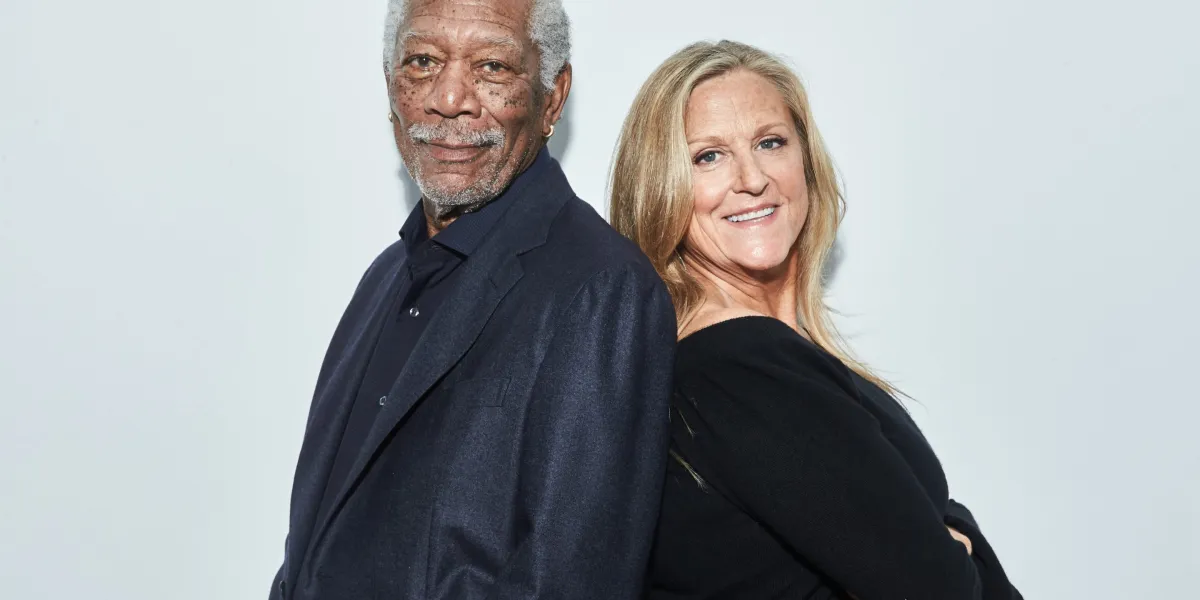
Morgan Freeman has warned that unauthorised AI voice replicas are compromising performers’ privacy, saying digital copies of artists can be made to say things they never said.
The actor, whose voice is among Hollywood’s most recognisable, said he was not opposed to the technology itself. His concern was the use of AI without a performer’s consent.
“You can create artists and make them say things they never said, which has happened to me,” Freeman said.
Freeman and his long-time producing partner Lori McCreary have been exploring new filmmaking technologies through their production company, Revelations Entertainment. McCreary said they had become determined to address AI after encountering an online clip featuring Freeman which neither of them remembered recording.
“He was like, ‘I don’t remember.’ And that was the first time when I thought, ‘Okay, we’ve got to get ahead of this,’” she said.
McCreary said the pair now received daily calls about products being sold online using Freeman’s voice, despite the actor having no connection with them.
“AI can reproduce his voice and his performance,” she said, “but it’s not the same as having the right to do it.”
Freeman has previously pushed back against unauthorised imitations of his voice, while his lawyers have identified several instances in which it was allegedly replicated without his consent.
Freeman and McCreary call for safeguards around AI
Freeman said technology should be used to expand what filmmakers can create, but argued that privacy protections needed to come first.
“What we should be doing with technology is what we actually are dreaming of doing,” he said. “But we have to somehow protect privacy, and that’s the first thing that loses its grip.”
McCreary, who studied computer science at UCLA, said generative AI was different from the digital tools Hollywood had used for years in post-production. She said the technology could generate a person who looked or sounded like Freeman from a text prompt, without any input from him.
She believes AI could help independent filmmakers produce ambitious-looking films without the resources normally required for large-scale productions. However, she said Revelations was avoiding using generative AI on actors until questions around consent and payment had been resolved.
The company is using AI on a current project to expand its scope, but has been working with lawyers to establish how consent and compensation should be documented.
“All of that is just being invented right now,” McCreary said.
Freeman said he had his own clear boundary. “I don’t really want to be created by artificial intelligence, unless I’m doing something I absolutely, absolutely cannot do—like flying,” he said.
McCreary said the central issue was who would decide the value of human performance in an industry increasingly shaped by technology.
“We don’t want technology companies deciding by default what our human storytelling is worth,” she said. “And I think unless we get ahead of it, that’s what will happen.”
Revelations’ long history of using new technology
Freeman and McCreary founded Revelations Entertainment in 1996, after working together on Freeman’s directorial debut, Bopha!, about apartheid in South Africa.
McCreary said she had entered Hollywood because she believed technology would transform storytelling. The film was edited using one of the first digital editing systems, and she wrote a programme to correct problems with its cutting lists.
The company later backed ClickStar, an online film service intended to make films easier to buy than pirate. It launched with 10 Items or Less, starring Freeman and Paz Vega, shortly after the film’s cinema release in 2006.
Although ClickStar did not become the lasting platform its founders had hoped for, Freeman said the idea had arrived before its time.
“ClickStar was a great idea at the time,” he said. “It was just ahead of its time.”
McCreary said the pair’s approach remained to stay ahead of technological change and use it to improve storytelling, while ensuring that performers’ rights were not left behind.
Revelations is also developing an adaptation of Arthur C. Clarke’s Rendezvous with Rama, a project the pair has worked on for decades. The film is currently in script development, with Denis Villeneuve attached to direct.
Freeman advised new filmmakers to keep pace with technology while remaining focused on the quality of their stories. McCreary added: “Don’t wait for permission to tell your own story. The thing that isn’t available to everyone is each of your own unique perspectives.”
