


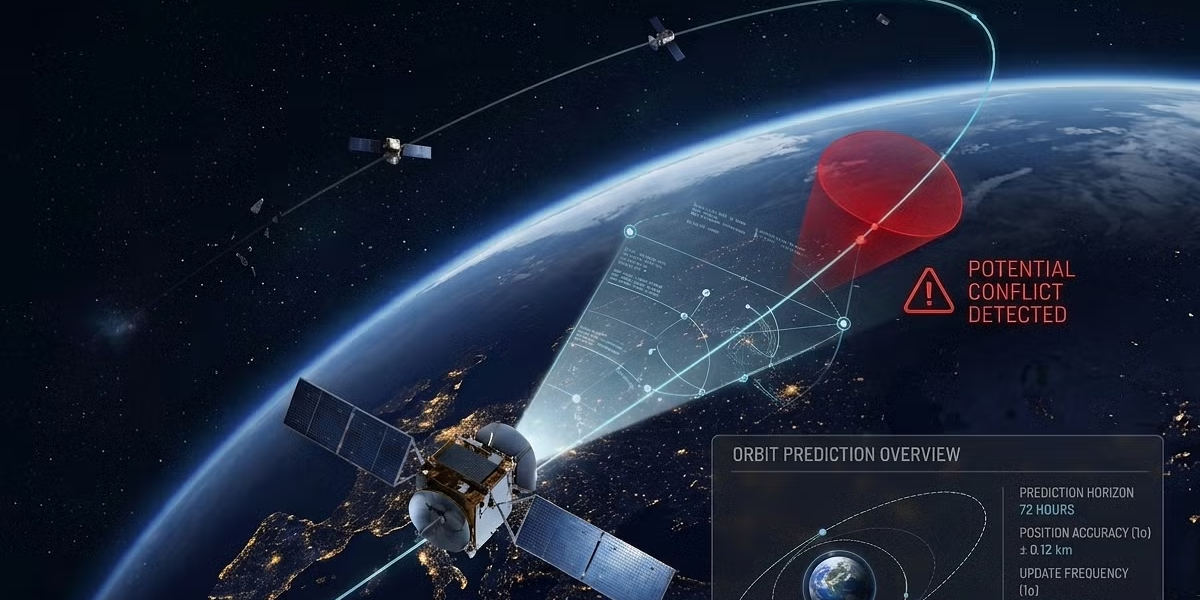
A Syracuse-based company developing space debris avoidance software says its system has completed ground testing and is heading to the International Space Station for testing in orbit, as satellite operators face rising costs from manoeuvring around debris.
BQP, founded in India in 2020 and now working with the US Space Force, says its technology could allow spacecraft to assess threats and alter their paths without relying entirely on human operators.
Abhishek Chopra, the company’s founder and chief executive, describes the system as “autopilot for satellites”. He said it had been tested on a partner company’s hardware and was now due to be assessed in the real space environment.
NASA estimates that each avoidance manoeuvre can consume about one million dollars’ worth of fuel. Across US civil and military satellites, the annual cost associated with debris is estimated at about 58 million dollars.
Space debris puts pressure on satellite operators
Earth’s orbit is becoming increasingly crowded, while responsibility for managing the traffic remains divided. The US military tracks about 60,000 objects and sends collision warnings to satellite operators around the world without charge.
A civilian tracking service run through a Commerce Department pilot programme, known as TraCSS, has cost almost 200 million dollars. The White House has proposed shelving it again this year, while Senate appropriators have proposed 50 million dollars to keep it operating.
Most satellite traffic is still monitored by people. “You literally have a human who’s monitoring your asset, and a human can monitor only so many,” Mr Chopra said. “We’re still writing down on paper.”
Operators faced with a possible collision must decide whether to spend fuel on a manoeuvre that could be prompted by a false alarm, or leave the spacecraft on its existing course and risk losing an asset that Mr Chopra said could be worth hundreds of millions of dollars.
He also warned that unidentified objects could go undetected. “What if a bad actor, some other country, has put an unknown thing? Nobody is tracking that,” he said.
BQP says its system can process orbital simulations considerably faster than existing tools. Mr Chopra said conventional systems could take about 40 days to simulate every object in orbit, while the company’s software could complete the task in under 30 minutes.
He said the system had become up to 2,000 times faster than Orekit, a widely used open-source orbital tool, compared with a figure of 250 times faster announced by BQP in September.
BQP pursues Space Force contract
The company’s approach is described as quantum-inspired because it uses techniques associated with quantum computing but runs on graphics-processing chips already used by customers.
Mr Chopra developed the idea after moving older simulation code on to Nvidia graphics chips and finding that only about 15 per cent of their capacity was being used. He said the underlying mathematics was still based on computer systems developed in the 1980s.
In July, BQP won its first federal contract, a small-business research award from SpaceWERX, the Space Force’s innovation arm. Mr Chopra said the initial phase had been completed and that the company was seeking backing for a second phase.
A second-phase contract would allow BQP to work with Space Force units to develop the software into an operational capability, he said.
IBM Ventures invested in the company in September, taking its total funding to eight million dollars. Mr Chopra said BQP’s contracted and committed revenue had increased eightfold since its 2025 seed funding round, with at least one further corporate investor joining since then.
