


Palestinians displaced from three refugee camps in the occupied West Bank are facing mounting debts, homelessness and a lack of medical care more than 20 months after Israeli forces forced them from their homes.
In Tulkarem, families from the city’s refugee camp are living in cramped rooms and temporary accommodation as repeated orders keeping the area closed as a military zone prevent them from returning. Many have lost their jobs and are struggling to pay rent or buy food.
More than 33,000 people were removed from the Jenin, Nur Shams and Tulkarem camps during a military operation in early 2025, according to the UN agency for Palestinian refugees, UNRWA. The agency said it was the largest single episode of forced displacement in the West Bank since Israel’s occupation began in 1967.
UN satellite imagery shows that one-fifth of buildings across the three camps have been destroyed and a further 28 per cent damaged, UNRWA said. Roland Friedrich, the agency’s director of West Bank affairs, described the destruction as “severe and unprecedented”.
Hakim Mar’i, whose family lived in Tulkarem camp, now spends much of his time lying on a single bed with his badly injured leg raised. The windows of the dilapidated flat where he lives with his wife and four children are covered with old blankets because he cannot afford electricity.
His leg injury, which he says began when he was working as a labourer inside Israel in 2019, has developed severe infections. He said it worsened after Israeli soldiers beat him while forcing his family from the camp.
Diabetes and other untreated conditions have added to his difficulties, but he cannot afford the medical treatment he needs. “This joint here is completely gone,” he said, pointing to his swollen, blackened lower leg.
“The medicine – by God, the medicine, I haven’t been able to get. My wife and kids tell me: get out travel. Go to America, Turkey – so I can the medical treatment I need… I’m a sick man.”
Mar’i said he had considered taking his own life several times during the past year and a half as his family’s debts grew and the threat of another eviction loomed.
Since January 2025, the family has moved four times, first taking shelter in a converted youth centre before settling in a small flat. Mar’i owes money to local shops for food bought on credit, while some nights his children eat at neighbours’ homes.
“I have children. I have food. I have drink,” he said. “My hands are empty. Nobody is with me. Nobody is standing beside me.”
West Bank refugee camp families face eviction
Mar’i’s mother, Salwa, sat less than a kilometre from the family’s former four-storey home, which was built by the family after they were displaced in 1948 from al-Khudayra, the Arabic name for Hadera in Israel.
Israeli forces later demolished the house to make way for a road through the camp. “We really put a lot into that house,” Salwa said. “Seeing it destroyed was really painful for us – all of us.”
Friedrich said 85 per cent of those displaced from the three camps had no regular income, with many losing work when the camps were emptied. More than 80 per cent are renting, creating a new financial burden for families who had not previously paid for housing or utilities inside the camps.
The closed military zone covering the camps is renewed every two months, he said, with no indication of when residents might be permitted to return.
“What we saw there is forced displacement,” Friedrich said. “The UN’s position is very clear: People have to be allowed to return. The camps must be rebuilt.”
The Israeli military has said the camps were emptied for “operational security” during efforts to root out fighters. Friedrich said he feared the operations could be intended to “change the geographical expression of the Palestinian refugee issue”.
Unlike the rebuilding of Jenin camp after the second Intifada between 2000 and 2005, displaced residents and UNRWA staff fear there is no plan for the camps to be restored this time.
UNRWA has continued running schools and basic health clinics, but funding shortages have forced it to reduce its support and adopt a “targeted approach”, leaving thousands without assistance. The agency has also reported rising gender-based violence linked to financial pressures, as well as increased depression and anxiety among displaced children.
“We’re already at the brink now,” Friedrich said.
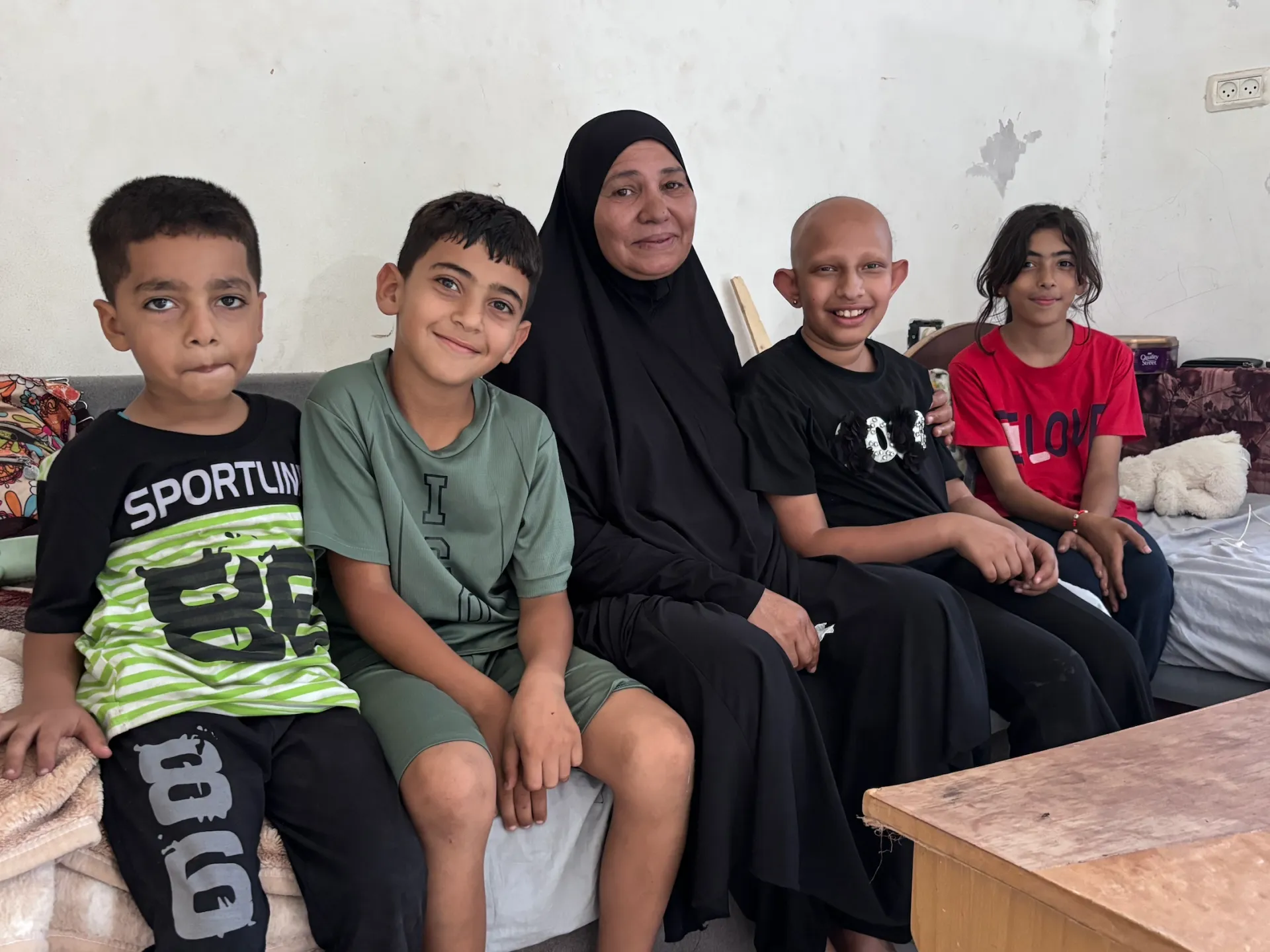
Khadija Zbeidat, a widow from Tulkarem camp, is among those facing the prospect of another eviction. She shares a single sparse room with nine relatives, most of them children, in the Dhinnaba neighbourhood on the outskirts of Tulkarem.
The family had initially spent four months crowded into her daughter’s home before a relative’s in-law offered them the room without rent. It contains a small bathroom and kitchen, with a worn sofa occupying part of the living space and peeling paint on the ceiling.
“It got really cramped, the pressure on each other,” Zbeidat said. “And we became a burden too.”
She said her family had been removed from the Haret al-Nadi section of Tulkarem camp in January 2025. Much of the area has since been destroyed.
“The camp was excellent,” she said. “I swear, I wish they’d take us back. Everything was close to us, dear – … the closeness, that sense of belonging and the warmth, the company and the neighbours.”
Before the displacement, residents prepared stuffed vine leaves and maamoul biscuits together for Eid. This year, Zbeidat said, there was no celebration.
“Nothing. No cookies,” she said. “Nobody even had it in them to do anything any more. Everyone went their own way – scattered.”
The family was not allowed to take its possessions when it left the camp. Some residents have since been permitted to collect belongings once or twice, but much remains behind. Zbeidat’s daughter-in-law returned to the ruins at the risk of being shot to retrieve a doll for her granddaughter, Sandy.
Even basic errands have become difficult. Zbeidat has no car and must travel about two kilometres to buy groceries, while the family spends evenings outside because the room becomes unbearably hot.
Israeli military drones pass overhead, she said, and raids have followed displaced families into the areas where they sought shelter.
“We don’t feel safe,” Zbeidat said. “Nor the kids. It’s dangerous. When they want to go out somewhere, my heart stays busy until they come back.”
Landlords, relatives and shopkeepers initially helped families absorb the shock of the displacement by offering free accommodation or allowing them to buy food on credit. But after almost two years, that informal support is beginning to collapse.
The economic strain has been particularly severe in Tulkarem, where many families had previously depended on jobs inside Israel before Palestinian work permits were revoked following the Hamas-led attacks in southern Israel and the start of Israel’s war in Gaza in October 2023.
The owner of the room where Zbeidat’s family is staying has told them to leave, saying the land and property are needed. “But where can we get money, where to pay from?” she said. “The rent is very high, and we can’t afford it. We don’t know what to do if she comes again and kicks us out.”
Mar’i’s family has received a one-off rental subsidy of 3,000 shekels, worth about 985 dollars, from UNRWA, as well as a separate 1,700-shekel cash payment for short-term assistance. He said he remained constantly fearful of eviction.
“Every minute, I am waiting for the landlord to kick us out,” he said.
Zbeidat still hopes to return to Tulkarem camp, despite the destruction and the uncertainty over whether residents will be allowed back. She fears her children could inherit an even more precarious life as refugees displaced once again.
“Only God knows what tomorrow will bring us,” she said.
