


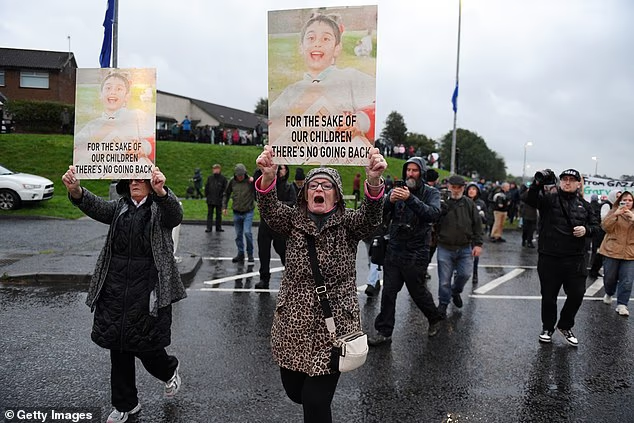
The Orange Order parade in Portadown remained blocked on Sunday after Sinn Féin president Mary Lou McDonald joined thousands of protesters on Garvaghy Road, despite a late-night court ruling allowing the controversial march to proceed.
First Minister Michelle O’Neill, MPs and Northern Ireland Assembly members were also among those who linked arms in the rain and sang songs shortly before the parade was due to begin at 8am.
An announcement over a loudspeaker warned protesters that they could be arrested for taking part in an unnotified parade. A spokesperson for the Garvaghy Road residents’ association said the community would not negotiate.
More than six hours after the scheduled start, the march had still not taken place. Police asked members of the Orange Order to remain inside Drumcree Church, where the procession was due to begin, while supporters gathered at Orange Hall in Portadown town centre.
DUP leader Gavin Robinson accused Sinn Féin of breaking the law by joining the protest. He said Ms McDonald was “the head of an executive” who was “prepared to wilfully disregard the ruling of our courts”.
Mr Robinson also criticised Ms O’Neill, accusing her of “giving two fingers to the police, the courts and the rule of law”. He described her presence at the protest as “shameful”.
Sir Chris Bryant, the Secretary of State for Northern Ireland, said he did not “think any elected politician should be supporting an unlawful protest”. He urged people to co-operate with police and said the court’s decision should be respected.
“Nobody should be attending an unlawful protest, that is the truth of the matter,” he said, adding that elected representatives had a particular responsibility to use “temperate language”.
Mr Bryant said he was leaving the Labour Party conference early to return to Belfast. He said he wanted the situation to pass off as calmly as possible and did not want to see Northern Ireland “go back 28 years” or have the Good Friday Agreement dismantled.
Orange Order parade remains at centre of stand-off
Ms O’Neill said there must be no march through the community, arguing that this was the way to restore calm and confidence. She questioned why, after 28 years of opposition to the route, the Parades Commission had decided to permit the procession.
“I commend this community. We stand with this community and we will continue to stand with this community,” she said.
Ms O’Neill said the reopening of the Drumcree dispute had brought into question how the peace process worked. Some protesters could be heard chanting “Bring Stormont down”.
Ms McDonald described the proposed parade as “madness” and called on Mr Bryant and the chief constable of the Police Service of Northern Ireland to intervene.
“This, in fact, is primitive treatment of any community in the year 2026. It is intolerable, and it will not be tolerated,” she said.
Armoured police vehicles arrived in the area and checkpoints were established on main roads into Portadown. The PSNI said it had an evidence-gathering operation under way, while chief constable Jon Boutcher said officers had helped ensure there had been no violence or disorder.
He said he was “unbelievably proud” of his officers and appealed to everyone to remain calm and peaceful.
Prime Minister Andy Burnham also called for “calm on all sides”, saying there had been “big gains made in Northern Ireland, and we don’t want to see things go backwards”.
Cheers broke out on Garvaghy Road when protesters were told that Orange Order members had left Drumcree. The cheers were followed by further chants calling for Stormont to be brought down.
Late-night court ruling permitted Portadown march
The parade was authorised after an extraordinary sequence of legal hearings that concluded at about 2.15am on Sunday, only hours before the scheduled start.
The Court of Appeal upheld an appeal by Portadown Orangeman Alan Hynes, while a subsequent High Court hearing also upheld the Parades Commission’s decision to permit the march.
Justice Michael Humphreys said the court could not replace the commission’s judgement with its own. Northern Ireland’s most senior judge, Lady Chief Justice Siobhan Keegan, described the circumstances as “unprecedented”.
The legal dispute followed a decision by the Parades Commission on Friday to reverse its long-standing position and permit the Orange Order to use the traditional route along Garvaghy Road.
That decision was welcomed by unionist parties but opposed by nationalist and republican parties. A High Court judge later paused the effect of the parade notification, before the Orange Order appealed successfully.
The stand-off at Drumcree was a major flashpoint during the Troubles, when nationalist residents objected to the Orange Order passing through the largely Catholic Garvaghy Road area. The Orange Order has unsuccessfully sought to complete its 1998 route for more than a quarter of a century.
