


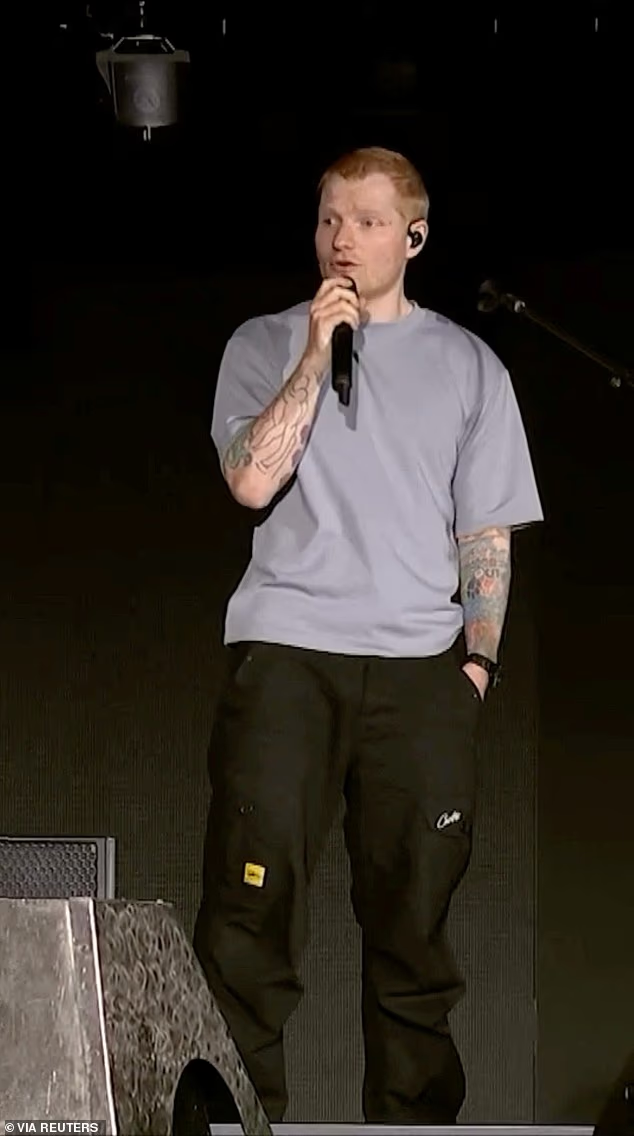
Ed Sheeran has been accused of “bowing to the mob” after apologising to fans over his handling of the Israel-Palestine controversy, which has thrown his Loop tour into turmoil.
The 35-year-old singer addressed the dispute during a concert in Philadelphia on Saturday, telling the audience that Israel’s response in Gaza was “catastrophic and unjustifiable” while describing Hamas’s October 7 attacks as “horrific”.
Sheeran had previously said he did not want politics to form part of his shows. But his remarks came after US rapper Macklemore was removed as an opening act following pro-Palestinian comments at two of Sheeran’s New Jersey concerts.
Macklemore had shouted “Free Palestine” while introducing his protest song Hind’s Hall, which condemns Israel’s military action in Gaza. Sheeran’s other opening acts, Finneas, Lukas Graham and Aaron Rowe, along with his backing band Beoga, subsequently announced they would leave the tour in solidarity with Macklemore and Palestine.
Sheeran read a statement from an autocue in Philadelphia, saying: “I have tried in my career not to be a political commentator of any kind because I want my music and shows to be about unity and not division, about humanity and not politics.”
He added: “But this is a humanitarian issue and I cannot hide how I feel about it anymore.”
“What happened in Israel at Nova music festival on October 7 was horrific and compounded centuries of Jewish pain,” he said. “What is happening in Gaza is catastrophic and unjustifiable and disproportionate.”
Sheeran also said his heart had been “broken by the scale of devastation and loss of civilians’ lives, of children’s lives”, adding that the “systemic injustice” in the West Bank could not be overlooked.
His speech drew criticism from broadcaster Piers Morgan, who said he agreed with Sheeran’s assessment of the conflict but wished the singer had not felt compelled to address it publicly.
Morgan wrote that Sheeran had “bowed to the mob” and appeared like “some bullied puppet”, adding that he needed better advisers. Other social media users similarly criticised his public relations team, while one defended the use of an autocue as evidence that Sheeran was trying not to misstate an exceptionally sensitive issue.
Sheeran told the Philadelphia crowd that he had decided to continue with the tour after seeing ticket sales rise rather than cancellations. “I see 50,000 people who haven’t abandoned me,” he said.
He became emotional as he apologised for bringing politics into the concert, saying: “The one thing that I would like to apologise for is the first bit of the show where it wasn’t about music and I had to talk.”
Sheeran said he understood that families had not bought tickets to hear a political statement, but added that it was something he felt he needed to say. He later told fans: “My shows are about people coming together that don’t know each other, that have different beliefs. They’re about unity. They’re about love. They’re about family.”
The singer also explained that he had scrapped his usual separate “B stage” because he was worried about what might happen if he stood among the crowd. “I didn’t know if they were going to throw things at me. I didn’t know if people would be angry with me,” he said.
With Beoga no longer taking part, Sheeran brought a new group of musicians on stage, led by fiddler Alicia Enstrom, to perform songs including Galway Girl. He said they had agreed to join him despite having only three days to learn the material and knowing they could face criticism for appearing with him.
Concertgoers outside the Philadelphia venue described a determination to enjoy an evening of music while supporting freedom of speech. Fans leaving the show said Sheeran had addressed both sides of the dispute and appeared sincere.
The controversy began after Robert Kraft, the Jewish owner of the stadium where Macklemore had been due to perform near Boston, accused the rapper of hate speech and of selectively presenting information while ignoring Hamas’s actions. Macklemore was subsequently removed from the tour.
Sheeran told the audience that he had never wanted to be an activist musician, but that the criticism had forced him to make difficult decisions. Despite the loss of his support acts and backing band, he vowed: “I will never stop doing this. I love doing this so much.”
