


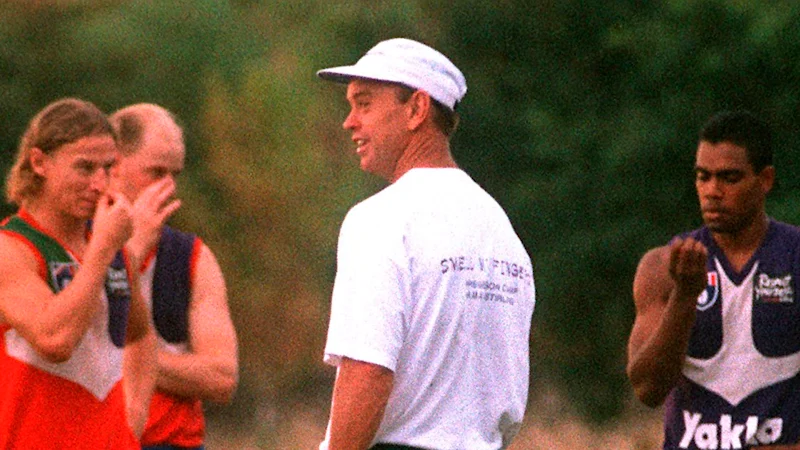
Gerard Neesham, Fremantle’s first coach, will watch the club’s grand final from Botswana on Saturday, with his precise location dependent on the internet connection available during a holiday in southern Africa.
Neesham is travelling with his wife, Heather, on a trip planned a year ago. He is currently staying in Maun, the gateway to the Okavango Delta, but may be on the edge of the Kalahari Desert when the opening siren sounds at the MCG.
His friend Danny Southern, a former Western Bulldogs player whom Neesham regards as a “guru” on Africa, will advise him on whether the connection is strong enough to stream the match.
“We’ll be watching,” Neesham said. “If I can’t watch it somewhere else, I’ll stay where I am. I’m going to watch it and hope like hell we win.”
The former coach’s whereabouts are an apt detail in the story of a club that has rarely followed convention. Fremantle have working-class roots tied to the port city, wear purple and white, and remain the only AFL club without an animal in their nickname.
The Dockers’ name reflects Fremantle’s maritime history, although the club initially allowed speculation that it might be known as the Sharks. Other possibilities included the Mariners, Dolphins and Doctors.
David Hatt, Fremantle’s first chief executive, said the club deliberately kept its preferred name quiet because of concerns about an association with the notorious Painters and Dockers union.
“We did help things along a bit by encouraging people to think the Sharks, through Malcolm Brown,” Hatt said. “We kept Dockers pretty low in the priorities because you may remember that there was a serious problem with a union.”
The club’s unusual identity extended to its colours and song. Red and green in the crowd represent the signalling flags used by dockers guiding ships into harbour, while the song, adapted from a traditional Russian folk tune, was intended to evoke workers pulling together.
Fremantle’s difficult beginning
Fremantle were also handed what Hatt described as the worst player rules given to a new franchise, as established clubs feared the creation of another Western Australian powerhouse alongside West Coast.
Despite limited access to players, Neesham helped the Dockers exceed expectations during his four seasons in charge. His fast, counterattacking approach was unusual for an era in which teams generally moved the ball long and directly.
“I didn’t use that term at all,” Neesham said of the media description of Fremantle’s style as “chip-and-draw”. “What we did was try and create an advantage. The optimal advantage in sport is one on none, on your own with the pill – whether it’s basketball, water polo or soccer.”
Although Fremantle did not reach the finals during Neesham’s tenure, members of that first generation, including Clive Waterhouse and Matthew “Spider” Burton, have become enduring figures among the club’s supporters.
Shaun McManus, who played 228 AFL games for Fremantle, will present the cup to coach Justin Longmuir and captain Alex Pearce if the Dockers win. He said the achievement would mean a great deal to former players.
“It means a lot to all past players,” McManus said. “It means a lot to me to be a part of it and to be out there. I’ll be celebrating massively that night.”
Neesham, who was born and raised in Fremantle, said he would accept remaining in Botswana if his absence coincided with victory.
“I’m born in Fremantle, grew up in Fremantle, schooled in Fremantle, so I’ll be dying a Fremantle supporter,” he said. “If me being in Botswana happens to coincide with us winning, I’ll live in Botswana. If that means we’ll win every year, I’ll stay here.”
