


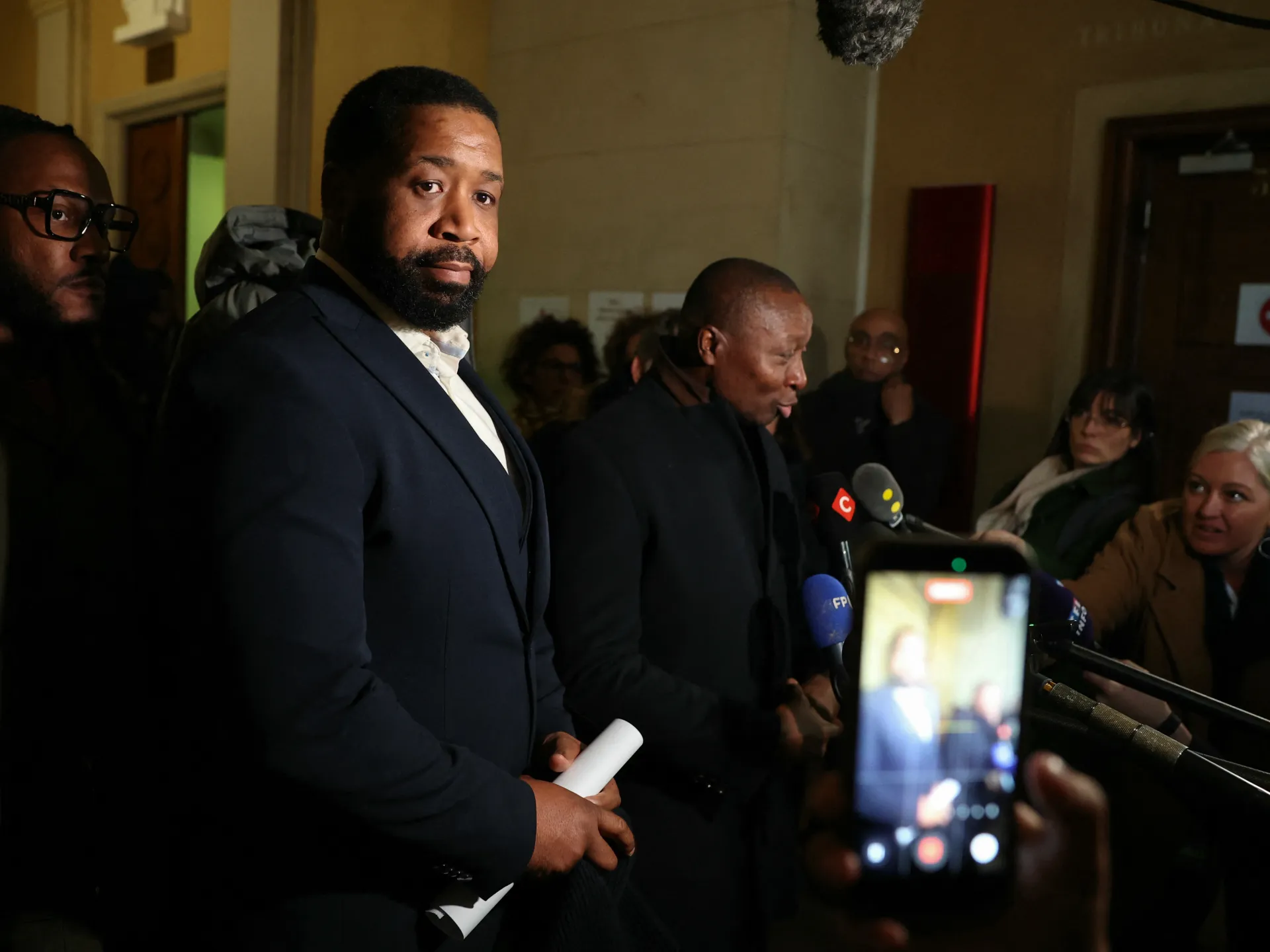
A Paris court is due to deliver its verdict on Friday in the trial of three French police officers accused of assaulting Black music producer Michel Zecler at his studio six years ago.
Surveillance footage from 21 November 2020 appears to show Aurélien Lapersonne, Pierre Plantier and Philippe Tondeux forcing their way inside the studio and beating Zecler before other musicians intervened.
The officers are accused of striking him 29 times in four minutes, followed by a further six blows to the face after he had been handcuffed. They also face allegations of making racist remarks and falsifying an official police report.
The footage became central to the case after contradicting the officers’ account that Zecler had attacked them. All three signed a report claiming that he had hit the police, although the surveillance recording did not support that version of events.
Lapersonne, who initiated the identity check and submitted the report, initially said Zecler had “struck out with his arms and legs”. When the presiding judge asked whether he had “made that up”, he replied: “Absolutely.”
He later acknowledged that he had left the officers’ blows out of the report. “I deliberately omitted them. I think out of fear. It was stupid of me,” he told the court.
The prosecution has called for all three men to be permanently barred from their positions and given prison sentences. It sought six years without parole for Lapersonne, five years for Tondeux, described as the most experienced officer present, and four years for Plantier.
“There is no room for a symbolic sentence,” a representative of the public prosecutor’s office said. “We are talking about crimes, violence and racial slurs. About a complete lack of control over what was done and an absolute determination to get away with it in the end.”
The case attracted widespread attention in France and prompted renewed debate over police violence and racism. Footballer Kylian Mbappe shared an image of Zecler with blood running from his face, describing the footage as an “Unbearable video. Unacceptable violence”.
Surveillance footage at centre of police brutality trial
Rim-Sarah Alouane, a legal scholar and associate researcher in public law at the University of Toulouse Capitole, said the proceedings had highlighted concerns about institutional racism, systemic discrimination and police violence.
“When these reports are falsified, we’re questioning the integrity of the entire system,” she said.
Alouane said the case was significant because the recording directly challenged the police account. “If there was no footage, we would not be here today. The police would have gotten away with it,” she said.
She described the alleged falsification of documents as a crucial part of the case, arguing that it showed the alleged violence was not an isolated incident but involved an attempt to conceal what had happened.
The trial has taken place amid wider scrutiny of French policing. The European Court of Human Rights condemned France last year over the racial profiling of Karim Touil, a French national of North African origin who was stopped by police three times within ten days in 2011.
France’s highest court acknowledged racial profiling during police identity checks in October 2023, while Human Rights Watch said the authorities had not been required to take measures to end the practice. The French government was also condemned in 2021 for “gross negligence” during an identity check involving three high school students at Paris’s Gare du Nord.
The verdict is also expected as France’s Senate considers legislation that would presume police officers and gendarmes acted in self-defence when using firearms in the line of duty. Critics have called the proposal a “licence to kill”, while the National Assembly approved it in July.
Alouane said such a law could make cases like Zecler’s harder to bring, arguing that it would strengthen a sense of impunity and make access to justice more difficult for victims and their families.
